In the high-stakes theater of global semiconductor dominance, a quiet but monumental shift has occurred within the industrial landscape of the People’s Republic of China. Faced with the looming threat of tightening U.S. export controls, Beijing has embarked on a multi-year strategy to stockpile advanced lithography systems from the Dutch giant ASML. A new, comprehensive report from the Washington-based Centre for Technology & Statecraft (CTS) has finally pulled back the curtain on the scale of this operation, revealing a strategic accumulation that challenges the efficacy of existing trade restrictions and raises critical questions about the future of the global AI chip industry.
The Anatomy of a Strategic Stockpile
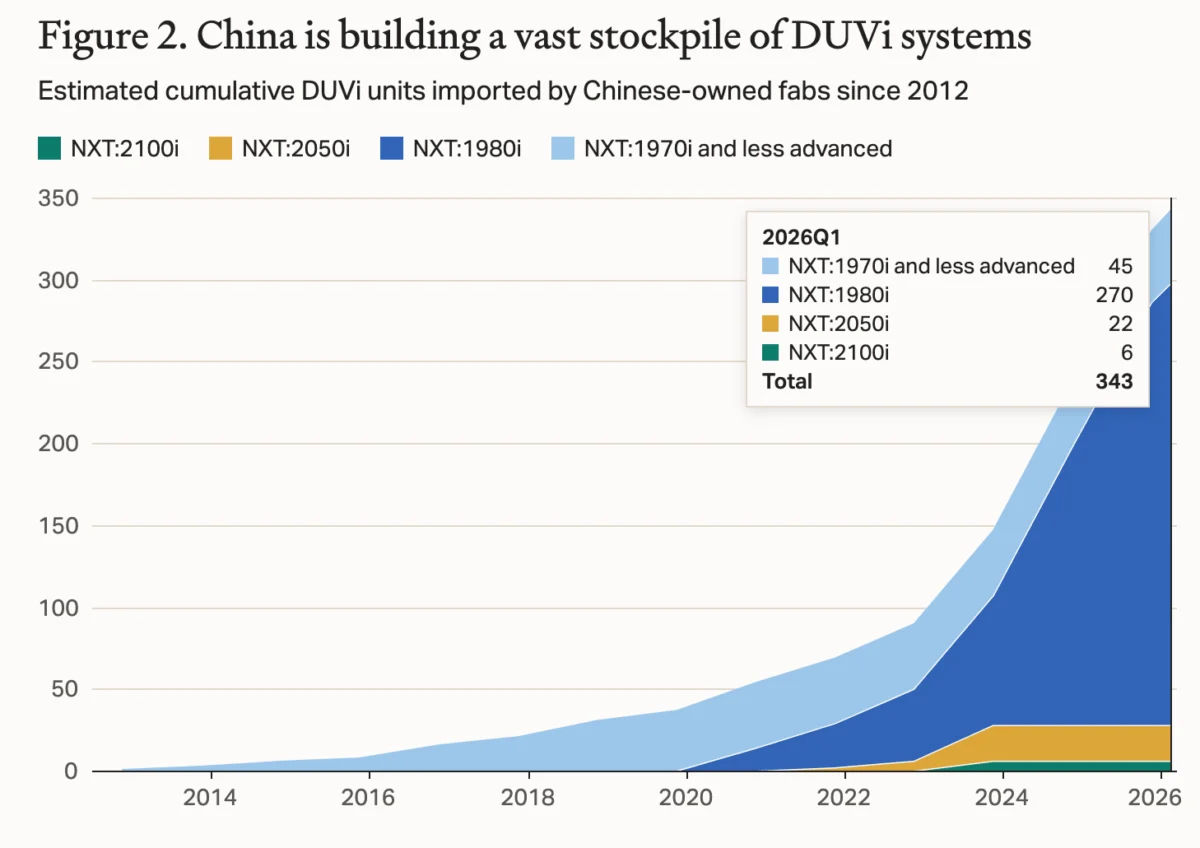
For years, rumors circulated within the industry regarding the sheer volume of Deep Ultraviolet (DUV) lithography machines flowing into Chinese ports. While ASML’s financial reports consistently hinted at outsized demand from the region, the CTS report provides the first detailed analysis of the magnitude of these shipments. According to the findings, China has been aggressively purchasing hundreds of DUV systems—specifically the high-end NXT:1980i immersion lithography tools—to insulate its domestic semiconductor sector from potential future sanctions.
The data suggests that the surge in imports was particularly pronounced between 2024 and 2025. During this window, China invested approximately $13 billion in lithography hardware. While the industry is accustomed to China being a significant customer, the intensity of this procurement cycle was unprecedented. By hoarding these machines, Beijing is essentially building a "buffer state" for its AI chip manufacturing capacity, ensuring that even if the supply chain were severed tomorrow, domestic foundries would have the necessary hardware to continue production for years to come.

Chronology of the Procurement Surge
The timeline of this hardware build-up aligns closely with the escalation of U.S. geopolitical rhetoric and the implementation of successive export control regimes.
- 2022–2023: The U.S. Department of Commerce began tightening the "Foreign Direct Product Rule," signaling to allies that the era of unfettered technology transfer to China was drawing to a close. ASML, caught in the middle of these geopolitical tensions, saw its Chinese order books swell as firms like SMIC and various state-backed startups scrambled to lock in long-term supply agreements.
- Early 2024: The impact was immediate and measurable. ASML reported that 49% of its total system revenue in the first half of 2024 was derived from the Chinese market. This was not merely organic growth; it was a preemptive strike by Chinese firms anticipating stricter licensing requirements.
- Late 2024–2025: As international pressure mounted, the proportion of ASML’s revenue coming from China dipped to 33%, but the installed base had already reached a critical mass. The CTS report identifies this period as the peak of the "strategic stockpiling" phase, where the focus shifted from general-purpose chipmaking tools to the specific high-end DUV scanners required for advanced AI hardware.
- September 2025: The publication of the CTS report brought these figures to the forefront of international discourse, forcing a re-evaluation of the "success" of existing sanctions.
Data Analysis: Parsing the ASML Revenue Streams
To understand the scale of the operation, one must look at the math behind ASML’s quarterly reports. Because ASML has effectively been barred from selling its most advanced Extreme Ultraviolet (EUV) systems to China, the entirety of its revenue from that region is comprised of DUV and legacy systems.
When accounting for the typical demand in Taiwan, South Korea, and the United States—the other three pillars of the global chip ecosystem—the revenue share attributed to China becomes staggering. Analysts estimate that upwards of 70% of all DUV scanner shipments during the 2024 period were diverted to Chinese entities. The CTS report projects that this equates to roughly 90 sophisticated systems entering the country annually, a rate that provides China with a formidable, if not world-leading, lithography infrastructure.

Implications for Global Technology Policy
The CTS report is not merely a descriptive account; it is a call to action. The institute argues that the current "leaky" sanction regime is insufficient to maintain the U.S. lead in the development of "Super Intelligence." By allowing a steady flow of DUV systems, the U.S. and its allies have inadvertently provided China with the tools necessary to bridge the gap in AI chip manufacturing.
The "Cymer" Leverage Point
One of the most controversial suggestions in the report involves the potential for the U.S. to exert pressure on ASML via its subsidiary, Cymer. Acquired by ASML 14 years ago, the San Diego-based Cymer is the world leader in light-source technology—the vital lasers that power almost every modern lithography machine. The report suggests that if the U.S. government were to restrict Cymer from providing service, parts, or light-source components for machines destined for China, it would effectively neutralize the entire fleet of ASML systems currently sitting in Chinese warehouses. This would be an escalation of unprecedented proportions, forcing a choice between the global unity of the semiconductor supply chain and the maintenance of American AI hegemony.
Economic Interests vs. National Security
A striking takeaway from the CTS analysis is the transparent shift in the justification for these controls. While "national security" is the public-facing argument, the report focuses almost exclusively on economic competition. The authors argue that if China successfully integrates these machines into a viable production ecosystem, the United States will lose its primary advantage in the AI race. The report posits that this is not about preventing a military threat in the traditional sense, but about preventing the emergence of a near-peer technological competitor capable of producing its own state-of-the-art AI processors.

The Innovation Gap: Why Stockpiling Isn’t a Silver Bullet
Despite the massive stockpile, the report offers a sobering assessment of China’s domestic progress. Even with the best hardware, the process of chip fabrication is a complex, iterative science that relies on centuries of accumulated Western R&D.
The CTS estimates that China remains roughly 14 years behind the global frontier in lithography capabilities. This gap is not necessarily shrinking; as China works to master current-generation technology, the West is already moving toward next-generation processes and high-NA EUV lithography.
To mitigate the lack of access to future-proof hardware, Chinese tech giants like Huawei have begun exploring "work-arounds," such as the Tau-Scaling Law, which aims to improve the performance of chips through advanced packaging and stacking techniques rather than raw transistor density. While these are impressive engineering feats, they are ultimately stop-gap measures. The report concludes that without the ability to continuously update their lithography toolsets, Chinese manufacturers will remain in a perpetual cycle of playing catch-up, struggling to match the efficiency and yield rates of companies like TSMC or Samsung.

Conclusion: A New Phase of Industrial Conflict
The revelation of China’s massive DUV stockpile marks a turning point in the geopolitical battle over silicon. The "strategic hoarding" strategy has bought China time, but it has also triggered a move toward more radical policy proposals in Washington.
As the debate intensifies, the future of the semiconductor industry rests on a knife’s edge. Will the U.S. continue to use targeted export controls, or will it shift toward the "Cymer Option"—weaponizing the very core of lithography technology? For ASML, the world’s most important company in this conflict, the path forward is increasingly narrow. Caught between the massive, immediate revenue of the Chinese market and the long-term, existential demands of U.S. policy, the Dutch firm—and the global supply chain it supports—faces an uncertain and volatile future.
The Silicon Hoard is not just a collection of machines; it is a testament to a world where technology is no longer a neutral commodity, but the central currency of global power. Whether this stockpile will enable China to achieve AI self-sufficiency or simply serve as a monument to the limitations of isolationism remains to be seen. What is clear, however, is that the era of "business as usual" in the semiconductor sector has definitively ended.