By Editorial Staff
Updated: October 17, 2026
The Antarctic ice sheet, a gargantuan reservoir containing approximately 90 percent of the world’s ice, is currently the focal point of a critical scientific investigation. While the world looks to political summits in Hobart, Australia, to discuss the conservation of marine life, the real-world battle against climate change is being waged in the freezing, dark depths of the Southern Ocean. Recent findings from the German research vessel Polarstern have unveiled a surprising geological ally in the fight against melting ice: the seafloor itself. However, as researchers warn, this natural braking mechanism may be insufficient to counteract the accelerating threat posed by warming oceans.
The Geophysical Discovery: A Natural Brake on the Ice
For decades, the East Antarctic Ice Sheet was considered the "stable" counterpart to its rapidly deteriorating western sibling. Scientists long attributed this stability to higher altitudes and the influence of the Antarctic coastal current, which served as a thermal buffer, shielding the ice from warmer maritime intrusions.
During a recent expedition, a team of researchers led by marine geophysicist Sebastian Krastel utilized advanced echosounder technology to map the seabed off the East Antarctic coast. What they discovered fundamentally shifts our understanding of glacial stability: a massive, 260-meter-high and 65-kilometer-long ridge composed of sand, mud, and rock.
This geological feature, known as a sediment wedge, acts as a physical barrier. By pinning the edge of the ice sheet, the wedge has effectively acted as a "brake," slowing the retreat of the glacier in that specific region. "We have identified that the seafloor plays a more active role in ice dynamics than previously accounted for in our climate models," says Krastel. While these formations are present in various parts of the Southern Ocean, the discovery highlights a critical, albeit limited, resilience factor. Scientists are quick to note that while this provides a temporary buffer, it is not a panacea; it can slow the process, but it cannot stop the underlying thermal degradation.
Chronology of a Shifting Landscape
The vulnerability of the Antarctic has transitioned from a theoretical concern to an urgent reality. The following timeline outlines the progression of this crisis:
- Pre-2000s: The East Antarctic Ice Sheet is largely perceived as a stable, cold-locked system. Research focuses primarily on the West Antarctic and the Antarctic Peninsula.
- 2010–2020: Increased satellite monitoring reveals subtle but consistent mass loss across the continent. Annual loss estimates reach 150 billion tons of ice per year.
- 2023–2025: Advanced modeling begins to show that "Circumpolar Deep Water"—a warmer, saltier layer of the ocean—is encroaching upon the continental shelf.
- October 2026: The Polarstern expedition confirms the presence of stabilizing seafloor features, but simultaneously documents the aggressive melting of the Denman Glacier from below.
- October 19–30, 2026: The Commission for the Conservation of Antarctic Marine Living Resources (CCAMLR) convenes in Hobart, Australia, to address the intersection of climate change, biodiversity loss, and the collapse of the food web, starting with krill.
The "Bottom-Up" Crisis: Why the East is Warming
The stability of the East Antarctic is crumbling under a process known as "basal melting." Despite air temperatures hovering at a constant, bone-chilling -55°C, the ice is being eroded from beneath by the ocean.
Changes in global wind patterns have altered the circulation of the Southern Ocean, forcing deep, relatively warm water toward the coastline. This water finds access to the undersides of glaciers, particularly those that reach deep into the ocean, such as the 130-kilometer-long Denman Glacier.
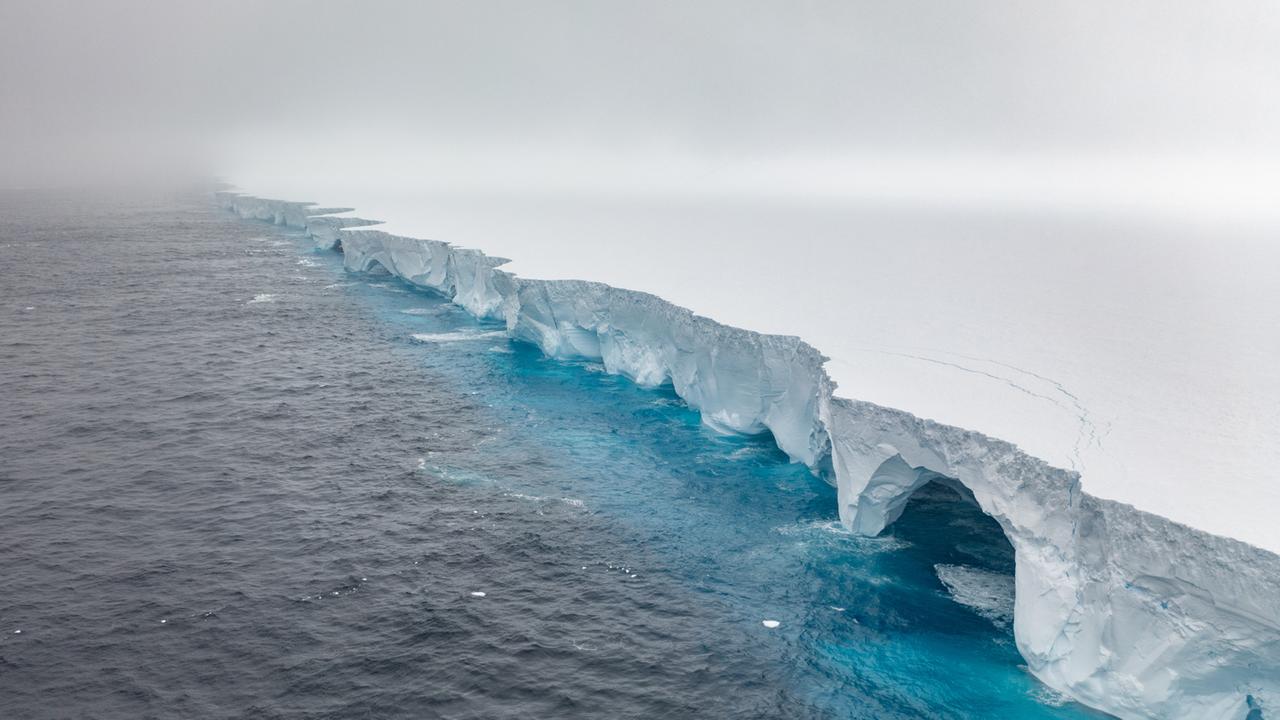
Geologist Marcus Gutjahr of the GEOMAR Helmholtz Centre for Ocean Research explains the mechanism: "At a depth of 300 meters, the water temperature shifts significantly. This warmer layer reaches the ice shelf and melts it from below, effectively thinning the glacier at its most vulnerable point." This revelation is particularly alarming because the Denman Glacier alone holds enough water to raise global sea levels by 1.5 meters. As these "stable" regions become exposed to the warming ocean, the pace of global sea-level rise enters a potentially exponential phase.
Data and Implications: The Albedo Feedback Loop
The implications of this melting are not limited to the coastlines of Antarctica; they represent a fundamental destabilization of the Earth’s climate regulation system.
The Albedo Effect
The planet relies on the "albedo effect"—the reflection of solar radiation by bright, white snow and ice back into space. As the ice melts, it reveals the dark, absorbent surface of the ocean. This creates a dangerous feedback loop:
- Melting: Increased atmospheric and ocean temperatures cause ice loss.
- Absorption: Less ice leads to more open water, which absorbs more solar heat.
- Acceleration: Increased heat absorption leads to further melting, accelerating the entire process.
Socio-Economic Consequences
The human cost of this phenomenon is staggering. If the current trends continue, the projections from the Intergovernmental Panel on Climate Change (IPCC) paint a grim "worst-case" scenario for the year 2100. With a projected sea-level rise of one to two meters, the following impacts are anticipated:
- Coastal Abandonment: Large swathes of the northern European coastline, particularly in Schleswig-Holstein, Germany, and parts of the Netherlands, face chronic flooding.
- Cultural Loss: Iconic, low-lying cities such as Venice, Italy, face an existential threat, with high-tide events becoming permanent inundations.
- Global Displacement: Hundreds of millions of people living in coastal megacities from Jakarta to Miami will be forced to migrate, leading to unprecedented geopolitical and economic instability.
Official Responses and the Path Forward
The findings from the Polarstern are being integrated into international policy discussions. The CCAMLR meeting in Hobart serves as the primary diplomatic venue for these concerns. However, there is a growing disconnect between scientific observation and political action.
"We are seeing the early warning signs of an irreversible process," says Marcus Gutjahr. "The seafloor provides a momentary pause, a small grace period for the Earth’s climate system, but it is not a substitute for the drastic reduction of greenhouse gas emissions."
Official statements from climate researchers underscore that the geological "brakes" found by the Polarstern team—while scientifically fascinating—are a symptom of a planet in distress. The consensus among the scientific community is clear: the mitigation of the Antarctic meltdown requires immediate and radical decarbonization. Without a significant shift in global energy policies, the physical defenses of the Antarctic—be they ridges of sediment or cold-water currents—will eventually be overwhelmed by the sheer scale of the heat imbalance.
As the international community debates the protection of Antarctic marine life, the underlying message from the Polarstern is a sobering reminder of the interconnectedness of our planet. The fate of the ice sheets is inextricably linked to the survival of coastal civilization. The question is no longer whether the ice will melt, but how quickly we can act to prevent the most catastrophic outcomes.