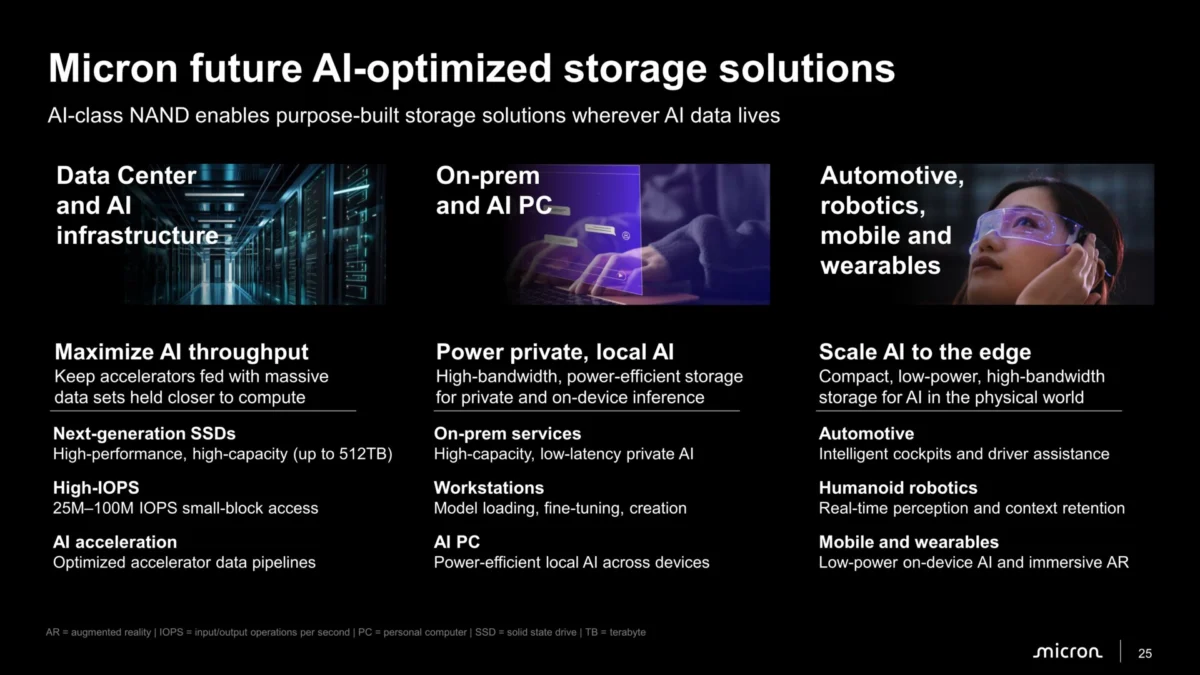
The semiconductor landscape is undergoing a tectonic shift. As artificial intelligence models grow exponentially in parameter size and data complexity, the bottleneck for AI training and inference is no longer just the GPU or the HBM (High Bandwidth Memory). Increasingly, the limitation lies in the storage subsystem’s ability to feed data to these hungry accelerators. Micron Technology has officially entered the high-stakes race to redefine data storage for the AI era, announcing ambitious plans to develop specialized "AI-class" NAND flash capable of reaching up to 100 million IOPS (Input/Output Operations Per Second).
This strategic move places Micron in direct competition with industry leaders like Kioxia, as both firms pivot toward a new paradigm of storage: the High-IOPS SSD. By leveraging next-generation architectures and utilizing artificial intelligence to accelerate the design cycle, these companies are attempting to solve the massive data-delivery demands of modern data centers.
The Core Mandate: Why AI Demands Extreme IOPS
The shift from traditional computing to AI-centric, data-intensive workloads has forced a radical rethinking of storage requirements. Historically, SSDs were designed for balanced throughput and latency, sufficient for database management and general enterprise applications. However, modern large language models (LLMs) and generative AI pipelines require the near-instantaneous movement of massive datasets.
NVIDIA, through its "Storage-Next" initiative, has been a vocal proponent of this change, calling for storage solutions that can keep pace with the massive compute power of their H100 and Blackwell-series GPUs. The goal is to minimize the "data starvation" that occurs when high-performance compute clusters sit idle while waiting for the storage stack to retrieve training checkpoints or massive vector databases.
Kioxia was the first to formalize this trajectory with its GP1-series SSDs, which utilize proprietary XL-Flash technology to achieve 10 million IOPS, with a target of 100 million IOPS by 2028. Micron is now signaling its intent to challenge this leadership, aiming for an initial target of 25 million IOPS for its upcoming generation of enterprise drives, with a long-term roadmap that reaches the 100-million-IOPS milestone.
Chronology of the High-Performance Storage Evolution
The path to 100 million IOPS did not emerge in a vacuum; it is the culmination of years of iterative storage development:
- The X100 Era (2019): Micron previously experimented with the X100, the world’s fastest SSD at the time, which utilized 3D XPoint memory to deliver 2.5 million IOPS and 8-microsecond latency. While the X100 never saw mass market deployment, it served as the conceptual foundation for high-performance enterprise storage.
- The Rise of XL-Flash (2020-2024): Kioxia introduced XL-Flash as a low-latency, high-performance alternative to standard TLC NAND, setting the stage for the current "Super High IOPS" race.
- The AI Boom (2023-Present): The explosive growth of generative AI shifted industry priorities from standard NVMe speed to specialized, AI-optimized flash tiers.
- The Standardization of HBF (2024): Industry players, including SanDisk and SK Hynix, began pushing for High Bandwidth Flash (HBF) as a standard architecture, moving away from conventional NAND controllers toward a stacked-die approach similar to HBM.
- Micron’s AI-Class Announcement (Current): Micron formally announced its intent to produce "AI-class" NAND, marking the first time the company has publicly integrated this terminology into its long-term product roadmap.
Supporting Data: Technology Behind the Speed
To reach the staggering threshold of 100 million IOPS, manufacturers are moving beyond standard 3D NAND technology. Conventional flash, while dense and cost-effective, is inherently limited by the latency of the cell-programming process and the limitations of standard controller architectures.
High-IOPS AI-Class NAND
Micron’s "AI-class" NAND is expected to utilize a 1-bit-per-cell (SLC) configuration. By utilizing Single-Level Cell (SLC) technology, the drive can drastically reduce latency, as there is no need for the complex voltage-state programming required by TLC or QLC NAND. This maximizes reliability and speed, two critical factors for AI environments where data integrity during high-frequency access is paramount.
The HBF Paradigm
While Micron has not yet fully adopted the "High Bandwidth Flash" (HBF) branding, its description of its upcoming solution as "TSC-stacked NAND with a logic base die" mirrors the architecture currently being promoted by competitors.
HBF works on a principle analogous to HBM (High Bandwidth Memory). By stacking NAND dies vertically and using Through-Silicon Vias (TSV) to create direct electrical connections, the architecture bypasses traditional bottlenecks. A "logic base die" sits at the bottom of the stack, providing high-speed processing power to manage the massive flow of data directly at the source, effectively creating a "smart" storage device that behaves more like a high-speed buffer than a passive drive.

Official Responses and Strategic Vision
Micron has been measured in its communications, emphasizing that while their 100-million-IOPS goal is a long-term vision, the company is prioritizing the development of a scalable "AI-class" ecosystem.
Regarding the lack of a specific release date, industry analysts suggest that Micron is waiting for the ecosystem of PCIe 7.0 to mature. PCIe 7.0, which doubles the bandwidth of its predecessor, will be necessary to actually move the data that these 100-million-IOPS drives can output. Without a commensurate increase in interface bandwidth, the raw IOPS potential would be throttled at the bus level.
Furthermore, Micron executives have highlighted that their focus is not solely on the hardware but on the synergy between the storage media and the controller firmware. The company maintains that the future of storage lies in "software-defined hardware," where the drive’s internal logic is tailored to the specific data access patterns of AI training models.
The "Meta-Innovation": Using AI to Build AI Hardware
One of the most profound implications of this announcement is the shift in how these storage devices are being designed. Micron has revealed that the development of its latest SSD controllers and firmware is being significantly accelerated by AI itself.
By utilizing machine learning models to optimize RTL (Register Transfer Level) design and firmware code generation, Micron claims that the development lifecycle for new enterprise SSDs has been cut by nearly 50%. This "recursive innovation"—using AI to build the hardware that powers future AI—represents a significant competitive advantage.

The integration of AI into the design process allows for:
- Predictive Firmware Optimization: AI can simulate trillions of potential read/write cycles to identify bottlenecks in the controller’s command queue before the physical silicon is even fabricated.
- Rapid Iteration: Automated code generation for firmware ensures that the drive can be tuned for specific AI workloads, such as massive parallel read operations required for Transformer model training.
- Enhanced Reliability Modeling: AI-driven design allows for more accurate predictions of NAND wear-leveling, ensuring that drives remain operational under the intense, non-stop workloads typical of modern hyperscale data centers.
Future Implications for the Data Center
The emergence of 100-million-IOPS SSDs will fundamentally alter data center topology. As these drives become available, we can expect:
- Disaggregation of Storage: The current model of "compute and storage on the same server" may give way to massive, high-speed storage pools that can be accessed by any compute node in the cluster, thanks to the sheer speed of these new interfaces.
- Reduced Training Time: The most immediate benefit will be a reduction in the time-to-market for new AI models. By shortening the time spent on data loading, the total training duration can be reduced, significantly lowering energy consumption and operational costs.
- Evolution of the Storage Hierarchy: We are moving toward a future where the distinction between "memory" and "storage" continues to blur. With HBF and AI-class NAND, storage will behave increasingly like a persistent, high-performance extension of the system’s primary memory.
Micron’s entry into the high-IOPS race, supported by their internal AI-driven design methodology, confirms that the storage industry is no longer a slow-moving utility provider. It has become a core pillar of the AI hardware revolution. As the roadmap to 100 million IOPS solidifies, the winners will be those who can not only deliver the highest raw performance but also the most intelligent, efficient, and software-optimized integration into the complex, data-hungry landscape of modern artificial intelligence.