

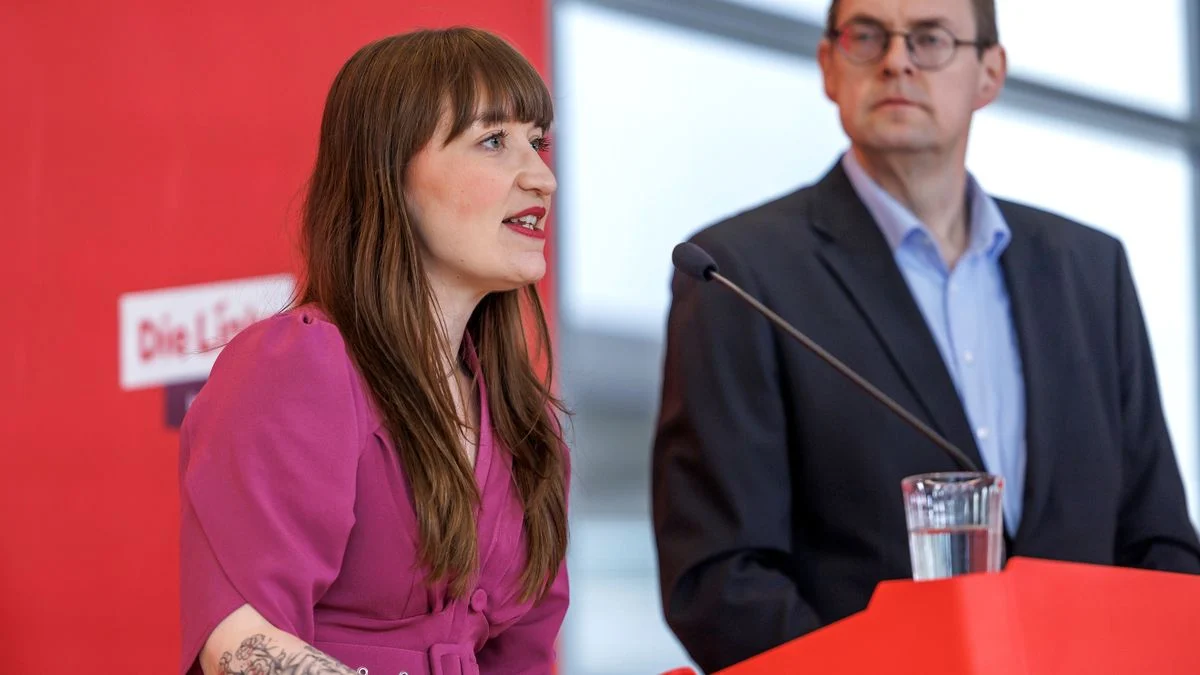
Berlin, Germany – A fierce internal conflict is roiling Germany’s Left Party (Die Linke) over a radical proposal to impose a strict salary cap on its members of the Bundestag and the European Parliament. The party’s executive, led by co-chairs Jan van Aken and Ines Schwerdtner, aims to mandate that all Linke parliamentarians limit their monthly earnings from their parliamentary allowances to the level of the average German gross salary. This controversial initiative has met with significant resistance from within the party’s Bundestag parliamentary group, sparking a debate that lays bare deep-seated tensions over ideology, trust, and the very nature of political representation.
The proposal, which is slated for a vote at the party conference in June, stipulates that any income exceeding the average salary, after deductions for taxes and insurance, must be channeled into a dedicated social fund designed to support individuals in need. While framed as a commitment to socialist principles and solidarity with the working class, critics within the party argue it fosters mistrust, ignores the complex realities of parliamentary work, and risks alienating segments of their voter base.
The Core Proposal: Capping Parliamentary Salaries to Reflect Average German Earnings
The genesis of this contentious debate lies in a resolution passed by the Left Party’s executive committee on April 18th, titled "Limitation of Allowances." This document outlines a mandatory commitment for all Die Linke representatives in both the German Bundestag and the European Parliament to cap their monthly parliamentary allowances. Specifically, their earnings are to be restricted to a gross amount equivalent to the current average income for full-time employees in Germany, including special payments. The exact figure cited in a later addendum to the resolution is €5,370 per month.
Crucially, the executive’s plan acknowledges varying personal circumstances by introducing a net allowance of €350 for each dependent child or family member requiring care. This provision aims to soften the impact on parliamentarians with greater financial responsibilities, reflecting a nuanced, albeit still prescriptive, approach to personal finances. However, the overarching principle remains: any remuneration received from parliamentary duties that exceeds this capped amount, after the usual deductions for taxes and insurance, must be transferred into a "social fund." This fund is envisioned as a practical expression of solidarity, providing direct financial assistance to individuals and families facing economic hardship. The resolution also makes provisions for exceptional financial burdens, allowing for special arrangements to be made with the federal treasurer, suggesting a degree of flexibility within the otherwise rigid framework.
The executive’s rationale is rooted in the party’s fundamental commitment to social justice and equality. By aligning the income of their elected representatives with that of average citizens, Die Linke seeks to demonstrate an authentic connection to the struggles of everyday people, differentiating itself from other political parties whose members often command significantly higher incomes. This move is intended to reinforce the party’s image as a champion of the working class and a vocal critic of economic disparities.
A Storm of Opposition from the Parliamentary Group: A Letter of Protest
The party executive’s initiative has, however, provoked a strong backlash, particularly from the Left Party’s parliamentary group in the Bundestag. At the forefront of this opposition are the group’s co-chairs, Heidi Reichinnek and Sören Pellmann. Towards the end of April, they dispatched an internal letter to the party executive, detailing significant reservations and widespread discontent within the parliamentary faction. This letter, which was also circulated to all Left Party MPs for their awareness, has since been obtained by SPIEGEL, following initial reports by "Welt" and "Politico," shedding light on a deep rift within the party leadership.
Reichinnek and Pellmann assert that the debate surrounding the salary cap has generated considerable discussion and unease among their fellow parliamentarians. They specifically highlight a recent parliamentary group meeting where the topic was intensely debated. Their letter expresses regret that such a crucial exchange with the party executive had not occurred earlier: "Much rather would we have held this exchange with the party executive in recent weeks and months." They lament that the participation of MPs in the decision-making process was "hardly given" for various reasons, a clear indictment of what they perceive as a lack of proper consultation and engagement from the party’s central leadership.
This perceived exclusion from a decision directly impacting their financial and professional lives has exacerbated feelings of disenfranchisement among the parliamentary group. It underscores a fundamental tension between the party’s grassroots executive, often focused on ideological purity, and its parliamentary wing, which must navigate the pragmatic realities of governance and public perception.
"We Already Cap Our Salaries!" – The Argument for Existing Contributions
A central plank of Reichinnek and Pellmann’s argument, echoing the sentiment within the parliamentary group, is that the proposed salary cap effectively casts a shadow of "mistrust" over Bundestag members. They vehemently reject any insinuation that they are seeking personal enrichment through their mandate. "We all do not want to enrich ourselves from our mandate," they declare in their letter.
They underscore that Left Party MPs already make substantial financial contributions, effectively capping their own salaries through various internal party mechanisms. These include "mandate holder levies, membership fees, contributions to the parliamentary group association, and various other donations to different extents." For many, these existing contributions are a matter of deep conviction and a demonstration of their commitment to the party’s principles. "We do this out of full conviction. That is why it is quite clear: we are already capping our salaries!" they assert.

This argument highlights a critical disconnect: the party executive appears to be proposing a measure that its parliamentary members believe they are already implementing through different means. The current system of levies and donations, while not a rigid cap, ensures that a significant portion of their parliamentary income flows back to the party or its causes. The new proposal, from the MPs’ perspective, implies that these existing contributions are insufficient or that their commitment is doubted, leading to resentment and a feeling of being unfairly targeted.
The Peril of Mistrust and Misguided Populism
Beyond the financial implications, Reichinnek and Pellmann voice profound concern over the psychological and political ramifications of the salary cap debate. They argue that, regardless of intent, the discussion is actively fostering "mistrust" towards federal parliamentarians. "Nevertheless, we perceive that mistrust is being stirred against us through this debate – whether intentional or not," their letter states.
They describe an atmosphere where MPs are constantly forced to justify, explain, and even apologize for their parliamentary allowances. "It already partly feels like a bidding war, we regularly have to justify ourselves, explain ourselves, and in the end, even apologize," they write. This creates a defensive posture that distracts from their core political work and erodes internal solidarity.
Furthermore, the parliamentary leaders warn that the proposal risks alienating a segment of their own voter base. By labeling certain income levels as "excessive" or "out of touch," the party could inadvertently criticize the aspirations of ordinary workers who strive for higher wages. "Apart from that, we describe salaries as out of touch, for which we otherwise fight. We want good collective bargaining wages and push away a part of our voters by saying – actually, what you have is too much," they argue. This points to a fundamental strategic dilemma: how to advocate for income equality without inadvertently demonizing those who earn above a certain threshold, especially when that threshold is defined as the national average. Such a stance, they fear, could be perceived as elitist or out of touch with the economic realities and aspirations of many working people, undermining the very solidarity Die Linke seeks to champion.
The "Jobcenter" comparison used by Reichinnek and Pellmann is particularly cutting. They describe the detailed questioning about private financial circumstances – children, dependents, illnesses – as akin to an interrogation by the unemployment office. This comparison powerfully conveys a sense of intrusive scrutiny and a lack of trust in the integrity and personal circumstances of the elected representatives, an experience they find deeply troubling and "often affected us both."
Constitutional Concerns and Practical Hurdles
While the original article briefly mentions that one MP considers the proposal "unconstitutional," this is a critical legal and political point that warrants further examination. In Germany, the remuneration of members of the Bundestag is governed by specific legal provisions designed to ensure the independence of their mandate. Article 38 of the Basic Law (Grundgesetz) guarantees that members of the Bundestag are "representatives of the whole people, not bound by orders and instructions, and subject only to their conscience." This principle of a "free mandate" is fundamental to German parliamentary democracy.
A party-imposed salary cap, particularly one that mandates the transfer of surplus funds, could be challenged on several grounds related to this free mandate. Arguments could be made that such a requirement infringes upon the financial independence necessary for an MP to perform their duties without undue influence or pressure, even from their own party. While parties can and do collect levies from their members, a mandatory cap with an enforced redistribution mechanism ventures into more ambiguous legal territory, potentially blurring the lines between party discipline and the constitutional independence of the individual representative.
Furthermore, the practical implementation of such a cap raises significant privacy concerns. The proposal’s allowance for exceptions based on "extraordinary financial burdens" would necessitate a level of financial disclosure to the federal treasurer or a party committee that many MPs would find intrusive and demeaning. "Is it really supposed to be that every MP has to appear before the federal treasurer, the party executive, or another group and completely strip naked? That which we otherwise always criticize? That people in offices are not trusted? Have we not in the last one and a half years tried to find a new, trusting way of dealing with each other? Why does that not apply to MPs?" Reichinnek and Pellmann ask pointedly. This highlights a perceived double standard and a regression in internal party culture, where trust and respectful engagement are sacrificed for a rigid ideological stance.
An Alternative Vision: The "Adaptive Cap"
In lieu of the executive’s rigid salary cap, Reichinnek and Pellmann propose an "adaptive cap" (or "atmender Deckel" – literally "breathing cap"). This alternative approach seeks to maintain the spirit of financial solidarity without imposing a uniform, mandatory limit that disregards individual circumstances. Their proposal suggests that, in addition to existing levies and contributions, MPs could make further donations "according to their given possibilities."
This "adaptive cap" would allow for greater flexibility, recognizing that MPs have diverse financial situations, family responsibilities, and personal obligations that a one-size-fits-all cap cannot adequately address. It shifts the emphasis from mandatory enforcement to voluntary commitment, empowering individual parliamentarians to contribute based on their personal capacity and conscience, rather than being dictated by a fixed average. This approach aims to foster a culture of solidarity built on trust and individual responsibility, rather than suspicion and mandatory compliance.

The parliamentary leaders also urge the party executive to reconsider the timing of such a significant and divisive debate. "Instead of putting pressure on ourselves to present something by June, we can also introduce a good concept next year," they suggest. They argue that the party’s energy and focus should be directed towards more pressing political battles, such as "the fight against social degradation, against militarization, and against autocratic state transformation, instead of on Excel lists." This plea underscores their belief that the current internal squabble is a detrimental distraction from Die Linke’s core mission and its external political struggles.
A Crisis of Communication and Unity
At its heart, this debate exposes a deeper crisis within Die Linke: a breakdown in communication and a struggle for internal unity. The parliamentary group leaders’ lament about the lack of prior consultation is not merely a procedural complaint; it reflects a fundamental issue of respect and inclusion within the party’s decision-making processes. When significant policy shifts directly affecting a key segment of the party are initiated without meaningful engagement, it inevitably leads to resentment and internal fragmentation.
The party executive’s perceived top-down approach risks alienating its own elected representatives, whose mandate is crucial for implementing the party’s agenda in the legislative arena. This internal friction could further weaken an already struggling party, particularly after the departure of prominent figures like Sahra Wagenknecht, which led to a significant split and the formation of a rival party.
The call from Reichinnek and Pellmann to refocus on the party’s core political battles – social welfare, anti-militarism, and democratic defense – is a tacit admission that the current internal wrangling is a costly diversion. In a political landscape increasingly dominated by complex challenges and competing ideologies, a party embroiled in internal disputes over its members’ salaries risks losing its focus, its public credibility, and its ability to effectively advocate for its broader political vision.
The Broader Implications for Die Linke
The outcome of the June party conference vote on the salary cap proposal will have profound implications for the future trajectory of Die Linke. If the executive’s proposal passes, it will solidify a more radical, purist stance on income equality within the party, potentially deepening the divide between its ideological wing and its more pragmatic parliamentary faction. It could lead to further departures of disillusioned MPs or make it harder to attract qualified candidates for future elections, particularly those with existing family commitments or financial obligations.
Conversely, if the proposal is rejected or significantly modified towards an "adaptive cap," it could signal a victory for the parliamentary group and a more nuanced approach to internal financial regulations. However, even a rejection might not fully heal the wounds of mistrust and perceived disrespect that have emerged during this contentious debate.
Beyond internal dynamics, the public perception of this battle is critical. While some voters might applaud the party’s commitment to income equality, others might view it as an impractical, self-defeating measure that distracts from the pressing issues facing the country. The image of a party squabbling over its own members’ salaries, rather than focusing on the cost of living crisis or geopolitical tensions, could further erode public confidence in Die Linke’s ability to govern or to offer viable solutions.
This internal conflict highlights the enduring tension within left-wing parties between maintaining ideological purity and achieving practical political influence. The desire to embody socialist ideals through radical policies, such as a strict salary cap, often collides with the realities of parliamentary work, the need for broad public appeal, and the practicalities of attracting and retaining talented individuals in public service. As Die Linke navigates this fraught internal landscape, its ability to find a constructive path forward will determine not only the cohesion of its current membership but also its very relevance in Germany’s evolving political future. The June party conference will thus be a pivotal moment, a litmus test for the party’s capacity to reconcile its foundational principles with the complexities of contemporary political action.





















Leave a Reply