Berlin, Germany – July 21, 2026 – Deutsche Bahn (DB) CEO Evelyn Palla’s ambitious proposal to implement a nationwide alcohol ban across all German train stations has ignited a fervent discussion within political circles and among the public. While the initiative, aimed at bolstering the safety of both passengers and railway personnel, finds initial openness within the governing coalition and the opposition Christian Democratic Union (CDU/CSU), significant concerns regarding its practical enforcement and underlying rationale have quickly emerged. The Left Party, Die Linke, has been particularly vocal, dismissing the plan as a superficial attempt to deflect responsibility, advocating instead for comprehensive station modernizations and robust social support systems.
The proposed ban, set for a full rollout by October 15, 2026, would prohibit the consumption of alcoholic beverages such as beer, wine, and spirits on platforms and within station concourses, with exceptions only for designated station gastronomy areas. This move marks a significant expansion of existing regional restrictions and underscores Deutsche Bahn’s commitment to creating a safer and more welcoming environment for its millions of daily commuters and travelers.
The Proposed Ban: A Quest for Enhanced Safety
At its core, Deutsche Bahn’s initiative stems from a stated desire to enhance security and reduce incidents linked to alcohol consumption. CEO Evelyn Palla’s push for a blanket ban reflects a growing concern over the safety of both the railway’s extensive workforce and its vast passenger base. While specific statistics detailing the nexus between alcohol and security incidents were not immediately released, the implication is clear: a correlation exists, and DB believes a ban can mitigate associated risks.
The proposal envisages a future where German train stations are free from the disruptive and sometimes aggressive behaviours often associated with excessive alcohol intake. This aligns with broader societal trends in Germany and elsewhere, where public spaces are increasingly being subjected to stricter regulations concerning alcohol consumption in a bid to improve public order and safety perceptions. The ban is designed to cover all areas of train stations outside of licensed restaurants and bars, effectively transforming platforms and waiting areas into alcohol-free zones.
Initial reactions from politicians have been a blend of cautious optimism and pointed skepticism. The Union, Germany’s main opposition bloc, expressed a welcoming attitude towards DB’s intensified security efforts, yet immediately flagged the crucial question of enforceability. Similar sentiments resonated within the governing coalition, indicating that while the objective might be laudable, the path to implementation is fraught with challenges that demand extensive debate and clear strategies.
A Chronology of Policy and Proposal
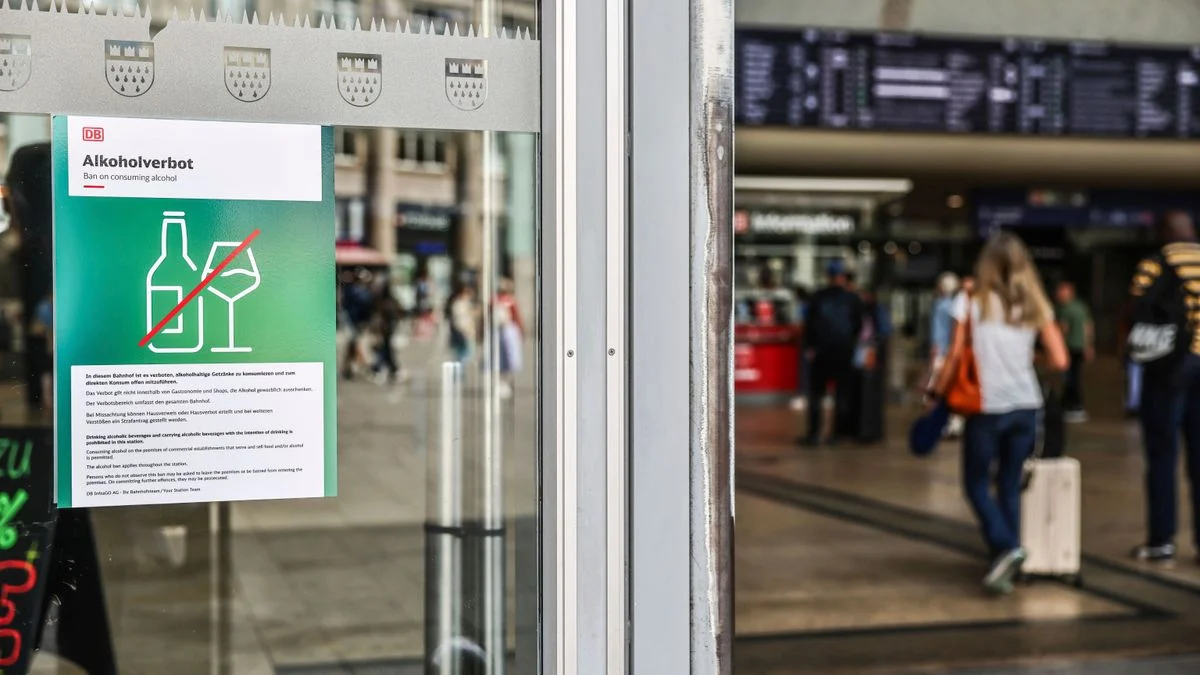
The idea of a nationwide alcohol ban at German train stations is not entirely new, with certain regional bans already in effect, notably at Cologne Central Station, as evidenced by existing signage. However, CEO Evelyn Palla’s current initiative represents the first concerted push for a uniform, nationwide prohibition.

The specifics of the plan first surfaced through a report in the "Bild" newspaper, which detailed the proposed scope: a ban on drinking beer, wine, or schnapps on platforms or in station halls, excluding designated gastronomic establishments. Deutsche Bahn subsequently confirmed these plans to the German Press Agency (dpa), affirming their intention for a complete rollout by mid-October 2026. This timeline suggests a rapid implementation phase, requiring swift coordination and consensus among various stakeholders.
Crucially, the responsibility for security at train stations in Germany is shared between DB’s internal security forces and the Federal Police (Bundespolizei), which operates under the purview of the Federal Ministry of the Interior. This dual responsibility forms a significant backdrop to the current debate, particularly in light of recent legislative developments. Just "the penultimate Friday" prior to this announcement, the German Bundestag passed a resolution that explicitly mandates the Federal Police to establish security standards for both train stations and trains. Under this new directive, Deutsche Bahn is required to implement these standards in agreement with the Federal Police. This legislative context adds a layer of complexity to DB’s unilateral proposal, highlighting the necessity for inter-agency collaboration and formal agreements before any such ban can be effectively and legally enforced.
Political Scrutiny: A Mixed Reception
The announcement has triggered a wave of political commentary, revealing a spectrum of views ranging from cautious support to outright rejection, primarily centered on the feasibility and philosophy of the proposed ban.
Coalition’s Cautious Endorsement
Within the broader political landscape, particularly among those aligned with the government or the largest opposition parties, the reaction has been one of conditional acceptance.
Alexander Throm, the internal policy spokesperson for the CDU/CSU parliamentary group (Union), welcomed Deutsche Bahn’s proactive stance on security. "I expressly welcome Deutsche Bahn’s strengthening of its own security efforts," Throm told SPIEGEL. However, he quickly tempered his support with a critical observation: "It also includes that the railway will enforce these rules with its own personnel." This statement underscores a central concern among politicians: the practical burden of enforcement and whether DB possesses the necessary resources and authority to effectively implement such a widespread ban. Throm further highlighted the Federal Police’s existing role, citing the recently enacted Federal Police Law. "With the new Federal Police Law, we are currently improving security at train stations, for example, through unannounced control options in weapon and knife ban zones, which include train stations in Berlin and Hamburg," he explained, suggesting that legislative tools already exist to enhance safety.
Federal Interior Minister Alexander Dobrindt echoed a similar sentiment of cautious optimism. Speaking in Berlin, Dobrindt stated that he found it "positive that there is an initiative by Deutsche Bahn to improve the situation at train stations in precisely this direction." Yet, like Throm, he immediately flagged the "problematic" nature of enforcing such a ban. The Minister expressed an understanding of the underlying objective – "that one might be able to reduce something, which is also a potential for aggression, with the issue of alcohol at train stations, or believes that one could reduce it." However, he stressed the need for concrete evidence. Dobrindt indicated his desire to discuss the matter with CEO Palla, seeking to understand "what basis, what information, or what studies she might have" that led to this proposal. Despite his reservations, Dobrindt concluded on a conciliatory note: "But it is not an idea that should be directly thrown in the bin from the very first moment."

Sebastian Fiedler, the internal policy spokesperson for the Social Democratic Party (SPD), a key member of the governing coalition, believes the proposal holds significant potential for positive change. "An alcohol ban at train stations and on trains would be a considerable gain in security," Fiedler told SPIEGEL, initially finding the railway executive’s suggestion appealing. Nevertheless, Fiedler, too, pointed to substantial hurdles in its practical execution. He specifically urged Ms. Palla to consider a recent parliamentary decision: "I would, however, ask Ms. Palla to take into account the resolution of the German Bundestag from the penultimate Friday. According to this, the Federal Police will from now on set the security standards for safety at train stations and on trains. Deutsche Bahn must implement them in agreement with the Federal Police." Fiedler pointed out that this agreement had "evidently not yet taken place." He made it clear that implementation could only be considered if DB could demonstrate a "significant personnel increase" for its own security staff (DB Sicherheit) and a strengthening of their role within the company. Furthermore, Fiedler stressed that the Federal Police are not responsible for enforcing such a ban. He demanded that Deutsche Bahn present a comprehensive concept demonstrating that this additional security task, namely the monitoring and enforcement of an alcohol ban, would not lead to the neglect of the security personnel’s existing duties.
The Left Party’s Vehement Critique
In stark contrast to the cautious approach of the Union and SPD, the Left Party (Die Linke) has launched a robust critique, characterizing the proposed ban as misguided and superficial.
Luke Hoß, the party’s spokesperson for legal policy, views the planned prohibition as an attempt to offload responsibility rather than address systemic issues. "Instead of shifting all responsibility onto employees with an alcohol ban, the railway CEO and the Minister of Transport should finally renovate the train stations," Hoß asserted. He argued that train stations must once again become places "where we can safely spend waiting times – well lit, with sufficient benches, and more station missions [Bahnhofsmissionen]." This perspective highlights a fundamental difference in approach: while DB and others focus on regulating individual behaviour, Die Linke calls for structural improvements to the physical environment and increased social support services. Bahnhofsmissionen are charitable organizations providing assistance to travelers, particularly those in need, at train stations, and an increase in their presence would address social issues more directly.
Ateş Gürpınar, Die Linke’s spokesperson for drug policy, further elaborated on the party’s criticism, identifying what he termed a "double standard" in the proposed ban. "Alcohol should still be available for a few euros at every corner, but consumers are then chased away if they take advantage of this offer," Gürpınar told SPIEGEL. His argument points to the hypocrisy of allowing widespread sales of alcohol within station premises while simultaneously banning its consumption in public areas. Gürpınar advocated for a more comprehensive and preventative strategy, demanding "instead a sales ban on alcohol at train stations and proactive addiction counseling." He argued that such measures would foster "real security and reduce alcohol consumption, completely without criminalization and displacement." This alternative approach seeks to tackle the root causes of problematic alcohol consumption and its associated issues, rather than merely displacing them.
The Broader Context: Underlying Issues and Supporting Data
While specific data supporting the direct link between alcohol consumption at train stations and a surge in security incidents was not extensively detailed in the initial reports, the push for a ban implicitly acknowledges a perceived or actual problem. Deutsche Bahn’s motivation likely stems from internal reports of disturbances, passenger complaints, and incidents involving its security and service personnel. The presence of existing regional bans, such as in Cologne, suggests that localized problems have prompted targeted interventions in the past, providing a precedent for a nationwide approach.
The Federal Police, as a primary security provider at German train stations, plays a crucial role. Their responsibilities include preventing and investigating crimes, ensuring public order, and responding to emergencies. The recent amendments to the Federal Police Law, allowing for "anlasslose Kontrollmöglichkeiten" (random control possibilities) in designated weapon and knife ban zones, illustrate a governmental push to empower law enforcement with more tools to ensure public safety in high-traffic areas. However, as noted by Sebastian Fiedler, the new parliamentary resolution places the onus on the Federal Police to set security standards, with DB then responsible for implementing them in agreement. This legislative shift means DB’s proposed alcohol ban cannot be a unilateral decision but must be integrated into a broader, coordinated security framework.

The debate also touches upon broader societal questions concerning public order, individual freedoms, and the role of alcohol in public spaces. Proponents of such bans often highlight the potential for reducing noise, litter, public urination, and violent incidents. Opponents, however, frequently raise concerns about over-regulation, the "nanny state," and the potential for such bans to disproportionately affect certain demographics, including homeless individuals or those for whom train stations serve as quasi-public living spaces.
Implications and the Road Ahead
The proposed nationwide alcohol ban at German train stations carries significant implications across various domains, from operational logistics to social policy.
Enforcement Challenges and Resource Allocation
The most immediate and frequently cited challenge by politicians is enforcement. Deutsche Bahn’s internal security forces (DB Sicherheit) are responsible for maintaining order within railway premises. However, their capacity and authority differ significantly from those of the Federal Police. Implementing a nationwide alcohol ban would necessitate a substantial increase in DB Sicherheit personnel, extensive training on de-escalation techniques, and clear protocols for interacting with individuals found violating the ban. This would incur considerable costs for Deutsche Bahn, which would need to be justified and budgeted for. The question of how DB security personnel would effectively enforce such a ban without exacerbating conflicts or overstepping their authority remains largely unanswered. Furthermore, the interplay with the Federal Police, who maintain ultimate authority over serious criminal matters, requires precise demarcation of responsibilities to avoid jurisdictional ambiguities.
Economically, the ban could impact station businesses that rely on alcohol sales. While the proposal exempts "Bahnhofsgastronomie" (station gastronomy), many smaller kiosks and shops within stations sell alcoholic beverages for off-site consumption. A ban on public consumption would likely reduce sales for these retailers, potentially leading to financial losses or a shift in their business models.
Societal Debates and Alternative Approaches
The debate also delves into philosophical considerations. Is a blanket ban the most effective way to address alcohol-related problems, or does it simply displace them to areas just outside station perimeters? Critics like Die Linke argue that such bans can lead to the criminalization of individuals, particularly those from marginalized communities, without addressing the underlying causes of problematic alcohol consumption.
The Left Party’s proposals for station renovation – better lighting, more benches, increased Bahnhofsmissionen – offer an alternative vision focused on creating safer, more welcoming environments through infrastructure and social support rather than punitive measures. Their call for an alcohol sales ban, coupled with addiction counseling, represents a more comprehensive public health approach, aiming to reduce availability and provide assistance to those struggling with addiction, rather than just prohibiting consumption in specific areas. These alternative perspectives underscore the complexity of the issue, suggesting that a multi-faceted approach addressing both environmental factors and social needs might be more effective in the long run.

Navigating the Legislative and Operational Maze
For the alcohol ban to move forward, Deutsche Bahn must navigate a complex legislative and operational landscape. The recent Bundestag resolution is a critical factor, requiring DB to develop and implement its security standards, including any alcohol ban, in "Einvernehmen" (agreement) with the Federal Police. This necessitates close coordination, detailed planning, and potentially, pilot phases to test the efficacy and enforceability of the ban before a full nationwide rollout.
DB will need to present a robust concept that addresses all the concerns raised by politicians: the number and training of its security personnel, the clear demarcation of responsibilities between DB Sicherheit and the Federal Police, the financial implications, and a strategy for communicating the ban to the public and gaining their cooperation. Public consultation and engagement with various stakeholders, including passenger associations, retailers, and social welfare organizations, will be crucial to ensure broader acceptance and to anticipate potential unintended consequences.
Conclusion
Deutsche Bahn CEO Evelyn Palla’s proposal for a nationwide alcohol ban at train stations represents a significant policy initiative aimed at enhancing public safety and improving the travel experience. While the underlying goal of reducing alcohol-related disturbances finds a degree of resonance across the political spectrum, the specifics of its implementation and its broader societal implications have opened a vigorous debate.
From the pragmatic concerns of the Union and SPD regarding enforcement capacity and jurisdictional clarity, to the systemic critiques of Die Linke advocating for holistic station improvements and social support, the discussions highlight the multifaceted nature of public order issues. The path forward for Deutsche Bahn will involve careful negotiation, a transparent presentation of data and resources, and a concerted effort to align its security initiatives with the mandates of the Federal Police and the broader expectations of a diverse society. The deadline of October 15, 2026, looms large, signaling that these critical discussions must quickly translate into concrete, actionable strategies that address both the immediate safety concerns and the underlying social complexities of Germany’s bustling railway network.