In the fast-evolving landscape of generative AI, tech giants are racing to integrate Large Language Models (LLMs) into every facet of our digital lives. From search engines to email clients, artificial intelligence is being positioned as a helpful assistant, designed to synthesize vast amounts of data into bite-sized, actionable insights. However, nowhere has this integration felt more intrusive or misplaced than in the recent updates to Google Maps.
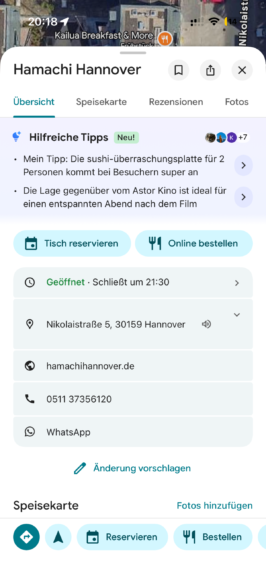
Since June, users navigating Google Maps have been greeted by a new feature: AI-generated “helpful highlights” powered by Gemini. While Google frames these as a convenience, many users—and tech observers—are finding them to be an exercise in algorithmic overreach. By prioritizing opaque machine-generated summaries over essential factual data like opening hours and website links, Google is fundamentally altering the user experience in ways that raise significant questions about transparency, corporate design philosophy, and the future of human decision-making.
The Core Conflict: When Algorithms Pretend to Be Human
The primary point of contention lies in the nature of the recommendations themselves. When a user looks up a restaurant in a city like Hannover, they are now likely to see a summary generated by Gemini. These summaries might suggest a specific dish—such as a "sushi surprise platter"—or comment on the ambient temperature of an outdoor seating area.
The dissonance here is stark: a piece of software that lacks taste buds, digestive systems, or the ability to feel physical cold is offering subjective culinary and environmental advice. Gemini derives these insights by scanning user reviews from the preceding twelve months, looking for recurring patterns, and distilling them into a “helpful summary of the general sentiment.”
However, the user experience is suffering. By placing these AI-generated blurbs at the very top of the interface, Google has effectively pushed critical, high-utility information—such as contact details, menus, and precise operating hours—further down the screen. The result is a UI that favors decorative, conversational text over the functional data that users actually need to plan a visit.

A Chronology of the AI Rollout
The deployment of Gemini within Google Maps follows a broader corporate strategy to weave AI into the fabric of Google’s product suite.
- Pre-June 2024: Google Maps functioned primarily as a directory and navigation tool. Reviews were available to users in their raw format, allowing individuals to gauge the sentiment of a location by reading diverse human experiences.
- June 2024: Google begins the phased rollout of "helpful highlights" in select markets. The feature is framed as an evolution of its existing review aggregation tools, now enhanced by the reasoning capabilities of the Gemini model.
- Present Day: The feature has become a standard, yet polarizing, fixture of the Maps interface. While not present on every business page—the system requires a sufficient volume of reviews to generate a summary—it has become widespread enough to trigger a wave of user frustration.
The transition from raw data to AI-curated interpretation represents a shift from "information discovery" to "curated consumption." Users no longer scan the crowd; they are handed a conclusion by the platform.
Supporting Data and the "Illusion of Proximity"
One of the most unsettling aspects of this integration is the tone of the generated text. Gemini is designed to mimic the conversational style of a friend or a local guide. It uses phrases that imply personal experience, effectively creating a "technical proximity" that is, by definition, fraudulent.
The Breakdown of AI Limitations
- Lack of Sensory Input: AI cannot experience temperature. A comment about a "fresh" or "cool" outdoor area is a statistical correlation of words, not a physical observation.
- Lack of Subjective Taste: An AI cannot enjoy a meal. Recommending a dish based on the frequency of mention in reviews is not a culinary recommendation; it is a popularity contest disguised as expert advice.
- Opacity of Selection: Because the process of selecting these three specific bullet points is hidden within a "black box" algorithm, users cannot verify why certain information was prioritized over others.
This leads to a psychological phenomenon where users may feel "gaslit" by their own apps. When an interface claims to offer a "personal tip," it attempts to bridge the gap between human emotion and machine output, a move that many critics argue is inherently dishonest.
Official Responses and Corporate Strategy
Google’s stance on these features remains steadfastly focused on "user efficiency." According to company literature, these summaries are intended to save users time, helping them understand the "vibe" of a place without having to scroll through hundreds of individual, often contradictory reviews.
However, Google has yet to provide an opt-out mechanism for these highlights. For users who prefer raw data or who find the AI intrusions distracting, there is currently no simple toggle in the settings menu to disable these summaries. This lack of user agency is a hallmark of Google’s current design trend, where the platform dictates the interaction model rather than adapting to the user’s preferences.
Implications: The Road to an Agentic Dystopia?
The deeper concern is not just about a sushi recommendation; it is about the long-term erosion of user autonomy. As we become accustomed to letting AI interpret our surroundings, we risk falling into a state of "algorithmic dependency."
1. The Death of Independent Research
If users are trained to accept the first three bullet points offered by Gemini as the final word on a venue, they will stop engaging with the underlying source material—the reviews themselves. This makes it easier for platforms to manipulate user perception by highlighting specific sentiment trends while burying others.
2. The Rise of Agent-to-Agent Interactions
We are approaching a future where "agentic AI" could manage our lives entirely. Imagine an environment where your personal AI agent communicates with a restaurant’s AI agent, cross-referencing your past "dietary preferences" (as defined by your previous consumption) with the restaurant’s "available inventory," and finalizing a reservation without you ever speaking to a human or visiting the actual website.
3. The Loss of Serendipity
Human experience thrives on the unexpected. By "optimizing" our restaurant choices, we are narrowing our horizons to the statistically most likely outcome. If every recommendation is just a reflection of what others have already liked, we lose the chance for unique, individual discoveries that defy the data.
Conclusion: A Call for User Control
The current iteration of AI in Google Maps serves as a cautionary tale of "innovation for innovation’s sake." While generative AI holds massive potential for summarizing complex documents or coding assistance, its application in social and sensory-driven spaces—like hospitality—feels misplaced.
Google needs to recognize that "helpful" is a subjective term. For many, a helpful tool is one that stays out of the way, provides accurate facts, and leaves the judgment of "what tastes good" or "what feels comfortable" to the human user.
Until Google provides a clear, accessible way for users to disable these AI summaries, the platform will continue to alienate those who value their own agency over the synthetic suggestions of an algorithm. We are not just looking for a dinner recommendation; we are looking for a reliable, honest window into the world—a window that, for now, is being obscured by the unnecessary filter of generative AI.
If this is the beginning of an agentic future, it is time for users to demand a seat at the table—or, at the very least, the right to choose their own meal.