

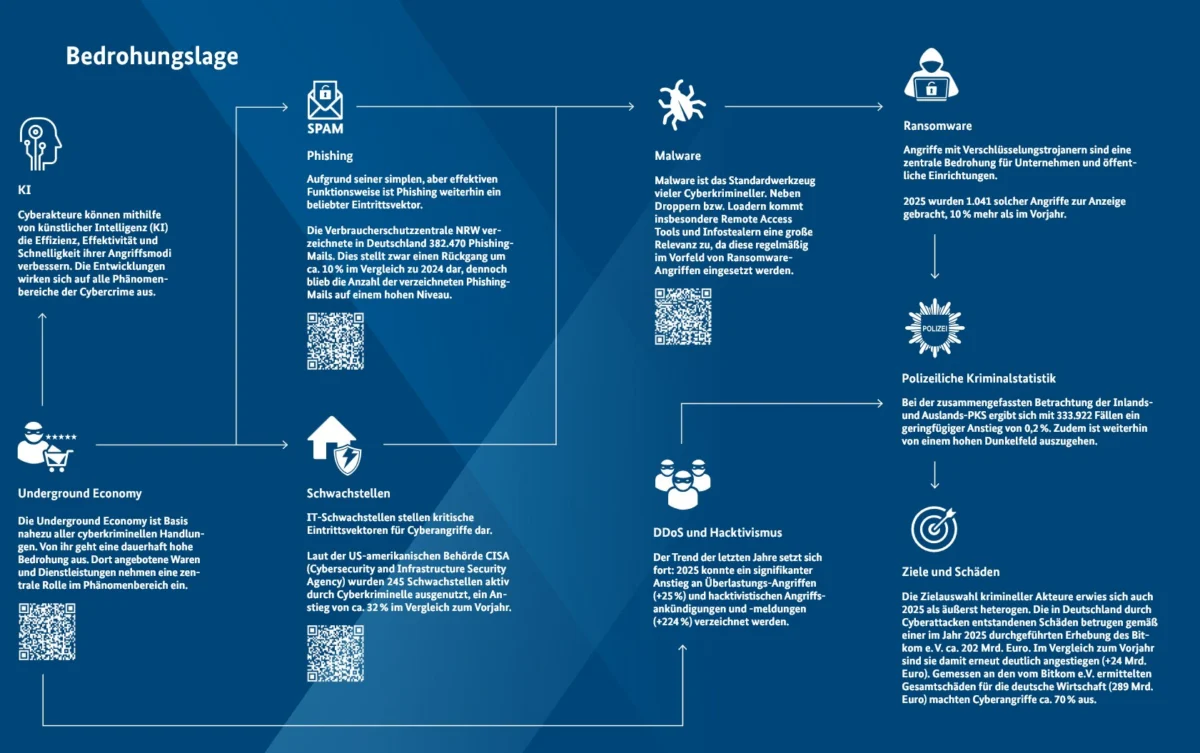
The digital landscape of Germany is no longer a peripheral concern for IT departments; it has evolved into a central pillar of national security and economic stability. The Federal Criminal Police Office (BKA) recently released its Federal Situation Report on Cybercrime 2025, revealing a reality that is as sobering as it is complex. Germany is currently facing a "permanent state" of high-level digital threat, characterized by the industrialization of crime, the weaponization of artificial intelligence, and the persistent expansion of an underground economy that functions with the efficiency of a legitimate service sector.
The New Reality: Professionalization and Globalization of Crime
The 2025 report makes one thing abundantly clear: cybercrime is no longer the domain of the lone "hacker in a basement." It is an organized, international, and highly specialized industry. The BKA distinguishes between "Cybercrime in the narrower sense" (CCieS)—offenses directed specifically against the internet, data, or IT systems—and the broader context of digital-enabled crime.
A significant challenge identified by the BKA is the "dark field" of unreported crimes. Many incidents remain undetected or are simply never reported to authorities. Despite this, the recorded data is alarming. A total of 333,922 cybercrime offenses were registered in 2025. Perhaps most notably, the jurisdiction of these crimes is increasingly ambiguous. Of these cases, 207,888 were classified as "abroad-based offenses," dwarfing the 126,034 "domestic" cases. For law enforcement, this creates a structural nightmare: the victims are on German soil, but the perpetrators, servers, payment flows, and infrastructure are scattered across disparate international jurisdictions, often beyond the reach of German law.
The economic impact is staggering. According to figures provided by the industry association Bitkom, cyberattacks resulted in an estimated €202.4 billion in damages to the German economy in 2025. This figure underscores that cybercrime is now a primary systemic risk to German prosperity, surpassing the traditional concerns of industrial espionage.

A Chronology of Chaos: The 2025 Attack Calendar
The year 2025 served as a stark reminder of the reach and audacity of cyber-adversaries. The BKA’s report provides a timeline that reads like a warning of systemic fragility:
- January: The Fraunhofer Institute for Industrial Engineering (IAO) was struck by a devastating ransomware attack involving the "Akira" variant.
- February: An Interpol database was compromised, with its contents auctioned off in underground forums. Simultaneously, the pro-Russian "Z-Pentest-Alliance" targeted a biogas plant in Lower Saxony, marking a move toward physical sabotage.
- March: Municipal utility providers (Stadtwerke) in Schwerte became a primary target, illustrating the vulnerability of critical municipal infrastructure.
- May: The German NGO Welthungerhilfe was targeted by the "Rhysida" group. This incident exemplified the "double extortion" model: data was exfiltrated before the systems were encrypted, and a €1.8 million ransom was demanded under the threat of public data exposure.
These incidents highlight the versatility of the targets. From logistics hubs and satellite companies to airports—such as the massive disruption at Collins Aerospace that grounded flights across Europe—the physical impact of digital attacks is now a tangible reality for citizens and businesses alike.
Supporting Data: The Anatomy of the Threat
The report highlights a shifting ecosystem where traditional defensive measures are constantly challenged by evolving vectors.
Ransomware and the Double Extortion Trap
Ransomware remains the most potent threat. There were 1,041 reported incidents in 2025, a 10% increase over the previous year. Most concerning is the prevalence of "Double Extortion," which occurred in 76% of these cases. By stealing data before encrypting it, attackers hold the victim hostage even if they have perfect backups. Interestingly, while the propensity to pay ransom has decreased—only 7% of victims report paying—the average payout has surged by 65%, reaching approximately $456,335. Attackers are shifting toward a "fewer victims, higher stakes" business model.

The Surge in DDoS and Hacktivism
Distributed Denial of Service (DDoS) attacks rose by 25% in 2025. Deutsche Telekom recorded over 36,700 such attacks on its networks alone. A major driver is the surge in politically motivated hacktivism. The group "NoName057(16)" doubled its activity compared to 2024, targeting German administrative and logistics infrastructure in protest of Germany’s support for Ukraine. While these attacks are often technically "moderate," their goal is psychological warfare: causing public disruption, generating headlines, and signaling political discontent.
The Underground Economy
The "Underground Economy" is the engine behind this growth. It functions as a SaaS (Software as a Service) marketplace. Threat actors can now purchase "Phishing-as-a-Service," exploit kits, and botnet access without needing deep technical expertise. This commodification of cybercrime has drastically lowered the barrier to entry, allowing even low-skill actors to conduct high-impact operations.
Artificial Intelligence: The Double-Edged Sword
The BKA explicitly addresses the role of Artificial Intelligence (AI). While there are no specific "AI crime" statistics yet, the agency notes that AI is acting as an accelerator for both sides.
- For Attackers: AI is used to craft perfectly localized, personalized phishing campaigns that bypass traditional spam filters. It is being used for reconnaissance to find zero-day vulnerabilities faster and, in early instances, to write polymorphic malware that changes its code to evade detection.
- The Risk of Agentic AI: The BKA warns of the danger of autonomous AI agents. If integrated too deeply into corporate IT, these agents could be hijacked, effectively turning an organization’s own efficiency tools against its security perimeter.
Official Responses and Strategic Shifts
The BKA has shifted its strategy from focusing on individual perpetrators to targeting the entire criminal ecosystem. In 2025, the agency coordinated 34 major investigations, focusing heavily on ransomware syndicates and infrastructure providers.

International cooperation, such as the multi-phase "Operation Endgame," demonstrates that the only way to tackle a globalized crime wave is through a globalized law enforcement response. The BKA’s "Four-Pillar Approach" is the core of this strategy:
- Identity: Identifying the individuals behind the screens.
- Infrastructure: Dismantling servers, domains, and botnet command centers.
- Finance: Cutting off the flow of illicit funds, particularly cryptocurrency laundering channels.
- Reputation: Disrupting the trust mechanisms within underground forums to make cooperation among criminals more difficult.
Implications: The New Corporate Mandate
The BKA report is a clarion call for the German economy. Cyber-resilience is no longer an "IT project"—it is a core business requirement. Organizations must adopt a posture of "assume breach." This entails strict network segmentation, rigorous multi-factor authentication, and an uncompromising approach to patch management.
For the state, the message is equally clear: the era of reactive policing is over. The digital domain requires a permanent, high-tech, and cross-border intelligence presence. As the BKA looks toward 2026, it warns that the threats will only become more automated and scalable. With the looming potential of quantum computing to eventually compromise current encryption standards, the race between defensive innovation and criminal exploitation has only just begun.
The 2025 BKA report concludes that cybercrime has reached a "steady state." It is a permanent fixture of our environment, like the weather, requiring constant vigilance, massive investment in infrastructure, and a fundamental shift in how society perceives digital safety. The digital siege is not ending; it is simply entering a more sophisticated, AI-driven phase.






















Leave a Reply