After years of iterative, somewhat fragmented attempts to dominate the living room, Apple has finally signaled its intent to consolidate the smart home market. During a high-profile event in New York City, the Cupertino giant unveiled an ambitious, end-to-end ecosystem designed to place its hardware at the literal and metaphorical center of the modern household. However, while the technological promise is substantial, a deepening rift between Apple and the European Union threatens to leave European consumers on the sidelines of this new era.
The Hardware Offensive: A Cohesive Ecosystem
Apple’s new strategy represents a shift from "add-on" gadgets to a "foundational" smart home experience. The lineup introduced in New York is comprehensive, targeting both the core hub experience and the peripheral utility of a connected home.
At the center of the hardware update are two legacy staples: the second generation of the HomePod mini and a refreshed, more powerful Apple TV 4K. Both devices have been optimized to serve as high-performance nodes within the Apple Home ecosystem, boasting improved processing power to handle local automation tasks without relying on cloud latency.
Perhaps more significant is the introduction of the "Apple Home Collection." In a rare collaborative move, Apple has partnered with industry stalwarts LG Electronics and Schneider Electric. This collection includes a suite of high-end surveillance cameras, automated smart locks, and intelligent radiator thermostats. By leveraging the manufacturing expertise of these partners while maintaining the "Works with Apple" certification, the company aims to ensure seamless integration that, until now, has been the primary pain point for smart home enthusiasts.
The Heart of the Home: Introducing "HomeView"
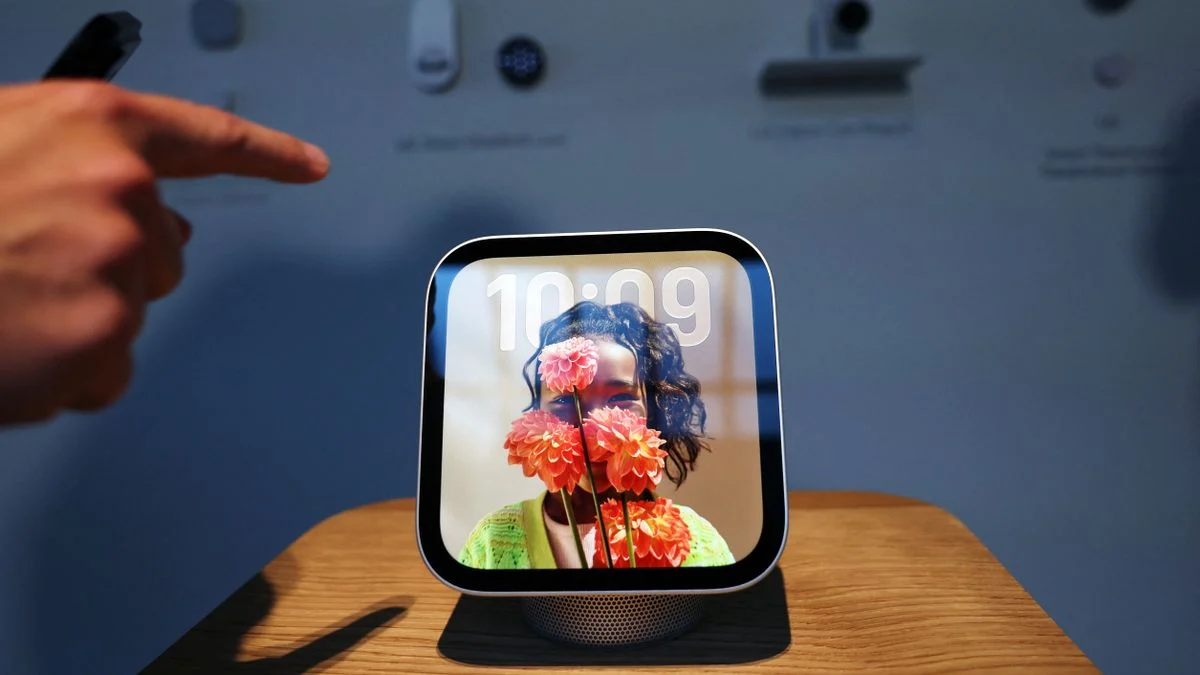
The undisputed star of the event was the "HomeView," a dedicated smart home control center that signals Apple’s desire to own the kitchen counter and the hallway wall. The device is a marvel of industrial design, featuring a circular, weighted base supporting a 7-inch square display. A secondary, wall-mounted version omits the base, offering a sleek, minimalist aesthetic.
The user interface of the HomeView is a hybrid experience. It draws design language from iOS, iPadOS, watchOS, and the spatial computing interface of the Vision Pro. It is an intuitive, touch-first environment that serves multiple roles: a video conferencing station (thanks to an integrated camera), a multimedia player for music and streaming, and a centralized dashboard for home automation.
One of the most requested features—a persistent, always-on clock face—has been implemented with a nod to the Apple Watch, allowing users to customize their display style. However, the true power of the HomeView lies in its integration with "Siri AI," Apple’s latest evolution of its digital assistant, which promises to transform the home from a collection of devices into an autonomous, responsive environment.
Chronology of Ambition: From HomeKit to HomeView
To understand the weight of this announcement, one must look back at the trajectory of Apple’s smart home strategy:
- 2014: Apple announces HomeKit, a framework designed to allow developers to create accessories that communicate with iPhones. It was praised for privacy but criticized for being difficult to set up.
- 2018–2020: Apple pivots toward the HomePod and Apple TV as central hubs, but market share remains dominated by Amazon’s Alexa and Google Home due to lower price points and wider compatibility.
- 2023: The rise of Generative AI forces Apple to rethink the "dumb" assistant model. Internal development of Siri AI accelerates, focusing on on-device processing.
- Late 2024 (New York Event): Apple unveils the unified HomeView ecosystem, marking the first time the company has fully integrated its own hardware, third-party partnerships, and advanced AI into a single "smart home" package.
The Regulatory Wall: Apple vs. the EU
While the excitement in North America is palpable, the announcement was underscored by a notable absence. Apple confirmed that the HomeView will not be available for purchase in the European Union at launch. The company’s statement, buried in the fine print of its press materials, was blunt: "Apple HomeView will not be offered for sale in the European Union, as Siri AI is currently unavailable under iOS in the EU. Apple is working constructively with the EU to find a solution."
This is the direct result of the EU’s Digital Markets Act (DMA). The European Commission has designated Apple’s iOS as a "gatekeeper" platform. Under these regulations, the EU demands that Apple provide third-party AI systems with the same level of integration, data access, and system-level permissions as its own proprietary Siri AI.
Apple, true to its "walled garden" philosophy, has balked at these requirements. The company argues that allowing third-party AI to hook directly into the core of its operating system poses an unacceptable security and privacy risk. Apple maintains that its closed system is the only way to guarantee end-to-end encryption and user data sovereignty. European regulators, however, see this as an anti-competitive tactic—a "golden cage" designed to lock users into the Apple ecosystem while stifling innovation from competitors.
Supporting Data: The Cost of Disconnect
The financial implications of this split are significant. The HomeView is priced at $299 (plus applicable sales taxes), a premium position that assumes high value for the integrated AI assistant. In the US market, this is seen as a competitive entry into the smart home hub space. In Europe, the lack of a release date creates a vacuum that competitors will be eager to fill.
Furthermore, the integration of LG and Schneider Electric products relies heavily on the "Apple Home" protocol, which is optimized for Siri AI. Without the local processing power and the advanced natural language understanding of the new assistant, the utility of these smart devices in a European household would be significantly diminished.
Implications: A Fragmented Future?
The standoff between Apple and the EU carries profound implications for the future of consumer technology:
- The Privacy Paradox: Apple is betting that its stance on privacy will resonate with consumers, even if it results in fewer features or delayed product launches. However, if the EU persists in its demands, Apple may be forced to choose between breaking its "closed" model or abandoning one of its largest markets for smart home technology.
- The Innovation Bottleneck: If the DMA effectively prevents companies from deploying integrated AI, European consumers may find themselves stuck with "legacy" technology, while the rest of the world moves toward the era of AI-driven home automation.
- The Rise of the "Local" Hub: The HomeView represents a shift toward local, on-device AI. If successful, this could reduce the amount of personal data sent to the cloud, potentially aligning with EU privacy goals. Paradoxically, the very regulations meant to protect European consumers may be preventing them from accessing the most privacy-focused AI hardware currently available.
Conclusion
The launch of the HomeView and the new Apple Home Collection represents a pivotal moment for the technology giant. It is a bold, unified vision that finally bridges the gap between hardware and software intelligence. Yet, it also highlights the growing friction between Silicon Valley’s "all-or-nothing" design philosophy and the EU’s mandate for open, interoperable markets.
For now, the European consumer is left waiting. Until a "constructive solution" is reached, the HomeView remains a North American ambition, and the dream of a fully integrated, AI-driven smart home remains, in the EU, a feature of the future rather than a reality of the present. Whether this standoff results in a compromise or a permanent decoupling of markets remains the most critical question for the tech sector in the coming year.