By Sports Editorial Staff
October 28, 2026
Borussia Mönchengladbach’s season of transformation continued on Tuesday night as the "Fohlen" punched their ticket to the DFB-Pokal Round of 16. In a match defined by tactical discipline and sheer grit, the Bundesliga side overcame a precarious position—playing over 50 minutes with ten men—to secure a clinical 2-0 victory over the Karlsruher SC.
Coming off their maiden Bundesliga victory against VfB Stuttgart just four days prior, manager Alexander Blessin’s squad displayed a newfound defensive maturity that had been missing in the early stages of their campaign. While the victory was professional, it was by no means easy, as a first-half red card threatened to derail the momentum the team had spent weeks building.
The Strategic Shift: Managing the Crisis
The narrative of the match was dictated by two distinct phases: the explosive start and the tactical lockdown. For a team that has struggled with consistency, this performance against the second-tier Karlsruher SC served as a litmus test for the squad’s psychological fortitude.
Early Dominance and the Turning Point
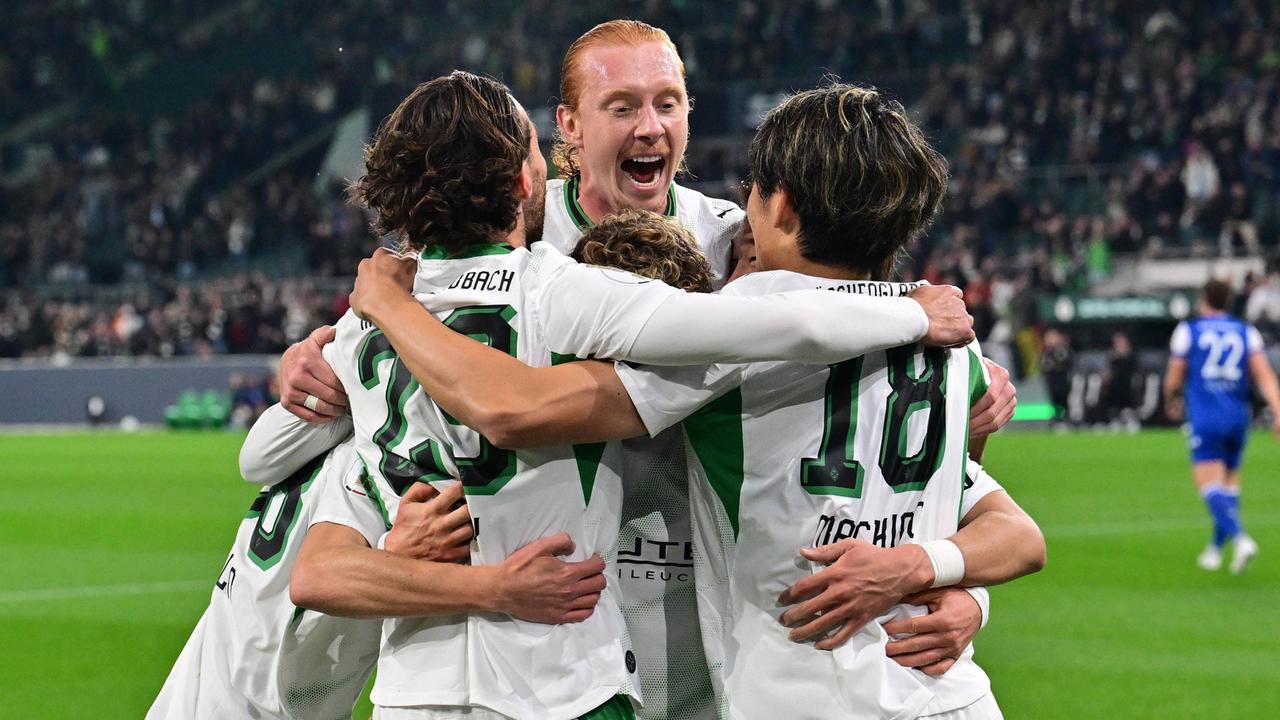
The match began with a frantic pace that saw both sides struggle for rhythm. However, it was Gladbach who broke the deadlock in the 7th minute. Following an intricate buildup sequence that bypassed Karlsruhe’s high press, Shuto Machino and Joe Scally combined to find Robin Hack, who calmly slotted the ball home. It was the dream start for a side looking to build confidence.
However, the tide turned in the 39th minute. Philipp Sander, tasked with anchoring the defense, was caught in a high-stakes transition. A clumsy challenge as the last man resulted in a red card following a VAR intervention. The dismissal left Gladbach to navigate the remainder of the first half and the entirety of the second with a numerical disadvantage.
The Tactical Lock-down
Entering the second half with a precarious 1-0 lead and a man down, the prevailing expectation was that Gladbach would crumble under the pressure of the KSC attack. Instead, manager Alexander Blessin opted for a masterclass in low-block defending. The team "mixed concrete," as the local media described it, conceding possession while maintaining an incredibly compact defensive shape.
The strategy paid off in the 49th minute. Lukas Ullrich, who had been introduced at halftime to reinforce the midfield, capitalized on a stray pass from Karlsruhe’s Lilian Egloff. A rapid counter-attack followed, with Ullrich playing a sharp one-two with Hack before burying the ball in the back of the net. The 2-0 lead effectively sucked the energy out of the Karlsruhe side, who appeared rattled by their inability to break down the ten-man wall.
Chronology of a Resilient Victory
- 7’ (1-0): Robin Hack scores the opener after a crisp team move.
- 39’ (Red Card): Philipp Sander is sent off for a professional foul, forcing Gladbach into a defensive shell.
- 49’ (2-0): Substitute Lukas Ullrich extends the lead against the run of play, punishing a Karlsruhe error.
- 60’–90’: Gladbach effectively manages the clock, forcing Karlsruhe into low-danger long-range efforts.
- Full Time: Gladbach advances, having successfully neutralized a desperate second-half surge from the visitors.
Supporting Data and Performance Analysis
The statistics from the match highlight the efficacy of Gladbach’s defensive approach. Despite playing 51 minutes with ten men, the home side allowed remarkably few high-quality scoring opportunities.
Karlsruhe, currently sitting 17th in the 2. Bundesliga, struggled to translate their possession advantage into efficiency. Their reliance on long-range efforts—most notably a 35-meter strike from Marvin Wanitzek—demonstrated a lack of tactical ingenuity. Gladbach’s goalkeeper, Daniel Batz, who stepped in for regular starter Moritz Nicholas, remained composed throughout, dealing with routine saves without needing to perform miracles.
The depth of the squad also proved vital. The decision to bench stars like Wael Mohya and Florian Neuhaus appeared initially risky, but the introduction of fresh legs in the second half provided the necessary energy to sustain the defensive pressure. The inclusion of ex-Karlsruhe player David Herold in the starting XI added an extra layer of familiarity that helped in reading the visitors’ tactical patterns.
Official Responses: A Tale of Two Dressing Rooms
The post-match atmosphere reflected the starkly different realities of the two clubs.
Alexander Blessin (Gladbach Manager):
"I am incredibly proud of my team," said an emotional Blessin during the post-match press conference. "A red card like that can completely change the trajectory of a game. We had to suffer for 50 minutes. But we didn’t just survive; we limited their chances to almost zero. Finding that second goal was the turning point that allowed us to bring the game home safely."
Maximilian Senft (Karlsruhe Manager):
In contrast, the mood in the visitors’ camp was one of frustration and missed opportunity. "We invited the opponent to score that second goal through sheer negligence," Senft admitted to the Sportschau microphone. "That cannot happen at this level. We had the numerical advantage, but we failed to convert that into creative chances. It is a very disappointing result; we should have performed significantly better."
Implications for the Season Ahead
For Borussia Mönchengladbach
This victory is more than just a progression in the DFB-Pokal; it is a psychological milestone. Having secured their first Bundesliga win last weekend and now a clean-sheet victory under duress, the team is beginning to shed the "bottom-of-the-table" mentality.
The upcoming Saturday match against SC Paderborn in the Bundesliga will be the true test of this momentum. Can they replicate this level of defensive discipline while managing the fatigue of a cup-tie? If they can maintain this grit, the "Fohlen" could be looking at a mid-table surge that looked impossible just a fortnight ago.
For the Karlsruher SC
For the Badeners, the result exacerbates an already difficult week. Following a crushing 1-6 defeat to Magdeburg in the league, the loss to ten-man Gladbach raises questions about the squad’s mental fragility. With a high-stakes match against 1. FC Heidenheim looming on Saturday evening, the coaching staff has little time to rectify the tactical deficiencies exposed by this defeat.
Conclusion: A Turning Point?
In the unpredictability of the DFB-Pokal, tactical adaptability is often the difference between a routine win and an embarrassing exit. On Tuesday night, Borussia Mönchengladbach proved that they are evolving from a team that leaks goals into a side that can weather the storm.
Whether this performance is a true indicator of a long-term turnaround remains to be seen. However, for a fanbase that has endured a tumultuous start to the season, the image of their side standing resolute at the back while scoring on the counter-attack is a welcome sight. As the club looks toward the next round of the cup and a critical league fixture against Paderborn, the narrative surrounding the team has shifted—from one of crisis to one of burgeoning, hard-fought potential.