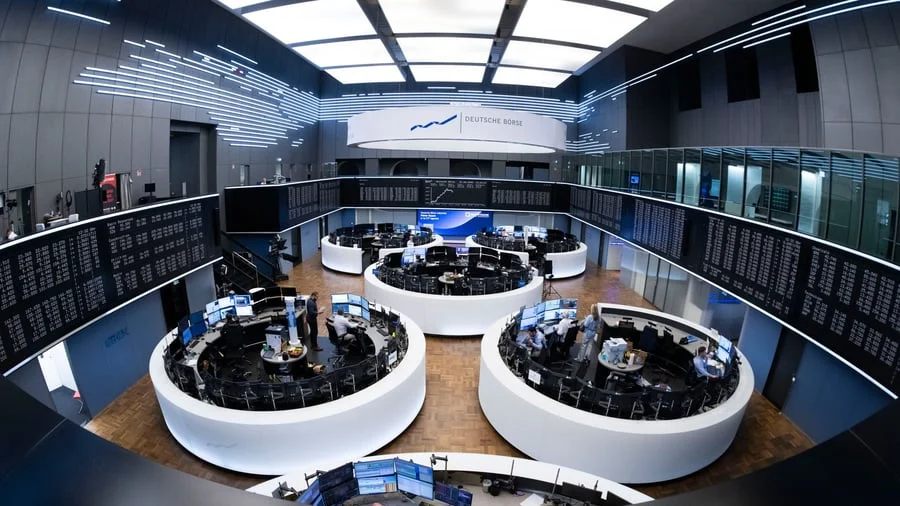
Düsseldorf. In a display of resilient optimism, the German stock market climbed on Tuesday, with the DAX index closing 0.7 percent higher at 15,590 points. This positive momentum follows a solid performance on Monday, where the index gained 0.9 percent to finish at 15,411 points. Despite the gains, market participants remain cautious, trading within a well-defined, multi-week consolidation range. As major global economies brace for pivotal interest rate decisions from the U.S. Federal Reserve (Fed) and the European Central Bank (ECB), investors are looking toward corporate earnings to provide the necessary direction for the market.
Main Facts: A Market in Search of Direction
The current market environment is defined by a "wait-and-see" approach. The German benchmark index has been oscillating within a horizontal trading corridor for several weeks. Market psychology remains consistent: whenever the DAX approaches the 15,500-point threshold, investors engage in profit-taking, curbing further upward momentum. Conversely, whenever the index dips toward the 15,000-point mark, new waves of buyers emerge, providing a "floor" that prevents deeper slides.

This lack of a clear, overarching trend reflects the broader anxiety concerning macroeconomic headwinds. While corporate earnings reports are beginning to paint a picture of operational resilience, the structural concerns regarding energy costs, inflationary pressures, and the potential for a cooling global economy continue to weigh heavily on investor sentiment.
Chronology: A Week of Corporate Disclosures
The current week is critical for the German equity landscape as the third-quarter earnings season shifts into high gear.

- Monday: The market opened with a bullish tone, closing 0.9 percent higher. This set a positive, albeit nervous, stage for the rest of the week as traders anticipated further clarity from the technology sector and central banks.
- Tuesday: The DAX extended its gains, closing up 0.7 percent. The highlight of the day was the influx of data from major industrial and consumer goods players. Specifically, companies like Beiersdorf and the MDax-listed Porsche AG moved into the spotlight, providing investors with tangible metrics on how German industry is weathering current supply chain and cost pressures.
- The Outlook: The remainder of the week promises a deluge of reports from other major DAX-listed firms. Each disclosure is being scrutinized for forward-looking statements that might suggest how management plans to navigate the high-interest-rate environment and the persistent risk of energy-driven inflation.
Supporting Data: The Drivers and Drags of the Market
Market analysts are paying close attention to the divergence between sector performances. While the index as a whole showed strength, not all components fared well.
The Mercedes-Benz Factor
A notable laggard during Tuesday’s session was the Mercedes-Benz stock. Despite the overall positive market sentiment, the automotive giant faced significant selling pressure. This highlights a broader concern regarding the luxury automotive sector, which faces a dual challenge: the transition to electric vehicle (EV) production and a potential slowdown in demand from key markets like China. Investors are wary of the margins these companies can maintain amidst stiff competition and the high capital expenditure required for electrification.
Energy and Inflation: The Macro Constraints
Andreas Lipkow, a prominent market analyst at CMC Markets, notes that the current volatility is not merely a result of individual stock performance but is deeply rooted in the macro-landscape. The "energy cost" narrative continues to be a central theme. While energy prices have stabilized from their historical peaks, they remain elevated compared to pre-crisis levels. This keeps upward pressure on inflation, which in turn limits the room for central banks to maneuver.
"The situation is particularly volatile in the run-up to the upcoming central bank meetings," says Lipkow. The triad of the Federal Reserve, the European Central Bank, and the Bank of Japan are all at a crossroads. Their decisions regarding interest rate trajectories will determine the cost of capital for businesses and the attractiveness of equities versus fixed-income assets.

Official Responses and Expert Commentary
Financial institutions and market analysts remain divided on the short-term trajectory of the German market. Most experts agree that while the "worst-case scenario" (a deep, prolonged recession) currently appears to be avoided, the "Goldilocks" scenario (stable growth with falling inflation) remains elusive.
Institutional investors are reportedly hedging their positions, utilizing derivatives to protect against a potential breakdown of the current trading range. The consensus among analysts is that unless there is a significant upside surprise in corporate earnings—specifically regarding profit margins—the DAX is likely to continue its sideways movement. The earnings reports are not just numbers; they are barometers for the health of German manufacturing, which remains the backbone of the national economy.

Implications: Navigating the "Range-Bound" Future
For Retail Investors
The current "sideways" market requires a disciplined strategy. For the average investor, the persistent range between 15,000 and 15,500 points offers opportunities for "swing trading" but increases the risk of being caught in a false breakout. Experts recommend focusing on companies with strong pricing power—those that can pass on higher costs to consumers without sacrificing volume. Companies like Beiersdorf, with their strong brand portfolio, are often viewed as defensive plays in such environments.
For Institutional Players
Large funds are currently focused on the "pivot" rhetoric from the Federal Reserve. If the Fed signals a pause in interest rate hikes or hints at future cuts, the market could see a significant influx of capital into risk-on assets. However, if the "higher for longer" narrative persists, the valuation of growth-oriented stocks in the DAX could face further downward pressure.

The Broader Economic Impact
The implications of this market phase extend beyond the stock exchange. A stagnant or volatile stock market impacts corporate funding costs. When firms cannot easily raise equity capital, they become more reliant on bank loans, which have become significantly more expensive due to ECB rate hikes. This feedback loop of high interest rates and cautious corporate investment is the primary factor preventing a breakout to new record highs.
Conclusion: The Path Forward
As we look toward the end of the week, the focus will remain squarely on the intersection of monetary policy and corporate health. The DAX is currently a mirror of the global economy: hopeful, yet constrained by the realities of inflation and the potential for a restrictive monetary policy to dampen growth.

Investors should expect continued volatility. The upcoming reports from DAX-listed firms will be the ultimate litmus test. If major players can demonstrate that they have successfully adapted their business models to the "new normal" of high energy costs and shifting consumer behavior, the DAX may finally find the conviction to break out of its current range. Conversely, any widespread disappointment in earnings could force the index to re-test the support levels near 15,000 points.
For now, the German market remains a battleground between the bulls, who see value in the current price levels, and the bears, who are wary of the macroeconomic risks on the horizon. The key, as always, will be the ability of these corporations to deliver earnings that exceed the cautious expectations of a market that has become increasingly adept at pricing in uncertainty.

Summary of Key Market Indicators (End of Trading, Tuesday)
- DAX Index: 15,590 (+0.7%)
- Trading Range: 15,000 – 15,500
- Primary Concerns: Interest rate decisions (Fed/ECB), energy prices, corporate margins
- Key Stocks to Watch: Beiersdorf (Resilient), Mercedes-Benz (Under pressure)
This article is intended for informational purposes only and does not constitute financial advice. Investors are encouraged to consult with professional financial advisors before making investment decisions.