Kyiv, Ukraine – October 20, 2026 – The relentless hum of traffic in Kyiv, once a testament to the city’s vibrant pulse, has taken on a new, anxious rhythm. For weeks, Russia has systematically targeted the vital bridge infrastructure that spans the Dnipro River, the lifeblood of Ukraine’s capital. Residents, once accustomed to the daily ebb and flow of commuters, are now navigating a landscape of perpetual disruption. The once-familiar commute has become a daily test of patience and resilience, as the state of emergency has solidified into a grim, everyday reality.
The scene is a stark illustration of this new normal. Rush hour in Kyiv. Bus route 110, a lifeline connecting the city’s core to its eastern banks, is packed to capacity. Passengers stand shoulder-to-shoulder, a testament to the dwindling options available. For hundreds of thousands, these bridges are the only passage, the only way to traverse the vast expanse of the Dnipro. And for Andriy, a 32-year-old baker, the daily journey is becoming increasingly fraught.
"Packed doesn’t even begin to describe it," Andriy recounts, his voice tinged with weariness. "The buses are simply overflowing. And you’re not guaranteed a seat, or even a spot to stand. This morning, a bus just drove past, full. Didn’t even stop. I was lucky to squeeze onto the second one." This daily struggle for passage is not an isolated incident, but a widespread phenomenon, a direct consequence of Russia’s intensified aerial assault on Kyiv’s critical transport arteries.
A Pattern of Destruction: Escalating Attacks on Infrastructure
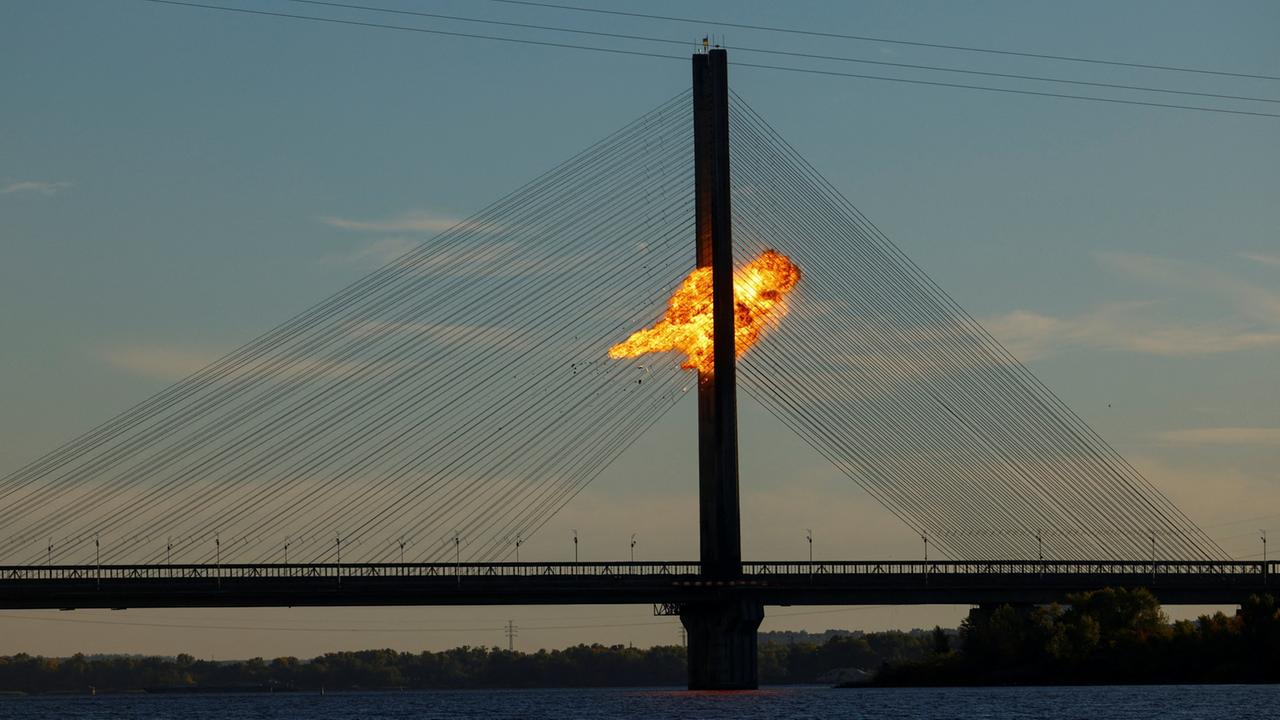
The strategic targeting of bridges is not a new tactic, but in recent weeks, Russia’s focus has sharpened. These assaults are no longer indiscriminate; they are deliberate strikes aimed at crippling Kyiv’s logistical and economic capacity. The timing of these attacks is particularly chilling. In early October, during a visit by German Chancellor Merz, a drone strike impacted the Northern Bridge, a crucial thoroughfare. The immediate aftermath was predictable: traffic rerouted, leading to kilometers of gridlock, snaking through the city and paralyzing movement.
The impact extends beyond road traffic. Metro lines, a vital component of Kyiv’s public transportation, are increasingly experiencing disruptions due to the attacks. This forces an even greater reliance on buses, further exacerbating the already strained public transport system. For residents like Iryna, en route to visit her mother, the constant threat has become a pervasive, psychological burden.
"Fear has become a constant state of being," she shares, her gaze distant. "You just know that something can happen at any moment. People are somehow getting used to it, but it’s not normal. It’s a constant undercurrent of anxiety." This normalization of fear, while a testament to human resilience, is a deeply unsettling indicator of the psychological toll the conflict is exacting on the civilian population.
Beyond Bridges: Russia’s Economic Warfare
The implications of these attacks, according to experts, extend far beyond the immediate disruption of traffic. Dmytro Bespalov, a leading expert in transportation planning and a lecturer at the National University of Civil Engineering and Architecture in Kyiv, posits that Russia’s objectives are multifaceted and deeply rooted in economic warfare.
"Russia is not merely targeting the bridges themselves," Bespalov explains. "With these attacks, Russia is directly targeting the entire Ukrainian economy." He elaborates on the intricate urban planning of Kyiv, highlighting a significant imbalance in the city’s structure. "In Kyiv, there is a substantial disparity between the distribution of the residential population and the available workplaces. Many people live on the left bank of the Dnipro, while the majority of employment opportunities are concentrated on the right bank."
This geographical division makes the bridges indispensable. Any significant disruption to their functionality directly impedes the ability of hundreds of thousands of citizens to reach their workplaces. This, in turn, has a ripple effect on productivity, supply chains, and the overall economic output of the capital. Furthermore, Bespalov points out that a substantial portion of freight transport, crucial for the movement of goods and resources, also relies on these vital river crossings. The sustained attacks, therefore, represent a calculated strategy to undermine Ukraine’s economic resilience.
Assessing the Structural Integrity: Hidden Dangers and Uncertain Futures
The physical damage inflicted by these attacks raises critical questions about the long-term structural integrity of Kyiv’s bridges. While Bespalov acknowledges that a few drone impacts are unlikely to cause immediate collapse, he cautions against underestimating the potential for hidden damage.
"An explosion can cause damage that is not immediately visible to the naked eye," the expert warns. "There can be hidden structural weaknesses that, over time, compromise the bridge’s stability." He emphasizes the need for meticulous monitoring and continuous assessment of the bridges’ performance under load. "Therefore, one must observe how the bridge behaves and whether it functions within its permissible load limits. Only then can it be assessed whether it can continue to be used safely. All of this takes time," Bespalov concludes, underscoring the complexity of assessing and mitigating the damage.
The uncertainty surrounding the bridges’ stability adds another layer of anxiety for commuters and authorities alike. The reliance on these aging structures, some of which were already in need of repair, is now amplified by the constant threat of further damage, potentially rendering them unusable or unsafe for extended periods. This creates a perpetual state of flux, forcing constant rerouting and adaptation.
Resilience in the Cockpit: Bus Drivers as Frontline Navigators
Amidst this widespread disruption, the city’s bus drivers continue their vital work, navigating the altered landscape with a pragmatic determination. Ruslan Kenja, a driver for the beleaguered route 110, takes a brief smoking break, the distant rumble of potential air defense fire a stark reminder of the ever-present danger. For him, the direct impact of the bridge attacks hasn’t drastically altered his daily routine, though the underlying tension is undeniable.
"We just keep working as normal," Ruslan explains, his voice steady. "If the bridge we usually use is closed, we reroute via the Northern Bridge and inform the passengers. And during an air raid alert, we use the loudspeakers to announce the location of the nearest shelter." This adaptability and clear communication are crucial for maintaining some semblance of order and safety for the passengers entrusting their journeys to these drivers.
However, the facade of normalcy is fragile. The true gravity of the situation in Kyiv, particularly in light of the persistent aerial assaults, becomes starkly apparent when Ruslan’s brief respite is interrupted. The sudden crackle of defensive fire echoes through the air, signaling the imminent threat of an incoming drone in the vicinity.
"We’ve gotten used to it in the fifth year of this major war," Ruslan says, a weary resignation in his tone. "You have to continue living somehow. So, we adapt. Even though it’s psychologically difficult, we keep going." This sentiment encapsulates the spirit of many Kyiv residents – a forced adaptation to a brutal reality, a testament to their unwavering will to persevere despite the immense psychological and physical strain.
The New Normal: An Ever-Present State of Emergency
As Ruslan gets back behind the wheel, the bus pulls away, heading back towards the heart of Kyiv. The journey is a microcosm of the city’s current reality: a constant negotiation with disruption, a quiet defiance in the face of relentless aggression. The state of emergency, once a temporary measure, has now become an ingrained part of daily life in Kyiv.
The targeted attacks on bridges are not merely tactical maneuvers; they are a deliberate strategy to erode civilian morale, cripple economic activity, and sow widespread fear. The resilience of the Ukrainian people, however, is proving to be a formidable counterpoint to Russia’s destructive ambitions. While the bridges may be under siege, the spirit of Kyiv, and indeed Ukraine, remains unbroken, finding ways to adapt, to endure, and to continue the essential task of living, even in the shadow of war. The daily commute, fraught with uncertainty and inconvenience, is now a powerful symbol of this enduring spirit. The city, with its damaged arteries, continues to beat, its citizens navigating the challenges with a quiet determination that speaks volumes. The question remains: for how long can these vital connections withstand the sustained onslaught, and what will be the long-term consequences for a nation fighting for its very existence? The answer, like the future of these embattled bridges, remains uncertain.