By Financial News Desk
The financial landscape across the Asia-Pacific region faced a turbulent awakening on Tuesday as a wave of aggressive selling swept through major stock exchanges. Triggered by a combination of cooling sentiment toward American artificial intelligence (AI) giants and growing anxieties regarding elevated valuation levels in the United States, investors scrambled to exit high-growth technology positions. The ripple effects of the Wall Street slump were felt acutely in Japan and South Korea, where key indices saw substantial losses, prompting regulatory interventions and sparking a broader debate about the sustainability of the current global tech rally.
Main Facts: A Synchronized Retreat
The early Tuesday session in Asia was characterized by a broad-based retreat in technology stocks, a sector that had previously served as the primary engine for global market growth. The catalyst for this localized panic was the deteriorating performance of US-listed chipmakers and AI infrastructure providers, which have seen their market caps swell to historic highs over the past eighteen months.
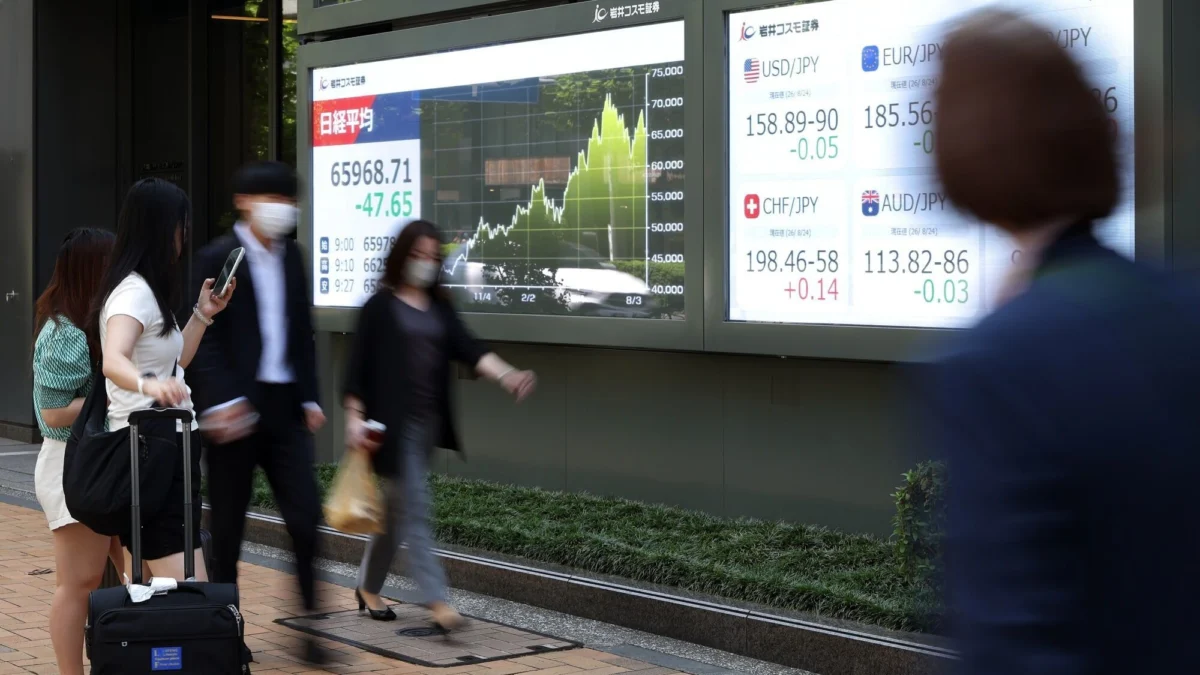
In Tokyo, the Nikkei 225 and the broader Topix index faced significant downward pressure, reflecting the market’s sensitivity to the export-oriented tech sector. Meanwhile, South Korean markets, heavily weighted toward semiconductor giants that form the backbone of the global AI supply chain, bore the brunt of the volatility. The sell-off was not merely a reflection of regional economic data but a direct spillover from the shifting risk appetite of global institutional investors who are increasingly questioning whether the revenue growth of AI-focused companies can justify their current price-to-earnings multiples.
Chronology of the Sell-Off
The morning trading session in Seoul provided a dramatic illustration of the market’s fragility. As sell orders intensified shortly after the opening bell, the velocity of the decline triggered a “Sell-Side-Sidecar” mechanism at 9:48 AM local time.
This specific regulatory tool is designed to stabilize the market without bringing the entire exchange to a standstill. By automatically pausing program-based sell orders for a period of five minutes, the Korea Exchange (KRX) sought to break the momentum of algorithmic trading loops that threatened to exacerbate the downward spiral. The intervention threshold was met after the KOSPI 200 futures contract plummeted by more than five percent within a single minute.
Unlike a “Circuit Breaker,” which forces a complete halt to all trading activity, the sidecar measure allows the underlying spot market to continue operating. This distinction is critical: the goal is to filter out the “noise” created by high-frequency trading (HFT) algorithms, which are often programmed to react instantly to price drops, thereby creating a self-reinforcing panic. By providing a brief window for human traders to re-evaluate the landscape, regulators aimed to inject a measure of rationality into a market gripped by technical liquidation.
Supporting Data and Regional Divergence
While Tokyo and Seoul saw the most dramatic volatility, the sentiment shift was visible across the continent, albeit with varying degrees of intensity:
- Taiwan: The Taiex, a global proxy for the semiconductor industry, experienced a sharp contraction, losing more than two percent at its nadir. The index is particularly vulnerable given its concentration in companies that manufacture the hardware essential for large language models.
- Greater China: The Hang Seng Index in Hong Kong and the Shanghai Composite Index both trended downward, shedding approximately one percent. The weakness here was compounded by existing structural concerns regarding the mainland property sector and consumer demand.
- Singapore: In a notable divergence, the Straits Times Index remained resilient, trading slightly in the green. This suggests that investors were rotating capital away from high-beta, tech-heavy growth markets and into more stable, yield-oriented sectors such as banking and utilities.
The disparity in performance across these markets highlights a significant pivot in investor strategy. As the “AI trade” faces a correction, capital is moving away from speculative assets and toward markets that offer defensive characteristics or are less tethered to the volatility of US tech sentiment.
The KI-Supply Chain Crisis
The severity of the impact in Japan and South Korea is no coincidence. Both nations represent the critical nodes in the global KI-Lieferkette (AI supply chain). From the production of high-bandwidth memory (HBM) chips to advanced lithography equipment, the companies listed on these exchanges are the primary beneficiaries of the current AI infrastructure build-out.
When major US tech firms signal a change in capital expenditure forecasts or when the broader US market experiences a valuation correction, these Asian suppliers are the first to suffer. The market logic is straightforward: if demand for AI chips from US hyperscalers (such as Microsoft, Alphabet, and Meta) is perceived to be cooling, the projected earnings growth for Japanese and South Korean suppliers must be recalibrated downward. This recalibration is currently manifesting as a violent repricing of assets.
Implications for Global Markets
The events of this Tuesday hold profound implications for the global economic outlook:
1. The End of the “Blind” AI Rally
For the better part of two years, the technology sector has benefited from a “rising tide lifts all boats” phenomenon. Investors were willing to overlook high valuations in the hope of future productivity gains. The recent sell-off signals that the market is entering a more discerning phase, where “AI-adjacent” companies must now prove their individual business cases rather than riding the coat-tails of the broader sector’s momentum.
2. The Influence of Algorithmic Trading
The necessity of the Sell-Side-Sidecar in Korea underscores the role of automated trading in modern finance. While these systems provide liquidity during calm periods, they act as force multipliers during volatility. The fact that the market was able to “self-regulate” through a temporary halt suggests that exchanges are becoming more sophisticated in their defense against systemic shocks, but it also serves as a warning to regulators that the speed of modern markets can outpace human oversight.
3. The US-Asia Feedback Loop
The synchronized nature of this sell-off confirms that the Asian tech market is no longer an independent actor. It is inextricably linked to the US financial system. Any shift in Federal Reserve policy, inflation data, or earnings reports from the “Magnificent Seven” in the US will continue to cause seismic shifts in Seoul, Tokyo, and Taipei. Investors must now view their portfolios through a global lens, acknowledging that geographic diversification is less effective when asset classes are highly correlated.
4. Monetary Policy and Inflation
Underlying the panic is the persistent concern over the “high price level” in the US. With inflation remaining sticky and interest rates held at restrictive levels, the cost of capital remains high. For tech firms—which rely on debt to finance massive R&D and capital expenditure projects—this environment is inherently challenging. If the US central bank keeps rates higher for longer, the “discount rate” used to value future earnings will remain elevated, permanently dragging down the valuation of growth-heavy tech stocks.
Conclusion: A Period of Reassessment
As the trading day concludes, the consensus among analysts is that the markets are undergoing a necessary, albeit painful, re-pricing. The volatility seen in Asia is a reflection of a global market coming to terms with the realities of a post-hype AI cycle. While the long-term potential of artificial intelligence remains undisputed, the current market environment demands a more cautious, data-driven approach.
For the coming weeks, volatility is expected to remain high. Investors will be watching US macroeconomic indicators with renewed scrutiny, looking for signs that the worst of the tech sell-off is behind us or if this is merely the beginning of a more profound market correction. For now, the message from Tokyo to Seoul is clear: the era of easy gains driven solely by AI-enthusiasm has hit a significant, structural wall.