By Editorial Staff
October 13, 2026
In the high-stakes, hyper-commercialized world of modern professional football, the SC Freiburg story is often treated as a quaint anomaly—a rustic, humble tale from the Black Forest that doesn’t quite belong at the summit of the elite. Yet, as the league table stands today, five matches into the 2026/2027 season, the "Breisgau-Brasilianer" sit proudly at the top of the Bundesliga.
For years, the Freiburg faithful and the local media have habitually referred to such success as a "momentary snapshot"—a humble disclaimer meant to temper expectations and ward off the inevitable gravity of the sport. However, the data, the tactical evolution, and the club’s structural stability suggest that this is no longer a fleeting moment. It is the new, calculated reality of a club that has mastered the art of sustainable growth.
The Foundation of Excellence: A Decade of Strategic Investment
To understand why SC Freiburg’s current position at the top of the table is not a surprise, one must look at the club’s trajectory over the last ten years. In financial terms, the club’s development mirrors a blue-chip stock: while there have been occasional dips, each correction has been followed by rapid consolidation and a subsequent climb to even greater heights.
The leadership trio of Jochen Saier, Klemens Hartenbach, and Oliver Leki has created an environment of unparalleled institutional stability. This management structure, which famously steered the long-standing era of Christian Streich, has successfully navigated the transition to the post-Streich landscape.
The club’s success is built on three pillars:
- The Football School: An academy that churns out high-caliber talent with remarkable consistency, reducing the need for desperate, high-cost external transfers.
- Financial Prudence: A rare, disciplined approach to budgeting that has seen the club expand its infrastructure—including the state-of-the-art Europa-Park Stadion—without compromising its financial integrity.
- Organizational Continuity: By promoting from within and maintaining a core philosophy, the club has avoided the "rebuilding year" syndrome that plagues so many mid-table clubs.
The Julian Schuster Era: Seamless Continuity and Tactical Evolution
When Julian Schuster was named head coach three years ago, the skepticism was palpable. Replacing Christian Streich, a man who had become synonymous with the club’s identity, was viewed as an impossible task. The "big shoes" metaphor was used in almost every press conference.
However, Schuster did not attempt to replicate Streich; he integrated his own tactical vision while respecting the club’s DNA. The results speak for themselves:
- Season One: Secured European football, proving the transition would not result in a decline.
- Season Two: A masterclass in tournament management, culminating in an appearance in the Europa League final and a DFB-Pokal semi-final.
- Season Three (Current): A dominant start to the Bundesliga campaign, sitting at the summit after five rounds.
Schuster has demonstrated a remarkable ability to adapt. He has maintained the intense, high-pressing identity that Freiburg is known for, while introducing a more refined tactical flexibility that allows the team to control games against superior possession-based opponents.
Chronology: The Road to the Top
The current success is the culmination of a deliberate process. Since the departure of the coaching legend, the path has been one of upward pressure:
- 2023/24: The "Adjustment Period." Schuster stabilizes the squad, focusing on defensive solidity while integrating youth prospects. The team finishes in the top six.
- 2024/25: The "Breakthrough Year." Freiburg becomes a fixture in European competition. The team gains international experience, hardening the squad for high-pressure matches.
- Summer 2026: Strategic recruitment. Unlike previous years where the club was forced to sell, this summer saw the club retain its core while adding targeted depth in the midfield and attack.
- August/September 2026: The current campaign. Five matches, four wins, one draw. Thirteen points from a possible fifteen. The team has scored in every match while maintaining one of the league’s best defensive records.
Statistical Analysis: Why This is Sustainable
Critics often point to "expected goals" (xG) or unsustainable shooting percentages as reasons for a team’s early success. However, Freiburg’s metrics suggest something more permanent.
The team currently ranks in the top three for both distance covered and high-intensity sprints, continuing the traditional "Freiburg way." However, they have also improved significantly in "expected goals against" (xGA), indicating that their defensive structure is not just luck-based, but a product of disciplined, compact defensive organization.
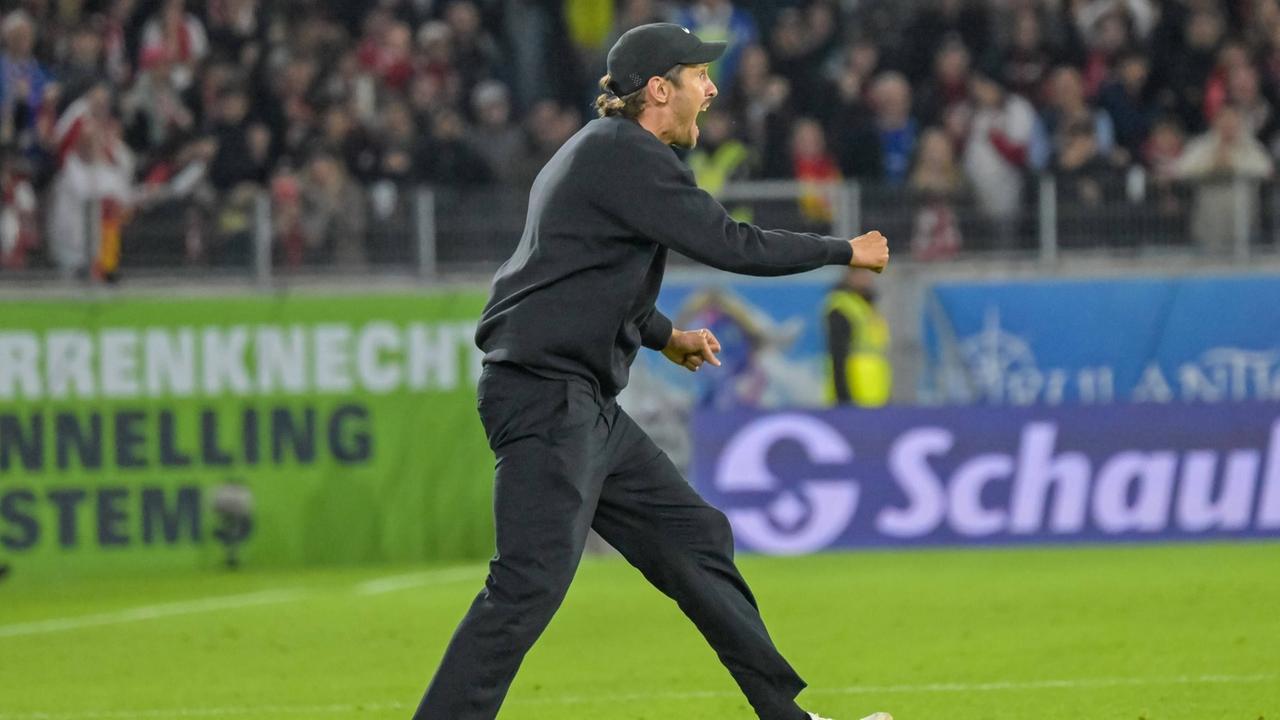
Furthermore, the depth of the squad is at an all-time high. In previous years, an injury to a key player like Vincenzo Grifo or a central defender would cause a tactical collapse. Today, Schuster’s rotation policy ensures that the drop-off between starters and bench players is minimal.
Official Responses and Internal Philosophy
The club’s internal messaging remains characteristically understated. In his most recent press briefing, Julian Schuster deflected praise, focusing instead on the "process."
"We are not looking at the table," Schuster remarked. "The table is a byproduct of the work we do on Monday through Friday. If we start looking at our ranking, we lose focus on the tactical details. My job is to ensure that the intensity remains high, regardless of whether we are first or tenth."
Sporting Director Jochen Saier echoed this sentiment: "We have built a structure here that can survive the highs and lows. We are delighted with the start, but we know the Bundesliga is a marathon. We have the internal culture to remain grounded, and that is our greatest strength."
Implications for the Bundesliga
Freiburg’s rise poses a significant question for the German football establishment. Can a club without the massive commercial backing of a Bayern Munich or the investment capacity of a Bayer Leverkusen sustain a position among the top four?
The answer seems to be yes, provided they can maintain their current model. If Freiburg continues to secure European qualification, the additional revenue will further solidify their ability to retain talent.
Moreover, the "Leicester City Effect"—a comparison often made by romanticists—is becoming increasingly relevant. In 2016, when Leicester City shocked the world, they had 11 points after five games. Freiburg currently sits at 13. While it would be premature to declare them title contenders, the psychological barrier of "aiming for the top" has been shattered. The team no longer plays with the fear of a small club; they play with the confidence of a side that expects to win.
A New Normal in the Breisgau
The argument that this is a "momentary snapshot" no longer holds weight. A snapshot is a blur; this is a sustained, high-definition performance.
The implications for the rest of the league are clear: Freiburg has moved from the category of "difficult opponent" to "championship-level contender." Whether they finish the season with a trophy or a European spot, the narrative has shifted permanently. The club has proven that patience, tactical intelligence, and a refusal to abandon one’s philosophy in favor of short-term fixes is a viable path to the summit of professional football.
As the season progresses, the pressure will mount. There will be defeats—the nature of the sport ensures that even the best teams falter. But in Freiburg, these "outliers" are no longer cause for panic. They are viewed as part of the developmental cycle.
For the fans, the message is simple: enjoy the view from the top. It is not an accident, it is not a dream, and it is certainly not just a moment. It is the result of ten years of hard work, grit, and an unwavering belief in a system that others said could not compete. The Bundesliga has a new, permanent heavyweight, and it is located in the heart of the Black Forest.