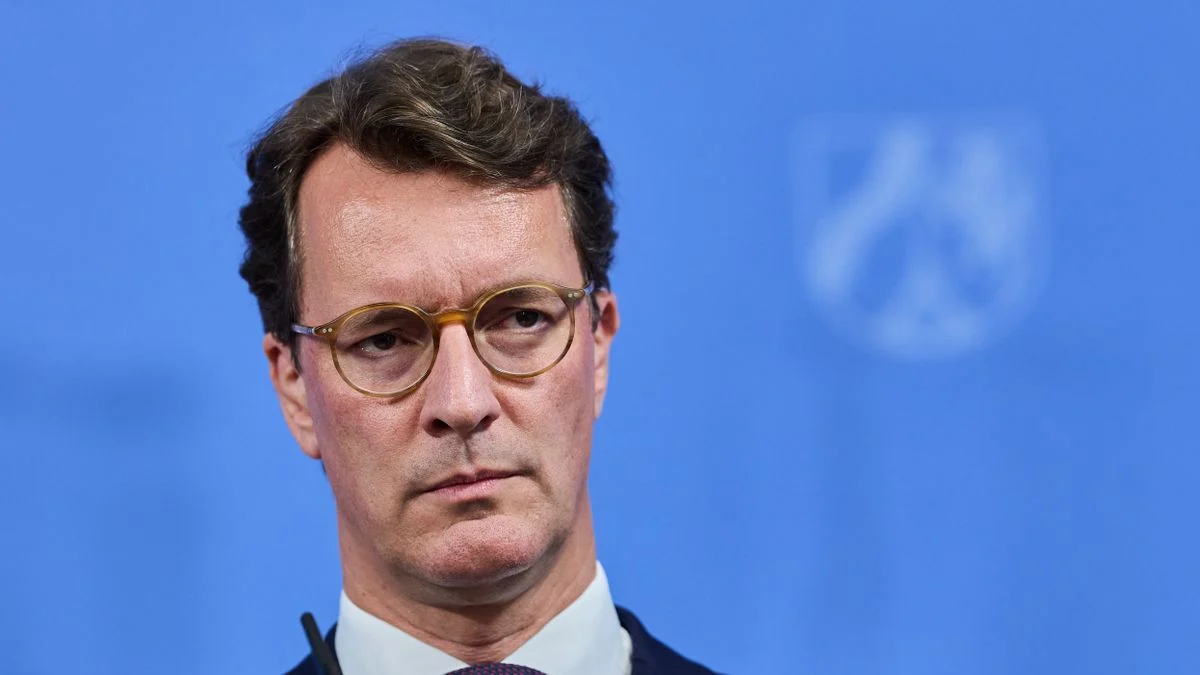
Magdeburg, Germany – The recent election of Tobias Rausch, a politician from the Alternative for Germany (AfD) party, to the esteemed position of Landtag President in Saxony-Anhalt has sent shockwaves across the German political landscape. The controversial vote, which saw Rausch garner support beyond his own party and the Bündnis Sahra Wagenknecht (BSW), has drawn sharp condemnation from mainstream political figures, most notably Nordrhein-Westfalen’s Minister President Hendrik Wüst (CDU). Wüst described the event as a "deep incision in our republic" and a sign that "something has come undone in our country," particularly given the AfD’s classification as a "reliably right-wing extremist" party in the state.
The election of Rausch, who will now preside over the legislative sessions of Saxony-Anhalt’s state parliament, represents a significant challenge to the long-standing "Brandmauer" (firewall) maintained by established parties against the AfD. The mystery surrounding the additional votes Rausch received has fueled intense speculation and accusations, further exacerbating inter-party tensions and raising profound questions about the resilience of democratic norms in Germany.
Main Facts: A Breach in the Firewall
On Tuesday, October 22nd, 2024, Tobias Rausch, an elected representative of the Alternative for Germany (AfD) in Saxony-Anhalt, achieved a surprising victory in the election for Landtag President. The position, akin to a Speaker in other parliamentary systems, is traditionally held by a member of a mainstream democratic party, symbolizing the impartiality and constitutional integrity of the legislative body. Rausch secured the presidency with a number of votes that exceeded the combined strength of the AfD and the newly formed Bündnis Sahra Wagenknecht (BSW) faction, both of whom had publicly declared their support. Specifically, Rausch received four additional votes from an unknown source within the parliament, as the ballot was conducted individually and secretly.
The immediate reaction was one of profound alarm and criticism, particularly from the Christian Democratic Union (CDU), Germany’s largest conservative party. Hendrik Wüst, a prominent CDU figure and the Minister President of Nordrhein-Westfalen, Germany’s most populous state, wasted no time in articulating his severe disapproval. Wüst did not mince words, labeling the incident a "deep incision in our republic" and emphasizing the parliament’s role as the "heart chamber of our democracy." His gravest concern stemmed from the fact that this "heart chamber" would now be led by a member of a party officially designated as "reliably right-wing extremist" by the state’s domestic intelligence agency, the Verfassungsschutz.
Wüst’s critique extended beyond the immediate event, serving as a stark warning against the "normalization of extremist thought patterns" within German parliamentary institutions. He demanded "clarity and unity in action" from his fellow Christian Democrats, reaffirming the CDU’s commitment to "oppose the AfD and its radical positions with all our might." Simultaneously, Wüst stressed the crucial need for the CDU to redouble its efforts to reclaim voters for the political center, acknowledging the underlying challenge that has contributed to the AfD’s rise.
The Saxony-Anhalt CDU swiftly and vehemently denied any involvement in providing the additional votes for Rausch, attempting to distance itself from the controversy. However, Rausch himself complicated matters by asserting that he had been in communication with CDU parliamentarians who had assured him of their support, directly contradicting the party’s official stance and deepening the mystery surrounding the secret ballot. This direct contradiction highlights the internal pressures and potential fissures within mainstream parties as they grapple with the growing influence of the AfD.
Chronology of Events: A Week of Political Upheaval
The election of Tobias Rausch did not occur in a vacuum but was the culmination of a tense political atmosphere, particularly pronounced in eastern German states where the AfD enjoys significant electoral success. The timeline of events underscores the escalating challenges faced by mainstream parties in upholding democratic norms against the backdrop of an increasingly fragmented political landscape.
Pre-Election Dynamics:
For several months leading up to the Landtag President election, the political discourse in Saxony-Anhalt, like many other federal states, had been dominated by the AfD’s persistent attempts to gain legitimacy and influence within parliamentary structures. The party, which emerged as the second-strongest force in the last state election, has consistently sought to occupy key parliamentary positions, often testing the resolve of other parties to maintain their "Brandmauer." The position of Landtag President, typically a consensual choice representing the entire parliament, became a battleground. Mainstream parties, including the CDU, SPD, FDP, and Greens, generally uphold a principle of not supporting AfD candidates for such high offices, fearing that it would lend undue legitimacy to a party classified as extremist.
The AfD’s strategy involves nominating its own candidates for these roles, knowing they are unlikely to secure broad support, but using the subsequent rejections to paint themselves as victims of a "system" or "establishment" that supposedly suppresses democratic choice. However, the emergence of the Bündnis Sahra Wagenknecht (BSW), a new left-wing populist party, added a new variable to this equation. The BSW, while ostensibly on the left of the political spectrum, has shown a willingness to cooperate with the AfD on certain procedural votes, often driven by a shared anti-establishment sentiment or tactical considerations. Ahead of the vote, both the AfD and BSW publicly indicated their intention to support Rausch, signaling a potential bloc that, while substantial, was still short of an absolute majority.
The Election Day: Tuesday, October 22nd, 2024:
The election itself unfolded in the Landtag chamber in Magdeburg. The procedure for electing the Landtag President involves a secret ballot, a fundamental aspect of parliamentary democracy designed to protect individual members from external pressure and allow them to vote according to their conscience. This secrecy, however, became the focal point of the subsequent controversy.
Tobias Rausch was put forward as the AfD’s candidate. After the ballots were cast and counted, it was announced that Rausch had secured the necessary majority to be elected Landtag President. The critical detail was the vote count: Rausch received a number of votes that clearly surpassed the combined total of AfD and BSW parliamentarians. This meant that at least four additional votes must have come from members of other factions, ostensibly those committed to the "Brandmauer." The secrecy of the ballot meant that the origin of these four votes could not be definitively identified, immediately creating a cloud of suspicion and distrust.
Immediate Aftermath and Public Statements:
The news of Rausch’s election and the mystery surrounding the extra votes quickly spread, triggering a wave of condemnation. The Saxony-Anhalt CDU was among the first to react, issuing a strong denial that any of its members had cast their vote for the AfD candidate. Party leaders emphasized their commitment to the anti-AfD consensus and launched internal inquiries to ascertain if any of their members had broken ranks.
However, the situation was further complicated by Tobias Rausch’s own statements. Far from denying the existence of cross-party support, Rausch publicly claimed to have been in contact with CDU parliamentarians who had privately assured him of their votes. This direct contradiction between Rausch’s assertion and the CDU’s official denial threw the state parliament into disarray, fueling accusations of hypocrisy and a breakdown of internal discipline within the CDU.
Hours after the election, Hendrik Wüst, speaking from Nordrhein-Westfalen, delivered his scathing criticism, setting the tone for a broader national debate. His powerful rhetoric, warning of a "deep incision" and the "normalization of extremist thought," underscored the gravity with which mainstream leaders view any breach of the anti-AfD consensus. Wüst’s intervention elevated the regional incident to a matter of national democratic integrity, signaling that the implications of this election would resonate far beyond the borders of Saxony-Anhalt.
Supporting Data and Context: The Fabric of German Democracy Under Strain
To fully grasp the significance of Tobias Rausch’s election, it is crucial to understand the foundational principles of German parliamentary democracy, the specific context of the AfD’s political identity, and the broader challenges facing the country’s political center.
The Office of Landtag President: Guardian of Democracy:
The Landtag President, or Speaker of a state parliament, is more than just a procedural figurehead. It is the second-highest office in a federal state, succeeding the Minister President in certain functions and representing the parliament both domestically and internationally. The President is responsible for conducting parliamentary sessions, upholding rules of procedure, ensuring decorum, and protecting the rights of all members. Crucially, the office demands strict impartiality, acting as a neutral arbiter above partisan divides. The President embodies the dignity and integrity of the legislative body, serving as a symbol of democratic order and constitutional adherence. For this reason, the election of a figure from a party widely seen as hostile to core democratic values is perceived as a direct assault on these principles.
The AfD’s "Right-Wing Extremist" Classification:
Central to the controversy is the classification of the AfD’s state branch in Saxony-Anhalt as "gesichert rechtsextremistisch" (reliably right-wing extremist) by the Verfassungsschutz, the state’s intelligence agency responsible for protecting the constitutional order. This designation is not made lightly; it is based on extensive evidence, including speeches, publications, and actions of party members, which demonstrate an ideology incompatible with fundamental democratic principles enshrined in Germany’s Basic Law. Such a classification allows the Verfassungsschutz to employ enhanced surveillance measures, including the use of informants, to monitor the party’s activities. While the national AfD is currently classified as a "Verdachtsfall" (suspected case) for right-wing extremism, the Saxony-Anhalt branch, along with those in Thuringia and Saxony, has already crossed the threshold into the "reliably extremist" category. This means that, according to state authorities, the party’s aims and actions actively seek to undermine or abolish the liberal democratic order. To elect a representative of such a party to a position that safeguards this very order is, for critics, a profound contradiction and a dangerous step towards legitimizing anti-democratic forces.
The Political Landscape of Saxony-Anhalt:
Saxony-Anhalt, located in former East Germany, has been a fertile ground for the AfD. In the 2021 state election, the AfD emerged as the second-strongest party, securing 20.8% of the vote and 23 seats in the 97-seat Landtag. The state is currently governed by a "Kenya coalition" comprising the CDU, SPD, and FDP. The AfD’s significant presence means that it is a powerful opposition force, but also that its candidates for leadership positions are almost always rejected by the other parties. This creates a recurring dynamic of confrontation and often, as in this case, unexpected outcomes. The BSW, which entered the Bundestag at the federal level in 2024 and is eyeing state elections, represents a new populist force. While originating from the left, its anti-establishment rhetoric and positions on issues like migration and foreign policy often find common ground with the AfD, leading to tactical alliances in parliamentary votes, as seen in Rausch’s election.
The "Brandmauer" and its Erosion:
The concept of the "Brandmauer" – a political firewall – refers to the broad consensus among Germany’s established democratic parties (CDU/CSU, SPD, FDP, Greens, Left Party) to refuse any form of cooperation or coalition with the AfD. This principle was established to protect Germany’s post-war democratic order from the resurgence of extremist ideologies, drawing lessons from the Weimar Republic’s collapse. The "Brandmauer" is meant to isolate the AfD and prevent its mainstreaming. However, it has faced increasing pressure, particularly in eastern states where the AfD is strongest. Previous incidents, such as the 2020 "Dammbruch" (breach of the dam) in Thuringia, where an FDP Minister President was elected with AfD votes, demonstrated the fragility of this firewall and the potential for internal dissent or strategic miscalculations to undermine it. Rausch’s election, particularly the anonymous cross-party votes, represents another significant crack in this firewall, revealing that the commitment to non-cooperation is not universally held or enforceable in secret ballots.
The CDU’s Internal Dilemma:
Hendrik Wüst’s strong words highlight a critical internal struggle within the CDU. While the party’s national leadership unequivocally rejects cooperation with the AfD, local and state branches, especially in the East, face immense pressure from voters who are increasingly turning to the AfD. There is a constant tension between upholding democratic principles and the pragmatic goal of winning elections. Wüst’s call for "clarity and unity" within the CDU underscores the concern that some members might be tempted to break ranks, either out of frustration, tactical calculation, or a misguided attempt to appeal to AfD voters. The accusation by Tobias Rausch that CDU members had promised him votes adds fuel to this internal fire, forcing the party to confront potential insubordination or ideological drift within its ranks. The challenge for the CDU is to defend the democratic center while also offering compelling solutions that can win back disillusioned voters, thereby addressing the root causes of the AfD’s appeal.
Official Responses: A Chorus of Condemnation and Disavowal
The election of Tobias Rausch has prompted a flurry of official responses, predominantly characterized by condemnation and disavowal from mainstream parties, while the AfD has sought to legitimize the outcome.
Hendrik Wüst (CDU, Minister President of Nordrhein-Westfalen):
Wüst’s reaction was perhaps the most forceful and widely reported. As a leading figure within the CDU and a potential future candidate for Chancellor, his words carry significant weight. He framed the event not merely as a regional political spat but as a fundamental threat to the core tenets of German democracy. His reference to the parliament as the "heart chamber of our democracy" underscored the sanctity of the institution, arguing that its leadership by an individual from a "reliably right-wing extremist party" was an unacceptable affront. Wüst’s alarm was palpable when he stated, "something has come undone in our country," reflecting a deep-seated fear that the foundations of the post-war democratic consensus are eroding. His demand for "no normalization of extremist thought patterns" served as a clear directive to all democratic parties to maintain a firm stance against the AfD. He further called for "clarity and unity in action" from his own party, implicitly acknowledging the internal challenges the CDU faces in enforcing its "Brandmauer" policy. Wüst concluded by expressing "considerable doubts" that Rausch, given his party affiliation, could genuinely fulfill his promise to lead the Landtag impartially, highlighting the inherent contradiction of an extremist leading a neutral democratic body.
Saxony-Anhalt CDU:
Immediately following the announcement of Rausch’s victory, the CDU faction in the Saxony-Anhalt Landtag moved quickly to issue a categorical denial. They vehemently rejected any suggestion that their members had provided the additional votes for Rausch. This denial was crucial for the party, as any admission or confirmed breach would not only contradict the national party line but also risk severe internal disciplinary action and public backlash. The state party leadership emphasized its unwavering commitment to the "Brandmauer" and the principle of non-cooperation with the AfD. However, the secrecy of the ballot and Rausch’s counter-claims leave their denial open to skepticism, placing the Saxony-Anhalt CDU in a difficult position of having to prove a negative. Internal investigations are likely to follow, though proving who cast which secret ballot is notoriously difficult.
Tobias Rausch (AfD, Newly Elected Landtag President):
In stark contrast to the condemnation, Tobias Rausch embraced his victory, using the opportunity to push back against the "Brandmauer" narrative. He asserted his intention to lead the Landtag in an "impartial" and "non-partisan" manner, a promise that Wüst and others view with deep skepticism given his party’s extremist classification. More controversially, Rausch directly contradicted the CDU’s denials by claiming that he had been in "exchange" with CDU parliamentarians who had "assured him of their votes." This statement was a calculated move, designed to expose perceived hypocrisy within the CDU, sow discord among mainstream parties, and legitimize his election by suggesting cross-party acceptance. It also aligns with the AfD’s broader strategy of portraying themselves as a legitimate political force unfairly ostracized by the "establishment."
Other Parties (SPD, Greens, FDP, BSW):
While not explicitly detailed in the original text, it is highly probable that other mainstream parties in Saxony-Anhalt and at the federal level would have issued similar condemnations. The Social Democratic Party (SPD) and the Greens, traditional allies against right-wing extremism, would likely have echoed Wüst’s concerns about the normalization of extremist forces and the erosion of democratic norms. The Free Democratic Party (FDP), despite its own past "Dammbruch" incident in Thuringia, would also be expected to reaffirm its commitment to the "Brandmauer." The Bündnis Sahra Wagenknecht (BSW), having explicitly supported Rausch, would likely defend their vote as a legitimate exercise of parliamentary procedure, possibly criticizing the "Brandmauer" as anti-democratic or discriminatory, thereby aligning with the AfD’s narrative of being unfairly excluded.
Implications: A Fragile Future for German Democracy
The election of Tobias Rausch as Landtag President in Saxony-Anhalt carries far-reaching implications for German democracy, inter-party relations, and the ongoing struggle against political extremism. It represents not just a regional incident but a potent symbol of deeper systemic challenges.
Erosion of Democratic Norms and Trust:
The most significant implication is the potential erosion of democratic norms. The office of Landtag President demands unwavering impartiality and a commitment to the constitutional order. Placing an individual from a "reliably right-wing extremist" party in such a role risks normalizing extremism and undermining the very principles the office is meant to uphold. It sends a dangerous signal that even those deemed hostile to the Basic Law can legitimately hold positions of democratic authority. This could, in turn, diminish public trust in democratic institutions, as citizens may perceive that the established parties are either unable or unwilling to effectively defend the democratic consensus. Wüst’s statement about "something coming undone" encapsulates this fear of a gradual, but fundamental, weakening of democratic resolve.
Challenges to the "Brandmauer":
The incident delivers a severe blow to the "Brandmauer" strategy. While mainstream parties maintain a public stance of non-cooperation with the AfD, the secret ballot for Rausch reveals that this firewall is permeable, at least in practice and under certain circumstances. The mystery surrounding the additional votes highlights the difficulty of enforcing a rigid "Brandmauer" when individual parliamentarians can vote according to their own convictions, or even tactical considerations, without immediate accountability. This breach will undoubtedly embolden the AfD, providing them with evidence that their ostracization is not absolute and that some members of other parties are willing to engage with them. It also puts immense pressure on mainstream parties to re-evaluate how they can effectively maintain the firewall, especially in future secret ballots for key positions.
CDU’s Strategic Dilemma and Internal Unity:
For the CDU, Wüst’s strong condemnation and call for unity underscore a profound strategic dilemma. On one hand, the party must uphold its commitment to democratic values and firmly oppose the AfD’s extremist tendencies. On the other hand, it faces the practical challenge of winning back voters from the AfD, particularly in the East. Some within the party might argue for a more pragmatic approach, believing that outright rejection only alienates voters further. However, Wüst’s message is clear: there can be no compromise on fundamental democratic principles. Rausch’s claims of CDU support will likely trigger internal investigations and heighten tensions within the party, potentially exposing ideological divisions between its more conservative and liberal wings, and between federal and state branches. The incident forces the CDU to confront its own internal discipline and the effectiveness of its messaging in defending the "Mitte" (center ground).
Future Parliamentary Confrontations:
Wüst’s prediction that Rausch’s election "will not have been the last tension test in the parliamentary confrontation with the extreme fringes, right as well as left," points to a future of increased political instability. As the AfD continues to gain strength in state and potentially federal elections, it will increasingly challenge the established order by nominating candidates for various parliamentary leadership roles. Each such nomination will become a test of the "Brandmauer," forcing mainstream parties to navigate between maintaining their principled stance and avoiding accusations of blocking democratic processes. The involvement of the BSW, willing to cooperate with the AfD on procedural matters, further complicates this dynamic, creating new, unpredictable alliances that can circumvent traditional political blocs.
Impact on Public Perception and International Image:
The incident also carries implications for Germany’s public perception and international image. Germany, as a beacon of post-war democracy and a staunch defender of constitutional values, has historically taken a firm stance against extremism. The election of an AfD member to a high parliamentary office, particularly one classified as "reliably right-wing extremist," risks tarnishing this image. Internationally, it could be seen as a sign of growing vulnerability to populist and extremist forces, raising concerns about the stability of Europe’s largest economy and its commitment to democratic principles. Domestically, it may further polarize society, deepening the divide between those who see the AfD as a legitimate opposition and those who view it as an existential threat to democracy.
In conclusion, the election of Tobias Rausch is far more than a local political squabble. It is a critical juncture that exposes the fragility of the "Brandmauer," the internal struggles of mainstream parties, and the persistent challenge of safeguarding democratic institutions against the rise of extremist forces. The coming months will reveal whether this "deep incision" can be healed, or if it marks a further step in the gradual unraveling of Germany’s cherished democratic consensus.