By Sports Desk | October 27, 2026
In a high-stakes DFB-Pokal showdown at the iconic Volksparkstadion, Eintracht Frankfurt secured their passage into the round of 16 with a 3-1 victory over the Hamburger SV. While the scoreline suggests a dominant performance by the visitors, the reality on the pitch was far more nuanced. Frankfurt proved to be the masters of clinical efficiency, ruthlessly punishing a Hamburg side that repeatedly failed to convert their dominance into tangible rewards.
The victory, sealed by goals from Robin Koch, Jonathan Burkardt, and Younes Ebnoutalib, sets up an intriguing narrative for the upcoming league rematch between these two sides. For Hamburg, the night will be remembered as a masterclass in squandered potential, a "chancenwucher" (waste of opportunities) that ultimately cost them their place in the domestic cup competition.
The Strategic Landscape: A Tactical Tug-of-War
From the opening whistle, it was evident that both managers had prepared for an aggressive, high-pressing encounter. The match was characterized by a rapid tempo, with both teams refusing to sit back, opting instead to exploit the transitional spaces in the midfield.
Hamburg, backed by a vocal home crowd, initially looked the more dangerous side. Their tactical setup allowed for quick transitions, consistently testing the Frankfurter backline. Frankfurt, meanwhile, remained patient, relying on their superior defensive structure and the individual brilliance of their attacking trio to turn the tide. The contrast in styles—Hamburg’s frantic urgency versus Frankfurt’s methodical composure—would define the evening’s proceedings.
Chronology: A Tale of Two Halves
The First Half: Hamburg’s Frustration
The early exchanges saw both teams feeling each other out, but the first significant warning signs came from the hosts. Around the 20-minute mark, the HSV attack began to click. Sambi Lokonga delivered a precise long ball to Terem Moffi, who found himself in a one-on-one situation with Eintracht keeper Noah Atubolu. It took a heroic, last-ditch slide tackle from Jeremiaha Maluze to deny what seemed like a certain opening goal.
Moments later, the momentum remained with the "Rothosen." Zakaria El Ouahdi exploited space on the right flank, forcing Atubolu into a sharp save. As Hamburg continued to press, Lokonga found Albert Grönbaek with a clever through-ball, but the midfielder narrowly missed the post.
Frankfurt, however, proved they were dangerous on the counter. Shortly before the half-hour mark, a defensive lapse by Hamburg’s Shafiq Nandja allowed Jonathan Burkardt to break free. Only a desperate block by Sebastiaan Bornauw prevented an early deficit. As the half neared its conclusion, the controversy of the night emerged: Robin Koch appeared to foul El Ouahdi inside the box. Referee Tobias Stieler waved play on, and the VAR team opted against intervention, leaving the Hamburger faithful—and their bench—incensed as the teams headed to the locker rooms locked at 0-0.
The Second Half: The Frankfurt Response
The second half began with immediate consequences for Hamburg’s first-half profligacy. In the 56th minute, Can Uzun found himself with time and space at the edge of the penalty area. His whipped-in cross was expertly guided by Burkardt into the path of Robin Koch, who tapped home from close range to break the deadlock.
The goal acted as a wake-up call for the hosts, who responded with an aggressive barrage of attacks. Terem Moffi, clearly frustrated by his earlier misses, had a golden opportunity to equalize following a corner kick. The entire Frankfurt defense and goalkeeper Atubolu were caught out of position, yet Moffi’s header sailed agonizingly wide.
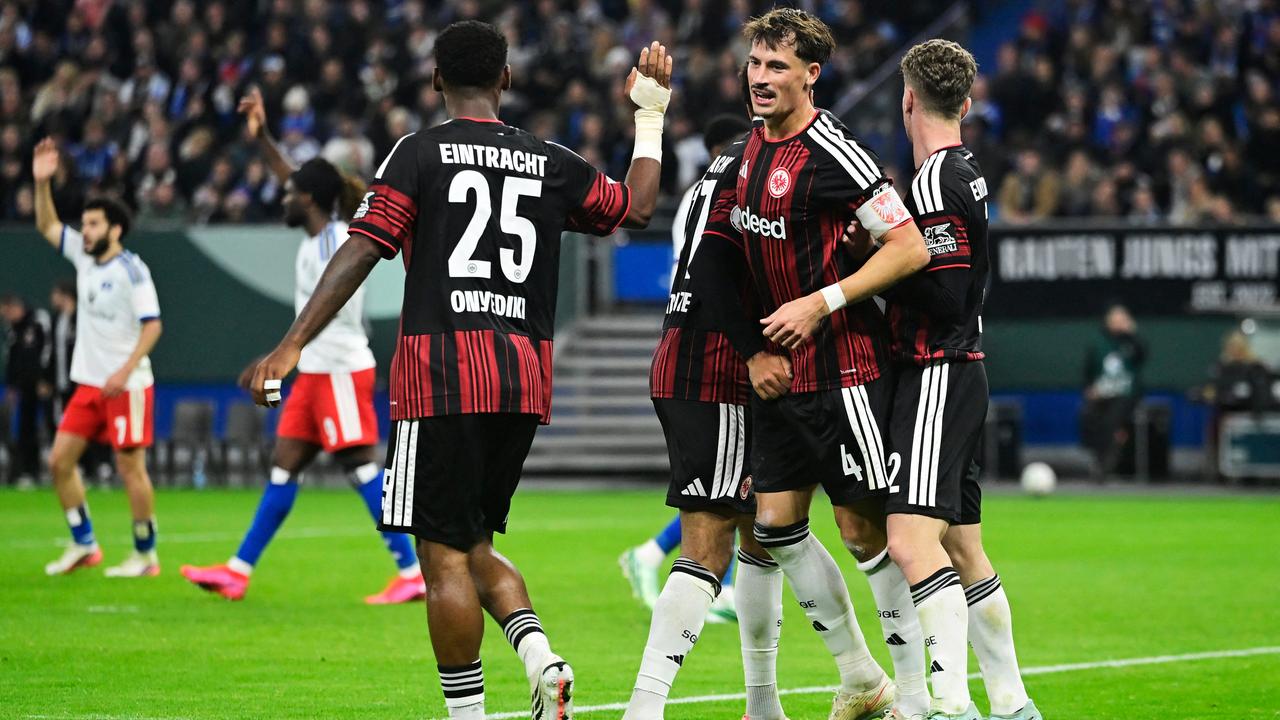
The turning point came in the 71st minute. Against the run of play, Frankfurt extended their lead. A long, lofted ball into the box caught Shafiq Nandja off guard, and Jonathan Burkardt was there to capitalize on the error, clinical as ever. The final nail in the coffin arrived in the 75th minute when substitute Younes Ebnoutalib added a third. While Terem Moffi finally found the back of the net in the 79th minute to give the home side a glimmer of hope, it was too little, too late.
Statistical Breakdown: The Anatomy of a Defeat
To understand why Hamburg fell despite their aggressive start, one must look at the underlying metrics of the match:
- Conversion Rate: Frankfurt maintained an exceptionally high conversion rate, scoring three times from limited high-quality chances. Hamburg, conversely, struggled with their "xG" (Expected Goals), failing to convert at least three clear-cut opportunities that would have altered the trajectory of the game.
- Defensive Errors: The game was ultimately decided by individual defensive lapses. The error by Shafiq Nandja leading to the second goal highlighted the difference in pressure management between the two sides.
- Goalkeeping Performance: With Sander Tangvik starting for Hamburg in place of Daniel Heuer Fernandes, there were questions regarding communication in the backline. While Tangvik made some notable saves, the lack of coordination on set-pieces ultimately proved costly.
Official Responses and Post-Match Analysis
In the post-match press conference, the sentiment from the Hamburg camp was one of collective dejection. "We played the football we wanted to play," noted the HSV coach. "We created the chances that should have put this game to bed by halftime. But at this level, if you don’t take your chances, you get punished. We were punished by a very efficient opponent today."
Frankfurt manager, while pleased with the result, acknowledged the fortune involved in the refereeing decision. "The penalty call could have gone either way. We were lucky there, certainly. But I believe our team showed the maturity required to survive a difficult phase in the second half and execute our plan when the space opened up."
Experts have pointed to the experience of Frankfurt’s backline as the key factor. Players like Robin Koch were instrumental not just in their defensive duties but in providing the composure needed to absorb Hamburg’s high-pressure waves.
Implications: The Road Ahead
This result has immediate and long-term implications for both clubs. For Eintracht Frankfurt, the victory serves as a massive morale booster as they progress deeper into the DFB-Pokal. It reaffirms their status as a team that can perform under the pressure of knockout football.
For Hamburg, the focus must shift immediately to the league. The scheduling gods have provided a peculiar twist: the two teams meet again this coming Sunday at 17:30 in Frankfurt. The "Rothosen" have the rare opportunity for immediate revenge, but they must address their finishing woes if they are to secure vital Bundesliga points.
Furthermore, the loss raises questions about the psychological impact of such a defeat. Will the missed chances in the cup lead to a lack of confidence, or will the "almost" performance serve as motivation? The rematch in Frankfurt will be a barometer for the current state of both squads.
Conclusion
The DFB-Pokal is often described as the great equalizer, a competition where the underdog can rise and the giants can stumble. However, tonight in Hamburg, it was the triumph of clinical professionalism over raw ambition. Eintracht Frankfurt did not need to be the better side for 90 minutes; they only needed to be the more efficient one.
As the dust settles on the Volksparkstadion, the narrative is clear: in football, dominance is a transient state, but goals are the currency that matters. Frankfurt leaves for home with their cup dreams intact, while Hamburg is left to contemplate the fine margins of the sport—the inches that separate a hero from a spectator. All eyes now turn to Sunday, where the cycle of competition begins anew.