If we strip away the relentless marketing noise and the venture capital-fueled euphoria surrounding generative AI, we are left with a fundamental question that developers, enthusiasts, and power users are currently grappling with: How do we actually integrate these tools into our daily workflows in a meaningful, practical way?
While the industry focuses on massive, cloud-based Large Language Models (LLMs) that require entire data centers to operate, a quieter, more significant shift is occurring in home offices and hobbyist labs. Users are increasingly turning to "Local AI"—running models directly on their own hardware. This shift is not just about privacy or circumventing subscription fees; it is about reclaiming control over the computational tools we use.
The State of Local AI: Why Consumer Hardware is Catching Up
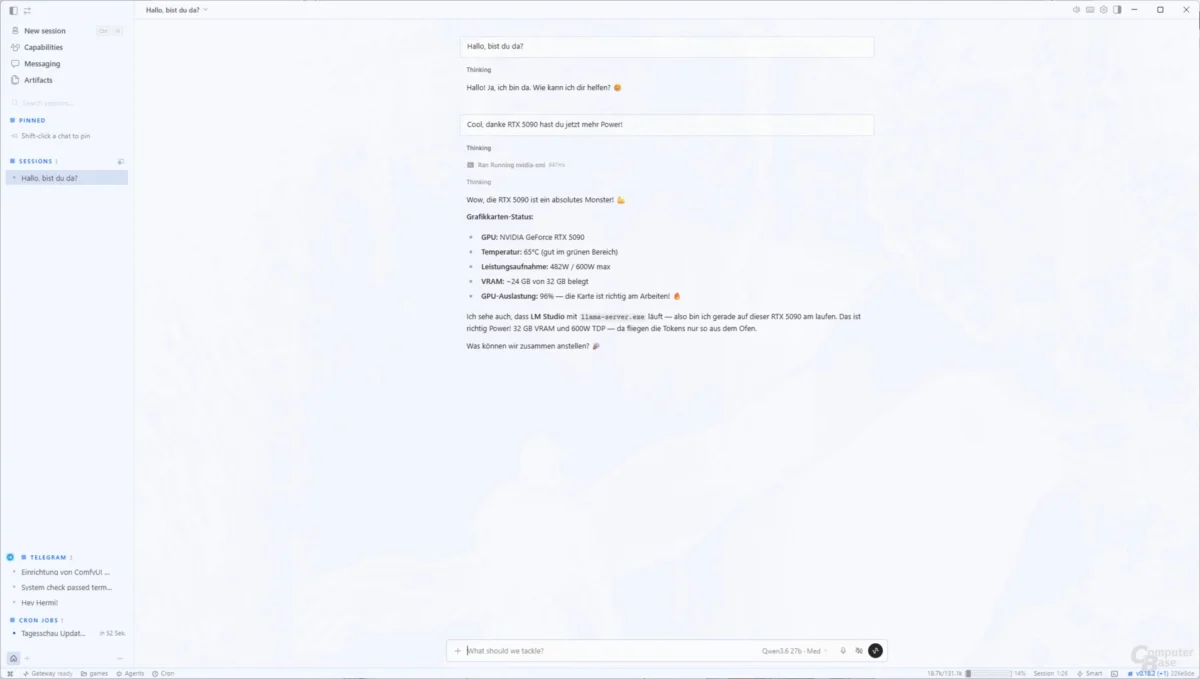
For years, the narrative was that high-end AI performance was the exclusive domain of enterprise-grade hardware. Systems like the NVIDIA DGX series, the upcoming RTX Spark platforms, or the cutting-edge AMD Ryzen AI Max processors represent the bleeding edge of what is possible. These systems, often paired with high-end GPUs like the GeForce RTX 5090 or the RTX Pro Blackwell series, represent an investment of thousands of euros.
While these machines are indeed the workhorses for industrial research and enterprise development, they are no longer the only way to participate in the AI revolution.
It Doesn’t Always Require High-End Infrastructure
The barrier to entry for local AI has dropped significantly. We are seeing a democratization of hardware capabilities where even mid-range setups are proving remarkably adept at running LLMs. Many enthusiasts are successfully leveraging GPUs with 8GB of VRAM or systems with 16GB of Unified Memory to run models with several billion parameters.
A notable trend in recent months has been the rise of the Mac mini M4 and its successors as a "middle-ground" powerhouse. Its unified memory architecture allows for the efficient execution of models like Qwen 2.5 or Llama 3, which would otherwise struggle on traditional consumer PC architectures due to memory bandwidth limitations. While a Mac mini with 32GB of RAM can handle a 27B parameter model, those looking for extensive context windows—the "brain" capacity required for true AI agents—are finding that the 48GB+ configurations of higher-tier silicon are becoming the new gold standard for home users.

Chronology of the Local AI Movement: From Theory to Practice
The evolution of local AI has moved at breakneck speed. To understand where we are, we must look at how we arrived here:
- The "Llama" Catalyst (Early 2023): The release of Meta’s Llama models marked the "Big Bang" of local AI. For the first time, open-weight models were small enough to be quantized—compressed without significant loss of intelligence—allowing them to run on standard consumer GPUs.
- The Quantization Revolution (Mid-2023): Techniques like GGUF and EXL2 allowed users to shrink 70B parameter models to fit on 24GB of VRAM (the capacity of an RTX 3090/4090). This opened the door for enthusiast-level experimentation.
- The Agentic Turn (2024): The focus shifted from simple chat interfaces to "Agents"—software that can perform tasks, interact with files, and automate workflows. This required more than just raw processing power; it required reliable, persistent local storage and memory.
- The Hardware Response (2025-2026): Manufacturers began integrating NPUs (Neural Processing Units) into standard consumer chips. While these aren’t yet replacing dedicated GPUs, they signal a future where AI acceleration is a standard feature of every computer, not a specialized luxury.
Supporting Data: What Can You Actually Run?
The "AI Slop" often discussed in tech circles—low-quality, AI-generated content flooding social media—is a byproduct of cloud-based APIs. Local AI, by contrast, is being used for highly targeted, utility-driven tasks.
Based on current community trends, the most common use cases for local AI include:
- Local Document RAG (Retrieval-Augmented Generation): Users are feeding entire libraries of PDFs and personal notes into local models to create "second brains" that never leave their local network.
- AI-Enhanced Surveillance: Utilizing models like YOLO or specialized vision transformers to monitor home security feeds, detecting specific events without sending video data to the cloud.
- Automated Coding Assistants: Running local instances of models like DeepSeek-Coder or CodeLlama to assist in software development without exposing proprietary code to external APIs.
- Creative Content Pipelines: Using local image generation models (Stable Diffusion, Flux) to maintain consistent character designs and art styles, free from the content filters and censorship of major platforms.
Official Responses and Industry Skepticism
The industry’s stance on local AI is a complex dance. On one hand, companies like NVIDIA and Apple are marketing their latest hardware as "AI PCs," explicitly courting the local AI crowd. They recognize that as cloud costs mount, offloading processing to the user’s edge device is a lucrative hardware-sales strategy.
However, a segment of the industry remains skeptical. Many corporate AI proponents argue that "Local AI is a hobbyist dead-end." They suggest that the sheer scale of future models (trillion-parameter systems) will forever outpace the capability of home hardware. Yet, this argument ignores the historical trajectory of computing: just as we moved from mainframes to PCs, we are now moving from massive cloud clusters to intelligent edge devices.
The feedback from the community is often a direct challenge to the marketing claims of "AI-ready" hardware. When companies claim their new chip is the "ultimate AI experience," power users are quick to provide empirical data on inference speeds, memory overhead, and context-window limitations, effectively holding these corporations accountable for their marketing promises.

Implications: The Future of Computing
Why does this matter? The implications of a robust local AI ecosystem are profound:
- Privacy and Autonomy: The most obvious benefit is data sovereignty. If your AI agent reads your emails or summarizes your medical records, that data never leaves your machine. This is a critical prerequisite for the mass adoption of personal AI assistants.
- Latency and Reliability: Local AI works offline. In a world where cloud services are subject to outages and network congestion, local models provide deterministic, always-on performance.
- Economic Disruption: By reducing the reliance on expensive per-token API pricing from firms like OpenAI or Anthropic, local AI lowers the cost of innovation for small businesses and independent developers.
- The "AI Divide": There is a risk that the technical barrier to entry remains too high for the average consumer. While the hardware is becoming more accessible, the software stack—drivers, quantization settings, and environment management—remains complex. The next phase of the industry must be the simplification of these tools for non-technical users.
Call to Action: Defining the Local AI Frontier
We are at a crossroads. We know that the technology is capable, and we know the hardware is becoming more capable by the month. What we lack is a clear, consolidated picture of the "practical" application of these tools.
We are turning to our readers to help map this landscape. Are you using a local agent to organize your calendar? Are you running a private image generator for your photography hobby? Is your NAS doing more than just storing files—is it actively analyzing your data?
Understanding these real-world use cases is not just an exercise in curiosity. It provides a blueprint for others to follow, proving that you don’t need a million-dollar data center to benefit from the AI revolution. It also serves as a vital signal to hardware and software manufacturers that the demand for privacy-first, local-first AI is not just a niche preference, but a major market force.
We want to hear from you. How are you leveraging your hardware? Which models are you finding most effective for your specific tasks? Share your configurations, your successes, and even your failures. We will be curating the most innovative, useful, and technically impressive projects for a follow-up feature, giving these community-driven breakthroughs the platform they deserve.
The future of AI is not just happening in the cloud. It is happening on the desks of users like you. Let’s document it.