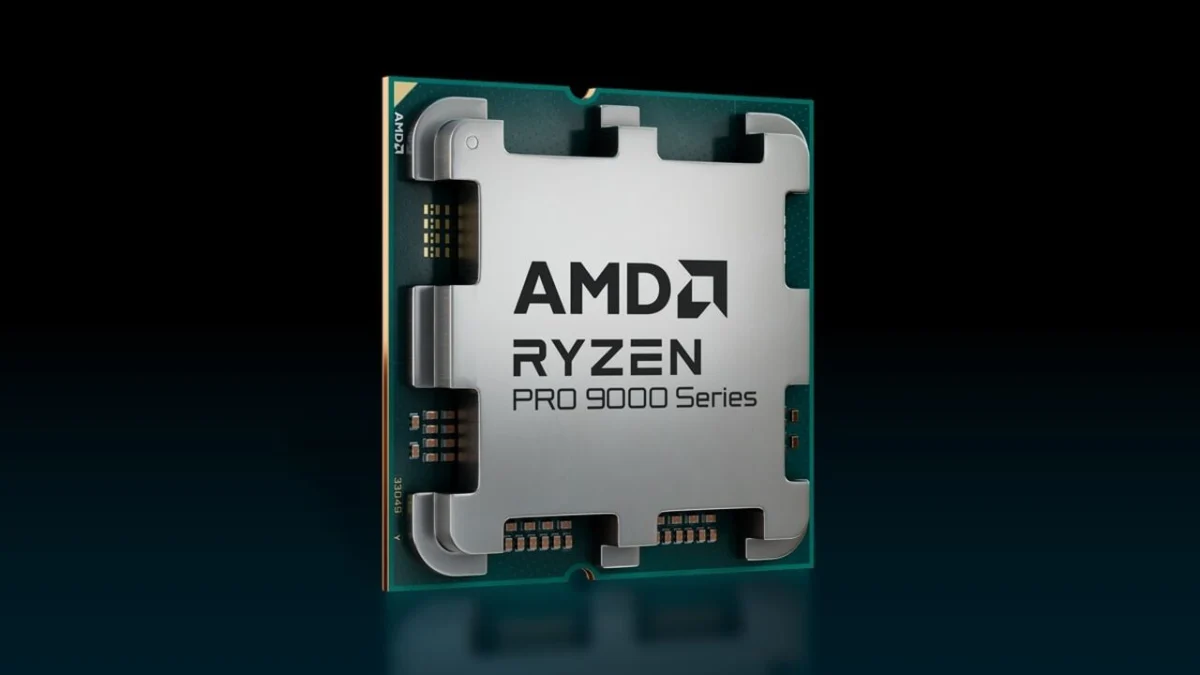
AMD has officially expanded its enterprise-focused processor portfolio with the launch of six new models in the Ryzen Pro 9000 series. This release marks a significant milestone in the evolution of business-grade computing, as it represents the first time AMD has integrated its acclaimed 3D V-Cache (X3D) technology into the Pro product line. By prioritizing cache-heavy architectures, AMD aims to bridge the gap between high-end consumer gaming performance and the rigorous, data-intensive demands of the modern enterprise workstation.
The New Vanguard: Specs and Capabilities
At the summit of this new lineup sits the Ryzen 9 Pro 9965X3D. This powerhouse is equipped with 16 Zen 5 cores and a staggering 128 MB of L3 cache, operating with a Thermal Design Power (TDP) of 170 watts. It is designed to be the ultimate solution for professionals engaged in complex simulations, 3D rendering, and real-time visualization.
Alongside the 9965X3D, AMD has introduced the Ryzen 7 Pro 9755X3D. While it scales down to 8 cores, it still boasts a substantial 96 MB of L3 cache, with a more conservative TDP of 120 watts. These additions represent a shift in strategy for AMD, acknowledging that business users—from engineers to financial analysts—require the same level of architectural optimization that was previously reserved for the enthusiast desktop market.
Technical Breakdown of the New Lineup:
- Ryzen 9 Pro 9965X3D: 16 Cores, 128 MB L3 Cache, 170W TDP.
- Ryzen 7 Pro 9755X3D: 8 Cores, 96 MB L3 Cache, 120W TDP.
- Ryzen 9 Pro 9965: 16 Cores, 64 MB L3 Cache (Standard), 170W TDP.
- Ryzen 9 Pro 9955: 12 Cores, 120W TDP (Performance-focused refresh).
- Ryzen 7 Pro 9755: 8 Cores, 120W TDP (Performance-focused refresh).
- Ryzen 5 Pro 9655: 6 Cores, 120W TDP (Performance-focused refresh).
Chronology: From Rumor to Reality
The announcement of these processors did not come as a total surprise to the industry. For months, tech analysts and regular followers of the hardware scene had been tracking leaks originating from benchmark databases.
Early in the development cycle, the Ryzen 9 Pro 9965X3D surfaced in synthetic benchmark results, signaling that AMD was testing "stacked" cache configurations within the Pro segment. Shortly thereafter, the Ryzen 7 Pro 9755 was spotted in similar databases. While these leaks provided a glimpse into the performance potential, the final unveiling has clarified the full scope of the launch, confirming that AMD is not just releasing single chips, but an entire ecosystem of refreshed and newly designed silicon.
The path from these early data points to the final product release highlights the growing transparency of the silicon supply chain, where performance leaks often act as a barometer for upcoming enterprise strategy shifts.
The 120-Watt Strategy: A Performance Pivot
Perhaps the most intriguing aspect of the refresh is the "120-Watt Upgrade" applied to the Ryzen 5, 7, and 9 series. AMD has taken existing configurations—previously capped at 65W—and allowed them to run at 120W.
This is not merely a change in power labeling; it is a tactical decision to unlock sustained clock speeds. By doubling the power envelope for models like the Ryzen 9 Pro 9955 (formerly the 9945), AMD is providing a solution for workstations that operate in thermally constrained environments but require burst performance for multithreaded workloads. While the core count remains similar to the predecessors, the thermal headroom allows these chips to maintain peak frequencies under sustained load, effectively turning standard business chips into high-throughput computing engines.
Official Responses and Strategic Intent
AMD’s official statement regarding the inclusion of 3D V-Cache centers on the acceleration of "complex, data-intensive workloads." In an official brief, the company stated:
"By introducing AMD 3D V-Cache technology to select models, we’ve significantly increased cache capacity to accelerate data access and enable your end-users to achieve faster performance in complex, data-intensive workloads such as simulation, rendering, and real-time visualization."
This statement serves as a clear indicator that AMD is positioning the Ryzen Pro series not just for standard office productivity, but as a direct competitor to high-end mobile and desktop workstation platforms. For IT departments, the promise is clear: higher efficiency in specialized tasks translates to reduced downtime and faster turnaround times for engineering and design teams.
Implications for the Enterprise Ecosystem
The introduction of these processors carries profound implications for the B2B market.
Security and Manageability
The "Pro" suffix remains synonymous with enterprise-grade security. Much like Intel’s vPro platform, AMD’s Pro series includes a suite of hardware-based security features, including memory encryption, secure boot, and advanced remote management capabilities. For large-scale corporate deployments, these features are as important as raw clock speed, as they provide the foundation for protecting sensitive company data in an era of sophisticated cybersecurity threats.
Pricing and Market Availability
While AMD has not released official public pricing for the new series, the market history of Pro-series silicon suggests a premium over consumer counterparts. In the retail market, Pro chips often carry a higher barrier to entry; for example, the older Ryzen 5 Pro 9645 currently commands a price point near 380 Euros. These chips are rarely aimed at the individual consumer, but rather at system integrators and large-scale enterprise procurement departments.
The Role of Strategic Partnerships
The ecosystem is already preparing for the arrival of this hardware. Lenovo has been the first to confirm integration, announcing the ThinkStation P4. This workstation is designed specifically to leverage the capabilities of the new Ryzen 9 Pro 9965X3D, pairing it with high-end memory and substantial VRAM configurations. This partnership signals that the industry is ready to transition to the new architecture as soon as it hits the shelves in the second half of 2026.
Conclusion: A New Era for Professional Computing
The Ryzen Pro 9000 series expansion is a testament to the blurring lines between high-end enthusiast hardware and professional workstation requirements. By introducing 3D V-Cache to the Pro line, AMD is acknowledging that the "average" business user is increasingly becoming a creator, a simulator, and a data analyst.
The strategic shift to higher TDPs for the standard Pro models further suggests that AMD is prioritizing sustained performance over power-sipping efficiency—a trade-off that many enterprise environments are eager to make. As we look toward the second half of 2026, the arrival of these chips in platforms like the Lenovo ThinkStation P4 will likely set a new benchmark for what businesses can expect from their desktop hardware. The challenge for AMD will now be to ensure that the supply chain meets the high demand for these specialized components, as enterprises look to modernize their infrastructure for the next generation of professional workflows.