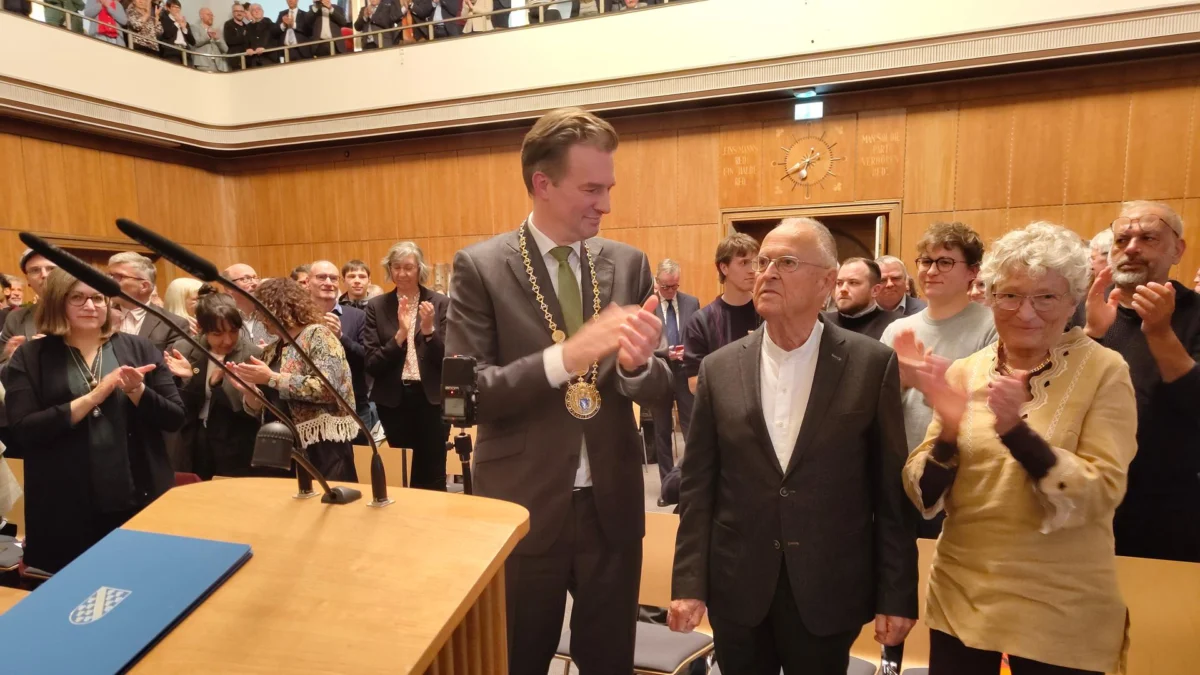
FRANKFURT, Germany – The Board of Trustees of the Peace Prize of the German Book Trade has announced that the esteemed French-British human rights lawyer, academic, and author Philippe Sands is the recipient of the prestigious 2025 award. The announcement, delivered during a press briefing in Frankfurt, highlights Sands’ lifelong commitment to international law, the pursuit of historical truth, and the unwavering defense of human dignity.
The Peace Prize, one of the most significant cultural accolades in the German-speaking world, carries a monetary endowment of 25,000 euros. It is traditionally presented in a high-profile ceremony at the Paulskirche in Frankfurt during the finale of the Frankfurt Book Fair in October.
The Verdict: A Beacon of Intellectual Clarity
In their official statement, the jury characterized Philippe Sands as "one of the most important intellectual voices of our time." The citation emphasizes that Sands does not merely observe the mechanisms of international justice from the ivory tower of academia; rather, he actively engages in the courtroom and on the written page to dismantle the structures of impunity that have historically allowed crimes against humanity to go unpunished.
The jury noted: "Philippe Sands has dedicated his career to the rigorous pursuit of justice. Through his masterful synthesis of legal scholarship and narrative nonfiction, he has made the complex, often dry language of international law accessible and urgent for a global audience. He reminds us that the rule of law is the only bulwark against the return of barbarism."
Chronology: From the Courtroom to the Bestseller List
Philippe Sands’ career is a unique tapestry woven from high-stakes legal battles and profound literary inquiry. To understand the significance of this award, one must look at the arc of his professional life:
1960–1990: Formative Years and Legal Foundation
Born in London in 1960 to a family with roots in Europe, Sands pursued studies at Cambridge University and Harvard Law School. His early career was defined by an interest in the intersection of international law and state sovereignty. By the 1990s, he had established himself as a formidable barrister, representing victims and states in cases ranging from environmental disasters to war crimes.
2000–2015: The Pinochet Precedent and Beyond
Sands played a pivotal role in cases that reshaped global jurisprudence, including the Pinochet case, which fundamentally changed the doctrine of sovereign immunity. During this period, he began to realize that legal judgments alone were often insufficient to address the intergenerational trauma caused by systemic atrocities.
2016: East West Street
The publication of East West Street: On the Origins of Genocide and Crimes Against Humanity marked a turning point in Sands’ public profile. The book, which traced the origins of international law through the lives of two Jewish lawyers in Lviv—Hersch Lauterpacht and Rafael Lemkin—who helped define the concepts of "genocide" and "crimes against humanity," became an instant classic. It bridged the gap between historical research and personal memoir, winning the Baillie Gifford Prize and propelling Sands into the global spotlight.
2020–Present: The Pursuit of Accountability
In recent years, Sands has turned his focus to the "crime of ecocide" and the ongoing conflicts in Eastern Europe. His 2020 work, The Ratline, further explored the mechanics of Nazi escapes, and his ongoing legal work—including his involvement in proceedings at the International Court of Justice—has solidified his status as a leading moral authority on the necessity of a rules-based international order.
Supporting Data: The Impact of Sands’ Body of Work
The impact of Sands’ work extends beyond critical acclaim; it has fundamentally influenced the legal and political discourse regarding human rights.
- Public Engagement: His books have been translated into over 20 languages, reaching a global audience that spans from legal professionals to casual readers of history.
- Legal Precedent: As a practicing barrister, Sands has appeared in many of the most significant international cases of the last three decades, including those before the International Court of Justice (ICJ) and the International Criminal Court (ICC). His work in these forums has contributed to the evolution of the concept of "Universal Jurisdiction."
- Educational Outreach: Beyond his books, Sands has produced documentary films (such as My Nazi Legacy) and podcasts, utilizing multi-media platforms to ensure that historical lessons are passed down to younger generations, a key metric for the Peace Prize jury.
Official Responses and Reflections
The announcement has triggered a wave of positive responses from the global cultural and legal communities.

From the German Book Trade:
Karin Schmidt-Friderichs, head of the German Publishers and Booksellers Association, remarked, "In times of increasing geopolitical fragmentation, Philippe Sands reminds us that our common humanity is rooted in the law. He does not provide easy answers; he asks the difficult questions that force societies to confront their pasts."
From the Legal Community:
Legal scholars have lauded the choice, noting that it recognizes the "narrative turn" in legal studies. Professor Elena Rossi of the European University Institute stated: "Sands has done what few lawyers can: he has turned the law into a human story. By humanizing the victims and contextualizing the perpetrators, he creates a form of justice that is restorative rather than merely punitive."
Philippe Sands’ Perspective:
In a brief statement following the announcement, Sands expressed his profound gratitude: "I am humbled to join the list of laureates who have come before me. The Peace Prize is not just an award for the individual; it is a recognition of the importance of the rule of law in an age where that rule is increasingly under threat. We are living in a moment where the lessons of the mid-20th century are being tested, and it is more important than ever to advocate for the principles that protect the vulnerable."
Implications: Why This Award Matters in 2025
The decision to honor Philippe Sands is deeply symbolic, particularly given the current global climate. Several key implications arise from this selection:
1. The Defense of the International Order
With the resurgence of authoritarianism and the erosion of international institutions, Sands represents a steadfast commitment to the "liberal internationalist" project. By honoring him, the German Book Trade is taking a clear stance: that the principles of international justice established after 1945 are not negotiable.
2. Confronting Historical Memory
Sands’ work is unique because it forces a confrontation with the "perpetrator perspective" while maintaining deep empathy for victims. His methodology—digging into family archives and local histories—serves as a model for how nations should grapple with their own suppressed histories of collaboration and violence.
3. The Power of "Narrative Justice"
The prize serves as an acknowledgment that academic legal texts alone cannot shift public opinion. The integration of literature and law—what Sands calls "the storytelling of history"—is essential for the health of a democracy. The jury’s choice reinforces the idea that books are not just repositories of knowledge, but tools for civic action.
4. A Message to the Future
As the ceremony in Frankfurt approaches, the focus will undoubtedly shift toward the challenges of the present day. Sands is expected to use his acceptance speech to address current crises, potentially touching upon the war in Ukraine, the climate emergency, and the rise of populism. His presence in the Paulskirche—a site of deep historical significance for German democracy—will be a focal point for European intellectual life this autumn.
Conclusion: A Legacy in the Making
The awarding of the 2025 Peace Prize of the German Book Trade to Philippe Sands is a testament to the enduring power of the written word to affect change in the real world. By bridging the gap between the courtroom and the bookshelf, Sands has provided a blueprint for how intellectuals can engage with the most pressing crises of their time without losing their commitment to truth, nuance, and, above all, justice.
As the international community prepares for the October ceremony in Frankfurt, the focus will be on the message that Sands brings: that the pursuit of peace is an active, ongoing, and often painful process that requires us to look directly into the shadows of our past to illuminate the path forward. In an era often characterized by cynicism and the erosion of norms, the recognition of Philippe Sands serves as a timely reminder that the law, when coupled with the human voice, remains the most powerful tool for defending the dignity of all people.