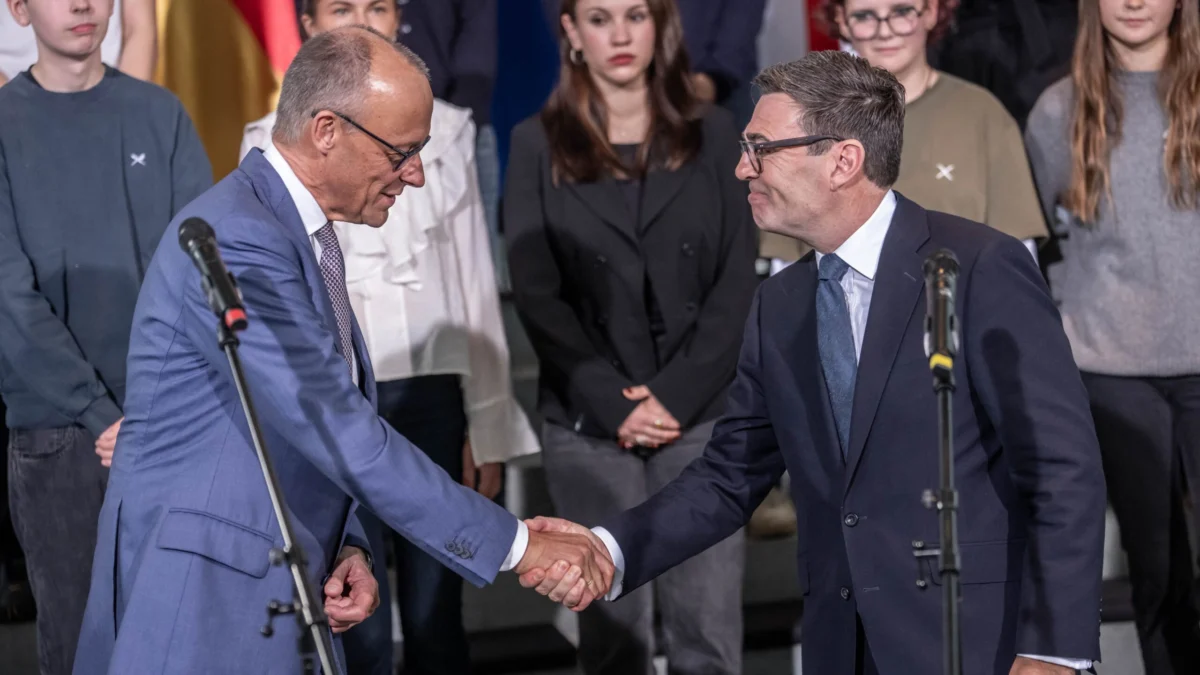
Berlin, October 8, 2026 – In a significant diplomatic and strategic overture, British Prime Minister Andy Burnham today extended a formal invitation to Germany to join the Global Combat Air Programme (GCAP), a cutting-edge next-generation fighter jet initiative currently spearheaded by the United Kingdom, Italy, and Japan. The landmark offer was made during Burnham’s inaugural state visit to Berlin, where he and German Chancellor Friedrich Merz signed into force a comprehensive Anglo-German Friendship Treaty, marking a pivotal moment in bilateral relations six years after the United Kingdom’s departure from the European Union.
The announcement comes on the heels of the recent collapse of the Franco-German Future Combat Air System (FCAS) project, leaving Germany in search of a viable path for its future air combat capabilities. Prime Minister Burnham emphasized the collaborative spirit of the GCAP initiative, stating, "We have signaled to Chancellor Merz the openness of Great Britain for Germany to participate in this endeavor. This is something we intend to advance in the coming period in cooperation with our other partners, Italy and Japan."
Chancellor Merz, speaking alongside Burnham at a joint press conference, hailed the day as "historic," underscoring the renewed commitment to cooperation between the two European powers. While the prospect of Britain rejoining the European Union remains "future music," as Burnham put it, the concrete steps taken in defense and cultural exchange signal a robust and evolving partnership that transcends past political divisions. Beyond the high-stakes defense proposition, the leaders also unveiled measures aimed at facilitating travel for students and scholars, fostering deeper educational and cultural ties.
Main Facts: A Strategic Pivot in European Defence
The core of today’s announcement revolves around the potential for Germany to integrate into the Global Combat Air Programme (GCAP). This program, launched in December 2022, represents an ambitious multinational effort to develop a sixth-generation stealth fighter jet by 2035. Its primary goal is to replace the Eurofighter Typhoon and F-2s currently in service with the air forces of the UK, Italy, and Japan, respectively. The invitation to Germany, a major European power and NATO ally, could fundamentally reshape the future of air combat development on the continent and globally.

GCAP is not merely about building a new aircraft; it envisions a comprehensive combat air system that will leverage artificial intelligence, advanced stealth technology, highly integrated sensor suites, and optionally manned capabilities. It is designed to operate in highly contested environments, offering unparalleled situational awareness, data fusion, and network-centric warfare capabilities. For Germany, whose own joint project, FCAS, with France and Spain dissolved this past summer amidst protracted disagreements, the British offer presents a crucial opportunity to secure its long-term aerial defense needs and maintain its technological edge within NATO.
The German government’s position, reiterated by sources close to Chancellor Merz, maintains that there will be no "solo approach" to fighter jet development. This stance reflects a preference for multinational cooperation, distributing the immense costs and technological risks associated with such advanced projects. Canada has also reportedly expressed interest in joining GCAP, indicating a broader appeal for the program and its potential to become a cornerstone of Western air power for decades to come.
In parallel with the defense discussions, the formal activation of the Anglo-German Friendship Treaty underscores a broader commitment to strengthening bilateral ties across various sectors. The treaty, initially signed last year in London, is designed to foster closer cooperation in areas ranging from trade and investment to cultural exchange and scientific research. The specific mention of "travel facilitations for pupils and students" highlights a tangible effort to bridge the gap in people-to-people connections that widened after Brexit, aiming to rebuild mutual understanding and collaboration at a societal level.
Chronology: A Path to Renewed Partnership
The seeds of today’s significant announcements were sown well before Prime Minister Burnham’s arrival in Berlin.

Summer 2026: The Future Combat Air System (FCAS), a highly ambitious project involving Germany, France, and Spain, officially collapses. Conceived as a holistic "system of systems" including a New Generation Fighter, remote carriers, and a combat cloud, FCAS had been plagued by internal disputes over industrial workshare, intellectual property rights, and differing national requirements since its inception in 2017. Years of negotiations failed to bridge the gaps between major industrial players like Airbus (Germany/Spain) and Dassault Aviation (France), and the political will eventually fractured. This failure left a substantial void in Germany’s long-term defense planning and created an urgent need for an alternative solution for its air force, the Luftwaffe.
Late 2025 – Early 2026: Informal discussions between British and German officials intensify, exploring avenues for enhanced post-Brexit cooperation. Defence is a natural fit, given Germany’s "Zeitenwende" (turning point) policy, initiated by Chancellor Merz’s predecessor, which committed to a significant increase in defense spending and a modernization of the Bundeswehr following geopolitical shifts in Eastern Europe. The UK, post-Brexit, has been actively seeking to forge "global Britain" partnerships, with defence and security being key pillars of this strategy.
Last Year (2025): The Anglo-German Friendship Treaty is signed in London by then-Foreign Secretaries, laying the groundwork for a formalized, broad-ranging partnership. This treaty was envisioned as a framework to manage and deepen relations in a post-Brexit landscape, moving beyond the immediate implications of the UK’s departure from the EU.
October 8, 2026: British Prime Minister Andy Burnham arrives in Berlin for his inaugural visit. The timing is strategic, allowing for immediate follow-up on the recent FCAS failure. The visit culminates in the exchange of ratification documents for the Friendship Treaty, officially bringing it into force. More importantly, it provides the platform for Burnham to formally invite Germany into the GCAP project. Chancellor Merz’s enthusiastic reception of the offer, while not an immediate commitment, signals strong interest and a clear strategic direction for Germany’s future air combat capabilities.
This sequence of events demonstrates a deliberate shift in German strategic thinking, moving away from an exclusively EU-centric defence development model towards a more flexible, partner-driven approach that includes key non-EU allies like the UK and Japan, alongside existing European partners like Italy.
Supporting Data: The Strategic Imperative and Economic Promise
The potential German entry into GCAP is underpinned by compelling strategic, technological, and economic arguments for all parties involved.
The GCAP Advantage: A Sixth-Generation Vision
GCAP, born from the UK’s Tempest project and integrated with Italy’s and Japan’s respective future fighter ambitions, aims for a true sixth-generation capability. This goes beyond the stealth and multirole capabilities of current fifth-generation jets like the F-35. Key attributes of a GCAP-level system include:
- Deep Stealth and Low Observability: Enhanced radar cross-section reduction across multiple spectrums.
- Advanced Sensor Fusion and AI: Integrating vast amounts of data from onboard sensors, off-board assets (drones, satellites), and other platforms, processed by AI to provide superior situational awareness and decision support for the pilot.
- Networked Warfare: Seamless integration into a "combat cloud" or "system of systems," allowing the fighter to act as a node, sharing and receiving data instantly with other air, land, and sea assets.
- Optionally Manned Capabilities: The potential for the aircraft to operate autonomously or be remotely controlled, reducing pilot risk in certain missions and expanding operational flexibility.
- Modular Design and Open Architecture: Facilitating easier upgrades and integration of new technologies throughout its lifespan, reducing obsolescence.
- Hypersonic Weapon Integration: Designed from the outset to carry and deploy future advanced weaponry, including hypersonic missiles.
For Germany, integrating into such a program would mean direct access to these cutting-edge technologies, ensuring its air force remains at the forefront of global military aviation. It addresses the urgent need to replace its aging Eurofighter Typhoon fleet by the mid-2030s, providing a clear and technologically superior successor.

The FCAS Fiasco: A Lesson Learned
The demise of the FCAS project serves as a stark reminder of the complexities inherent in large-scale international defense programs. Reports from "this summer" indicated that the core issues included:
- Industrial Leadership and Workshare: France’s Dassault Aviation and Germany’s Airbus Defence and Space frequently clashed over who would lead key development pillars and how the industrial work would be allocated, leading to repeated delays. Spain, a junior partner, often found itself caught in the middle.
- Differing Operational Requirements: The French Air Force, with its emphasis on strategic independence and nuclear deterrence, had distinct requirements compared to the German Luftwaffe, which operates within a NATO framework with a focus on collective defense. These differing visions made it difficult to agree on a common aircraft design.
- Political Interference and Budgetary Constraints: National political cycles and budget pressures often complicated decision-making, leading to stop-and-go funding and shifting priorities.
- Intellectual Property (IP) Disputes: Control over critical technologies and the ability to export them independently were contentious issues, especially between France and Germany.
The failure of FCAS underscores Germany’s need for a program with clearer governance, established partnerships, and a more harmonized vision, which GCAP potentially offers.
Germany’s "Zeitenwende" and Defence Modernization
Chancellor Merz’s government is continuing the "Zeitenwende" policy, which translates to a profound shift in Germany’s foreign and security policy. This includes a commitment to:
- Increased Defence Spending: Germany has pledged to consistently meet NATO’s 2% GDP target for defence expenditure, injecting billions into modernizing its armed forces.
- Strengthening European Pillar of NATO: While seeking to bolster European defense capabilities, Germany also remains committed to NATO’s transatlantic framework.
- Rapid Acquisition of Modern Capabilities: There is an urgency to replace outdated equipment and acquire advanced systems to meet contemporary security challenges.
Joining GCAP aligns perfectly with these objectives, providing a robust, collaborative, and technologically advanced solution for its air combat requirements.

Economic and Industrial Impact
The economic implications of German participation in GCAP would be substantial:
- Job Creation and High-Tech Investment: Significant investment in research, development, and manufacturing would create thousands of high-skilled jobs in Germany’s aerospace and defense sectors.
- Technological Transfer and Innovation: German companies would gain access to and contribute to cutting-edge technologies, fostering innovation that could spill over into civil sectors.
- Industrial Synergy: Integrating Germany’s formidable industrial base with those of the UK, Italy, and Japan could create a powerful defense-industrial alliance, enhancing global competitiveness.
- Cost Sharing: The immense development costs of a sixth-generation fighter (estimated in the tens of billions of euros) would be shared among more partners, reducing the financial burden on any single nation.
The Broader Friendship Treaty
Beyond the military aspects, the Anglo-German Friendship Treaty formalizes and strengthens cooperation in vital non-military areas:
- Trade and Investment: Mechanisms to boost bilateral trade and investment flows, potentially easing some of the post-Brexit trade friction.
- Research and Development: Joint initiatives in scientific research, renewable energy, artificial intelligence, and other critical technologies.
- Cultural and Educational Exchange: The mentioned "travel facilitations for pupils and students" could involve streamlined visa processes, increased funding for exchange programs, and mutual recognition of qualifications. This aims to rebuild trust and understanding between the younger generations of both nations.
- Climate Change and Global Challenges: Coordinated efforts on climate action, global health, and other multilateral issues.
These measures collectively aim to build a resilient, multi-faceted relationship that withstands political fluctuations and serves as a model for cooperation between EU and non-EU states.
Official Responses: A Chorus of Enthusiasm and Strategic Realism
The reactions to Prime Minister Burnham’s offer and the signing of the Friendship Treaty have been carefully calibrated, reflecting both political enthusiasm and strategic pragmatism.

Prime Minister Andy Burnham (UK):
Burnham’s tone in Berlin was one of genuine outreach and a vision for a stronger, more integrated European defense, albeit outside the EU’s direct institutional framework. His statement about "openness" for Germany to join GCAP, and his emphasis on collaboration with Italy and Japan, underscored the UK’s commitment to multilateralism in defense. "The collapse of FCAS was unfortunate, but it presents us with an opportunity to forge new, robust alliances based on shared technological ambition and strategic alignment," Burnham remarked. He positioned the offer as a natural progression of the UK’s post-Brexit global engagement, seeking partners with similar values and capabilities. His characterization of EU re-entry as "future music" also subtly reaffirmed the UK’s current path while keeping diplomatic channels open.
Chancellor Friedrich Merz (Germany):
Chancellor Merz’s declaration of a "historic day" signals a significant shift in German foreign policy. His response to the GCAP offer, while not an immediate acceptance, was unequivocally positive. "Germany has always been clear that large-scale defense projects require close international cooperation," Merz stated. "The British offer is an extremely compelling proposition that we will examine with the utmost seriousness. It aligns perfectly with our need to modernize our Bundeswehr and reinforces our commitment to shared security." His reiteration of "no solo approach" for Germany in fighter jet development highlights the lessons learned from the FCAS experience and a preference for proven, collaborative models. For Merz, who has consistently advocated for a more assertive and capable Germany on the global stage, this represents a major diplomatic win and a concrete step towards strengthening Germany’s defense posture.
Italy and Japan (GCAP Partners):
While not directly quoted in the initial report, it is highly probable that Italy and Japan would welcome Germany’s potential entry into GCAP. Adding Germany, with its significant industrial capacity, technological expertise, and substantial defense budget, would strengthen the program considerably.
- Italian Defence Minister (hypothetical statement): "The expansion of GCAP to include a major European partner like Germany would enhance the program’s industrial base, shared expertise, and geopolitical weight. It underscores the growing convergence of strategic interests among leading democracies."
- Japanese Minister of Defence (hypothetical statement): "Japan views the GCAP as vital for maintaining air superiority and fostering technological innovation. German participation would bring invaluable contributions and further solidify the alliance of like-minded nations committed to peace and stability, particularly in an increasingly complex global security environment."
Canada (Interested Party):
Canada’s reported interest in GCAP further illustrates the program’s international appeal. For Canada, which is also looking to modernize its air force, GCAP offers an advanced platform and an opportunity to deepen defense ties with key allies.

- Canadian Defence Official (hypothetical statement): "We are closely observing the developments with GCAP. The prospect of collaborating with such an advanced project, potentially including Germany, aligns with our commitment to modernizing our forces and contributing effectively to collective security frameworks."
France (Former FCAS Partner):
The French reaction, though not explicitly detailed, would likely be a mix of disappointment and a renewed call for broader European defence autonomy. While the collapse of FCAS was a blow, Paris might emphasize the need for continued, albeit perhaps re-evaluated, European-led defense initiatives. They might express regret over Germany’s potential pivot but understand the strategic necessity following the FCAS failure. Some voices in Paris might even advocate for a future convergence, where GCAP and any renewed European efforts could eventually find common ground or interoperability.
Implications: A Reshaping of Defence Alliances and Geopolitical Realignment
The British offer and Germany’s positive reception carry profound implications for the future of European defense, industrial cooperation, and geopolitical alignments.
Reshaping European Defence Cooperation
The potential German entry into GCAP marks a significant departure from the post-Brexit narrative that often depicted a growing chasm between the UK and the EU. Instead, it suggests a pragmatic, flexible approach to security cooperation, where national interests and technological compatibility trump institutional affiliations.
- Post-Brexit Pragmatism: This move highlights the UK’s successful pivot towards a "Global Britain" strategy, forging strong bilateral and multilateral alliances beyond the EU framework. For Germany, it demonstrates a willingness to engage in defense projects with non-EU partners when it serves its strategic interests, especially after the failure of an exclusively EU-centric initiative.
- A New Defence Axis: The inclusion of Germany would solidify GCAP as a formidable defense alliance involving three major European economies (UK, Germany, Italy) and a leading Asian power (Japan), with potential Canadian participation. This forms a powerful bloc for advanced combat air capabilities, distinct from, but complementary to, other European initiatives.
- Challenges for Future EU Defence: While not dismantling the idea of EU defence cooperation, Germany’s move into GCAP could diminish the impetus for a purely European-led next-generation fighter program, at least in the short to medium term. It forces a re-evaluation of how European countries achieve defense autonomy and interoperability.
Industrial Landscape Transformation
The defence industrial landscape will see a major realignment.

- Consolidation and Competition: The combined industrial powerhouses of BAE Systems (UK), Leonardo (Italy), Mitsubishi Heavy Industries (Japan), and potentially Airbus Defence and Space (Germany) would create a dominant force in the global fighter jet market. This could intensify competition with other major players like the US (Lockheed Martin, Boeing) and France (Dassault).
- Technological Synergy: German engineering prowess, particularly in areas like advanced materials, propulsion systems, and sensor technology, would be a massive asset to GCAP, accelerating its development and enhancing its capabilities.
- Workshare Negotiation: Integrating Germany will require careful negotiation of industrial workshare and intellectual property rights, building on the lessons learned from FCAS to ensure equitable distribution and avoid future disputes.
Enhanced NATO Interoperability and Burden-Sharing
From a NATO perspective, German participation in GCAP would be a significant boon.
- Standardization and Interoperability: A common, highly advanced fighter platform among key NATO members (UK, Italy, Germany, potentially Canada) would greatly enhance interoperability, joint training, and operational effectiveness. This is crucial for collective defense and rapid response scenarios.
- Strengthened European Pillar: While GCAP is not a NATO program, a stronger European industrial and technological base for air power contributes directly to a more capable European pillar within the alliance, allowing for greater burden-sharing with the United States.
- Collective Security: In an era of heightened geopolitical tensions, having leading industrial nations collaborate on such a critical defense asset sends a strong message of unity and resolve to potential adversaries.
Long-Term Strategic Vision
The implications extend to the long-term strategic vision for air power and global security.
- Air Superiority for Decades: GCAP aims to deliver air superiority well into the second half of the 21st century, ensuring participating nations maintain a decisive edge in a rapidly evolving threat landscape.
- Technological Sovereignty: For Germany, joining GCAP offers a pathway to maintain a degree of technological sovereignty in critical defense capabilities, reducing over-reliance on a single foreign supplier.
- Broader Diplomatic Alignment: The defense cooperation, coupled with the Friendship Treaty, solidifies a pragmatic diplomatic alignment between the UK and Germany. This could serve as a template for other areas of cooperation, demonstrating how major powers can collaborate effectively even with differing institutional relationships (EU vs. non-EU). The agreement on "travel facilitations for pupils and students" is a small but vital step in building long-term goodwill and understanding, ensuring that the next generation remains connected despite political shifts.
In conclusion, Prime Minister Burnham’s offer to Germany to join GCAP, against the backdrop of the newly ratified Friendship Treaty, represents a landmark moment. It signals a pragmatic realignment of European defense priorities, a deepening of Anglo-German ties, and a bold step towards securing the future of air combat capabilities for some of the world’s leading industrial democracies. The coming months will reveal the specifics of Germany’s engagement, but the direction is clear: a new, powerful alliance is taking shape, poised to redefine the landscape of global air power.