In the landscape of modern gaming, where high-fidelity graphics, instant gratification, and fast-paced multiplayer combat dominate the market, an outlier has emerged from the indie scene that defies almost every convention of the medium. Jono, a free-to-play 2D platformer released in early October on Steam, has captivated a global audience not through complexity or cutting-edge visuals, but through a radical social experiment in patience and shared responsibility.
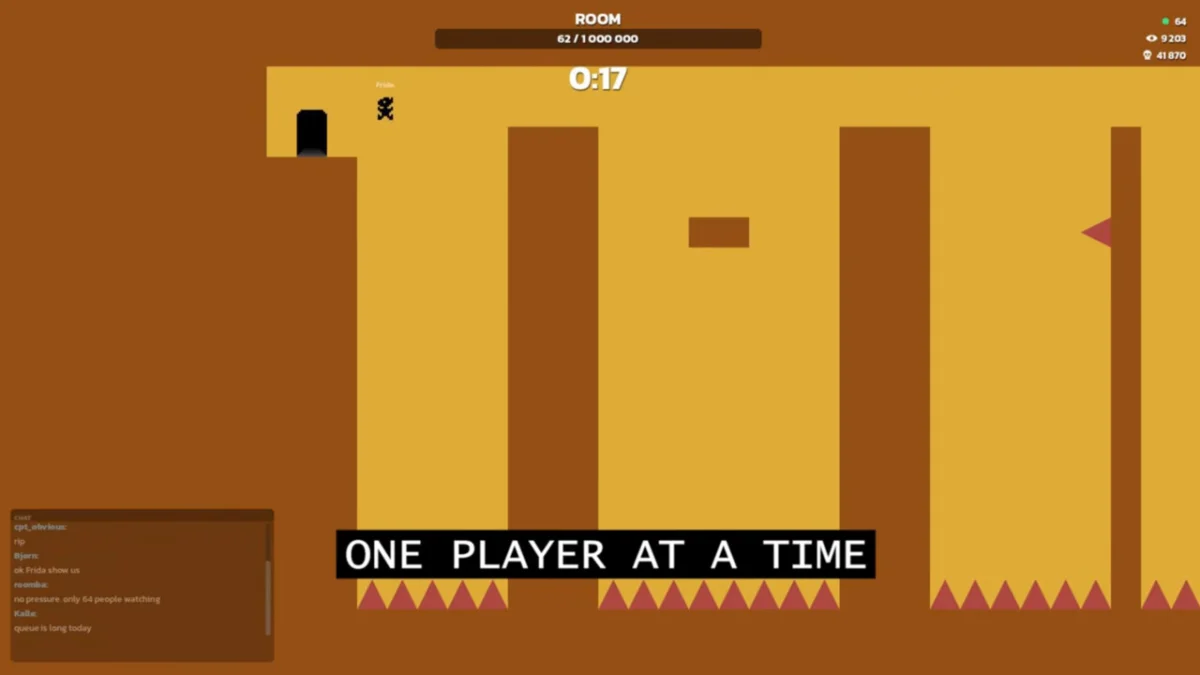
The core premise is deceptively simple: thousands of players from across the globe share a single, persistent character. Only one person on the entire planet can control the protagonist at any given moment. When your turn arrives, you have exactly 60 seconds to navigate a series of treacherous, trap-filled rooms. Once the timer expires, control is passed to the next person in the global queue. It is a game defined by the tension of the collective—an experience that one Reddit user aptly dubbed "Massively Singleplayer."
The Mechanics of a Global Marathon
At its heart, Jono is a platformer in the vein of Super Meat Boy or Celeste, requiring precise jumps, timing, and nerves of steel. Players navigate rooms filled with spikes, moving barriers, and environmental hazards. However, the stakes are altered by the game’s unique structure. When a player dies, they do not reset the entire game; they only reset the current room, allowing the next player in the queue to attempt the challenge immediately. Conversely, once a room is conquered, it remains cleared for the entire global community.
Technically, Jono is built on the Godot engine, but its networking architecture is what sets it apart from traditional multiplayer titles. To maintain a smooth experience for thousands of spectators, the game does not stream raw video data. Instead, it transmits only the input commands of the active player to the spectators’ local machines. This ensures that the game’s physics remain consistent and lag-free, allowing viewers to see the character move in real-time as if they were playing it themselves.
This "spectator-first" approach is reinforced by a robust social layer. While waiting in the queue, players are not merely passive observers; they are part of a community. An integrated chat system allows participants to trade strategies, offer encouragement, or heckle the active player. Emotes, character customization options, and minor tasks for spectators keep the audience engaged even when their turn to "drive" is still an hour away.
Chronology of a Viral Hit
The project is the brainchild of Tuomas Erikoinen, a Finnish developer and former lead artist on the original Angry Birds. Erikoinen’s development philosophy for Jono was intentionally reactionary. Fearing the rise of "slop"—low-effort, AI-generated clones that have flooded platforms like Steam—he wanted to build something that required a human, communal soul to function.
- Early October: Jono launches quietly on Steam.
- Late October: The game reaches a tipping point. As word-of-mouth spreads across Reddit and social media, the concurrent player count spikes.
- October 24: Erikoinen releases a data breakdown on Reddit, revealing that over 2,500 new players joined the experiment in just 60 hours.
- Present Day: The queue has become a staple of the experience. What was once a short wait of five to ten minutes has morphed into a steady stream of 60 to 100 people waiting, often requiring a wait time of over an hour for a single, fleeting minute of gameplay.
By the Numbers: The Psychology of the Queue
The data provided by Erikoinen paints a fascinating picture of player behavior. In the first 60 hours of the viral surge, the community logged over 3,300 hours of "watch time" compared to only 62 hours of actual "play time." This ratio—a nearly 50:1 disparity between observing and playing—highlights a unique psychological hook.
In Jono, the act of watching is not a secondary activity; it is the game. Because the progress is permanent, the audience feels a collective sense of ownership over the character’s journey. When a player manages to clear a difficult room, the chat erupts with a sense of shared victory. Conversely, when a player fails, the collective sigh of the community is palpable.

The "Meat Grinder" mode serves as the ultimate test of this collective endurance. In one particular instance, a high-difficulty level resulted in 2,626 failed attempts by various players. It took nearly five hours of global, consecutive effort before the 2,627th player finally conquered the stage. This endurance run underscores the game’s primary draw: it is not about the individual’s skill, but the combined resilience of a global population.
Official Responses and Developer Intent
Erikoinen has remained highly involved in the community, acting as both a developer and a moderator. The unexpected popularity has necessitated a more rigorous approach to content management. Because players can submit their own custom-made levels via an in-game editor, Erikoinen has had to implement a strict vetting process. Each custom level must be verified as beatable by the creator before it can enter the global rotation, preventing "troll levels" from stalling the community’s progress.
Regarding the monetization of the game, Erikoinen has been adamant: Jono is, and will remain, free. There are no microtransactions, no battle passes, and no pay-to-win mechanics. The developer has stated that his goal was to create something that could not be easily mimicked by AI or corporate-driven development studios. By anchoring the game’s value in the people playing it rather than the assets or the code, he has created a project that is, by design, impossible to replicate without a genuine, thriving community.
The One Million Level Milestone
Looking forward, the community has set its sights on an ambitious goal: completing one million individual rooms. As of late October, the count was approaching 100,000. Erikoinen has teased a significant, community-wide reward for reaching the first 100,000-room milestone, though he has kept the details under wraps.
Based on the current pace of approximately 5,000 rooms cleared per day, the community is on track to hit the one-million-room mark by April 2027. This long-term roadmap turns Jono into something more than a game—it becomes a multi-year project, a digital monument built by the hands of strangers.
Implications: The Future of "Massively Singleplayer"
Jono arrives at a pivotal moment in the gaming industry. As AI-generated content continues to threaten the viability of indie developers, Erikoinen’s experiment offers a potential path forward: the "Human-Centric Design."
By focusing on social synchronization and communal progress, Jono provides an experience that an AI-driven bot simply cannot replicate. It turns the act of waiting—usually the most boring part of gaming—into a social event. It highlights a hunger among gamers for experiences that are not just "content" to be consumed, but "events" to be participated in.
Whether Jono maintains this momentum until 2027 remains to be seen. The novelty of the one-minute turn may eventually wear thin for some, but for the thousands currently queuing, the game represents a rare digital space where the progress of one is the success of all. In an era of isolated, individualistic gaming, Jono stands as a testament to the power of shared struggle. It is a reminder that sometimes, the most engaging way to play is to simply stop and watch, waiting for your turn to change the world, one sixty-second burst at a time.