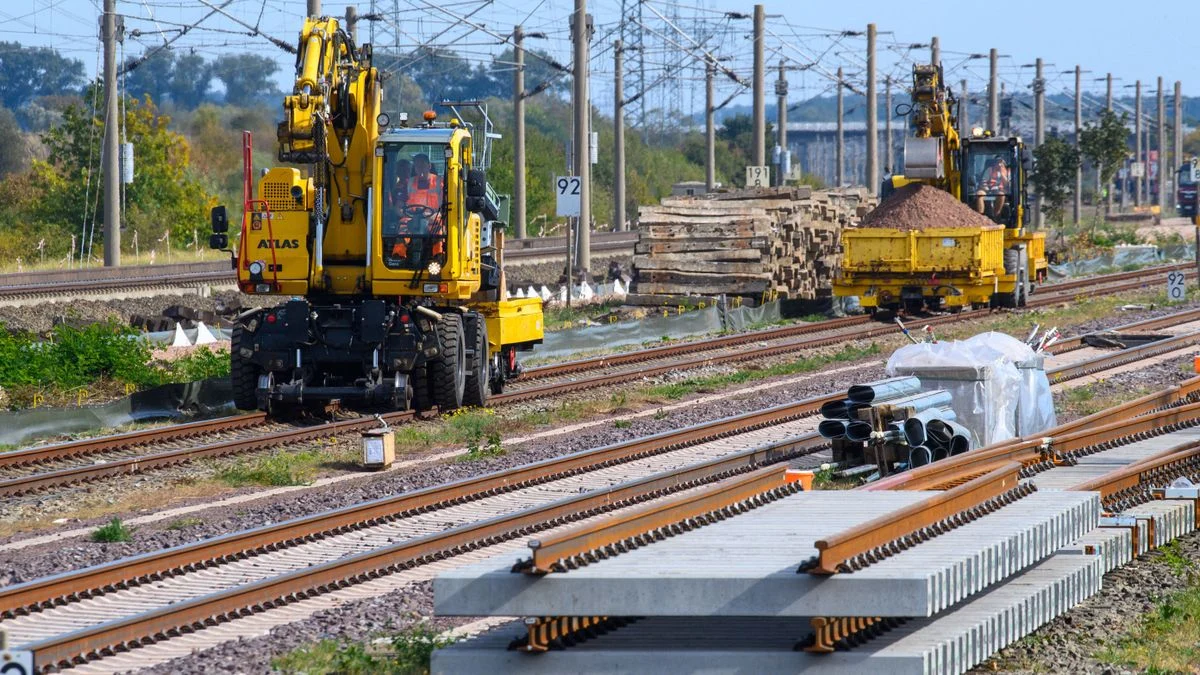
The ambitious plan to revitalize Germany’s crumbling rail network has hit a significant bureaucratic and operational roadblock. In a scathing assessment, the German Federal Audit Office (Bundesrechnungshof) has delivered a harsh critique of Deutsche Bahn’s (DB) flagship project: the comprehensive renovation of highly frequented rail corridors. According to a report obtained by the German press agency dpa, the audit office warns that the multi-billion euro infrastructure program is plagued by “grave flawed developments,” questioning the fundamental economic viability of the entire undertaking.
The Core of the Conflict: A Lack of Financial Accountability
At the heart of the Federal Audit Office’s report to the Bundestag’s Budget Committee is a fundamental breakdown in planning and fiscal transparency. The auditors concluded that the economic feasibility studies conducted by the state-owned rail operator—specifically its infrastructure subsidiary, DB InfraGO—are not only "faulty" but also "unreliable."
For a project involving billions in taxpayer funds, this assessment is damning. The Audit Office contends that there is no "sustainable decision-making basis" for the massive investments being funneled into these corridor renovations. Furthermore, the report highlights that the Budget Committee, which holds the power of the purse, has been systematically deprived of the essential information required to exercise its parliamentary oversight responsibilities.
The auditors are not merely criticizing the theoretical planning; they point to the practical reality of the initial pilot projects. In these cases, costs have spiraled, far exceeding initial projections, and the operational improvements promised to the public have largely failed to materialize in the immediate aftermath of the construction.
Chronology: From Grand Ambition to Strategic Retreat
To understand how the flagship project of the German rail system reached this point, one must look at the timeline of the "High-Performance Corridor" (Hochleistungskorridor) initiative.
The Initial Vision (2022–2023)
Recognizing that decades of underinvestment had left the German rail network in a state of chronic decay, the federal government and Deutsche Bahn launched an aggressive strategy. The concept was simple in theory: identify the most heavily utilized rail arteries, close them completely for a period of several months, and perform a total overhaul of all systems—tracks, signaling, overhead lines, and station facilities. The goal was to eliminate "stochastic" (random) faults and boost network-wide punctuality.
The First "Generalsanierung" (2023–2024)
The first corridors were taken under the knife, including the busy Frankfurt–Mannheim link. However, as the construction progressed, the operational reality clashed with the optimistic forecasts. Travelers faced extended periods of disruption, and even after the lines were reopened, the promised stability did not immediately return. Delays remained frequent, and the transition back to full-service capacity proved to be far more chaotic than anticipated.
The Strategic Pivot (October 2024)
Faced with mounting pressure and the findings of auditors, the federal government and DB announced a major course correction just two weeks ago. The timeline for the renovation of the remaining corridors has been drastically extended, and the total number of segments slated for "general renovation" has been significantly reduced. Furthermore, the operational restart procedure has been changed: instead of attempting to jump back to full capacity on a specific, fixed date, the network will now be ramped up in a gradual, step-by-step fashion.
Supporting Data and Technical Failures
The criticism from the Federal Audit Office is rooted in a lack of rigorous, project-specific verification. Under German budgetary law, major infrastructure projects are required to undergo a detailed cost-benefit analysis. The auditors found that DB InfraGO has failed to provide these for individual corridors, instead relying on broad, non-specific justifications.
Key Points of Technical Contention:
- Cost Overruns: While the audit does not cite a single aggregate figure for the overruns, it notes that the first completed corridors saw "partially significant" cost increases compared to original budgets.
- Operational Instability: The concept of closing a line for months to prevent future failures has backfired in the short term. The transition periods after reopening have been characterized by technical glitches, signaling failures, and communication breakdowns that left passengers stranded.
- The "One-Size-Fits-All" Problem: The auditors suggest that the lack of nuanced, site-specific planning has led to inefficient allocation of resources. Because the planning was done in bulk, the specific needs of individual route segments were overlooked, leading to redundant work in some areas and insufficient improvements in others.
Official Responses: A Quiet Admission of Defeat?
The reaction from the Federal Ministry of Digital Affairs and Transport has been notably muted, which political analysts interpret as a tacit admission of the report’s validity. In its formal response to the Audit Office, the Ministry did not attempt to refute the core accusations of faulty planning. Instead, it effectively confirmed the existence of major gaps in the success-monitoring process.
The Ministry’s response highlights the tension between the political desire for "quick wins" in rail infrastructure and the rigid, complex requirements of German fiscal oversight. By acknowledging the deficits in "success monitoring," the Ministry has essentially admitted that it cannot prove whether the billions spent have actually resulted in a more efficient, punctual rail network.
Implications for the Future of German Rail
The implications of this report extend far beyond the accounting offices of the federal government. The renovation of the rail network is a cornerstone of the German government’s climate and transport policy. If the backbone of the system—the rail corridors—cannot be renovated efficiently, the government’s goals for shifting traffic from road to rail become practically unreachable.
1. The Erosion of Public Trust
German passengers have endured years of worsening reliability. The promise that "things will get worse before they get better" was sold to the public as a necessary evil. If the "better" phase never arrives, or if it is delayed by years due to poor planning, the social contract regarding infrastructure spending will likely break.
2. Parliamentary Pressure
The Budget Committee of the Bundestag is now under immense pressure to tighten the reins. The Federal Audit Office has effectively handed the opposition parties a weapon to challenge the government’s handling of the rail budget. Expect to see significantly more rigorous, perhaps even obstructive, questioning of the Ministry’s future funding requests.
3. Structural Reorganization at DB
There is growing speculation that the management of DB InfraGO may face a shake-up. If the subsidiary cannot prove the viability of its projects, the Federal government—as the sole shareholder—may move to replace leadership or force a radical restructuring of the planning department.
4. A Slower, More Measured Approach
The most immediate outcome will be a move toward a more conservative, incremental investment strategy. The "general renovation" model, while intellectually elegant, proved to be too fragile for the complexities of the German rail grid. Future projects will likely involve smaller, more manageable construction windows, which, while less disruptive, will also take much longer to realize.
Conclusion: A Wake-up Call for Infrastructure Management
The Federal Audit Office’s report serves as a harsh wake-up call. It highlights the dangers of prioritizing high-level political goals over granular, evidence-based planning. The "High-Performance Corridor" initiative was intended to be the cure for a sick rail system, but according to the auditors, the treatment was administered without a proper diagnosis.
For the German government and Deutsche Bahn, the path forward is clear but arduous: they must rebuild their planning processes from the ground up, ensure that every euro of taxpayer money is backed by a verifiable economic case, and, most importantly, deliver the reliability that the German public demands. The era of "blind investment" is over; the era of strict fiscal and operational accountability must now take its place. Whether the current administration and DB management are capable of this transition remains an open question—one that will be decided in the committee rooms of the Bundestag in the months to come.