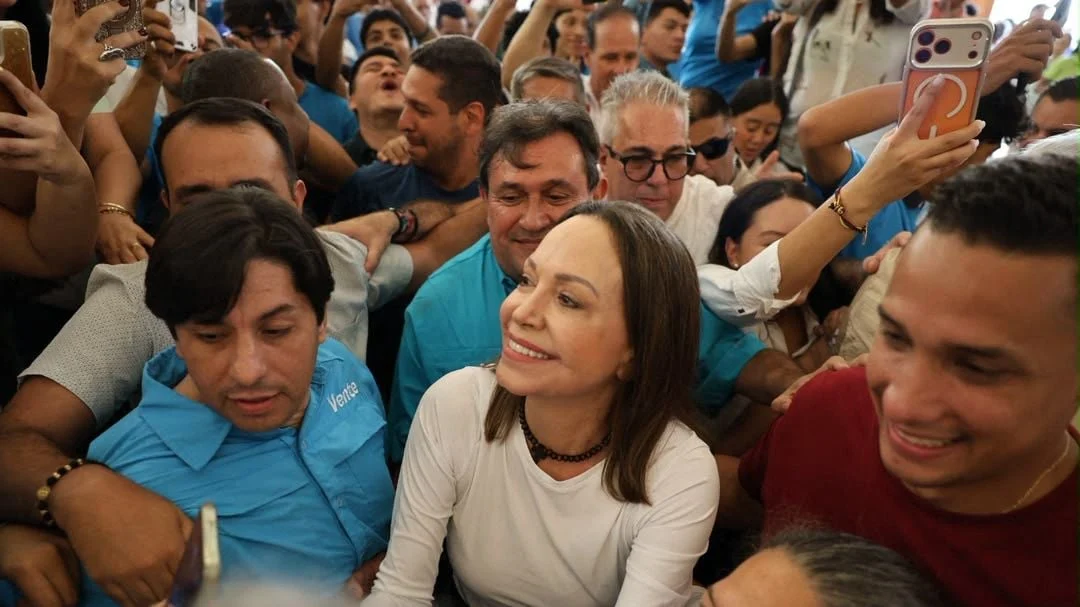
DÜSSELDORF/CARACAS – In a move that has sent shockwaves through the corridors of power in Caracas and galvanized the fractured Venezuelan opposition, María Corina Machado, the Nobel Peace Prize laureate and de facto leader of the country’s democratic movement, has returned to Venezuelan soil. After a protracted period of forced exile and multiple failed attempts to bypass the security apparatus of the Maduro regime, her arrival on Sunday marks a pivotal escalation in the nation’s long-standing political crisis.
Her return, confirmed through a succinct yet powerful message on the platform X—"I am here. With you."—signals a new chapter in the struggle for democratic restoration in a country currently grappling with economic collapse, international isolation, and a deeply entrenched authoritarian government.
The Chronology of a High-Stakes Return
The journey leading to this weekend’s arrival was fraught with systemic obstruction. For months, Machado—a former presidential candidate and the primary face of the opposition—had been a target of intense surveillance and travel restrictions.
A Pattern of Obstruction
In the months leading up to this successful entry, Machado attempted to return to Venezuela no fewer than seven times. Her efforts spanned a variety of transit methods: commercial flights, private charters, maritime routes, and overland crossings. Each time, the Venezuelan security apparatus anticipated her movements. Flights were canceled hours before departure without explanation, private vessels were detained or denied entry, and land crossings were monitored by intelligence services prepared to arrest her on sight.
For the regime, Machado represents more than a political rival; she is the symbol of the popular will that they claim to have suppressed through election engineering and repression. Her success in slipping through this dragnet suggests either a significant lapse in the regime’s intelligence capabilities or a strategic miscalculation regarding the political cost of her arrest upon arrival.
The Path to Oslo and Beyond
The roots of her recent exile trace back to December 2025. Facing an existential threat from security forces, Machado had spent over 18 months in clandestine hiding within Venezuela. She eventually emerged to travel to Oslo, Norway, to accept the Nobel Peace Prize, an honor that brought unprecedented international scrutiny to the Maduro administration. Following the ceremony, she remained in the United States and Panama, operating as a roving diplomat for the democratic cause. Her decision to return now, despite the known risks, indicates a calculated shift from external advocacy to grassroots mobilization.
Supporting Data: A Nation in Turmoil
To understand the weight of Machado’s return, one must analyze the environment to which she has returned. Venezuela remains trapped in a multi-year socio-economic decline that has triggered one of the largest migration crises in the Western Hemisphere.
Economic and Humanitarian Context
- GDP Contraction: While the regime claims a "recovery" in specific sectors, the broad economy remains a fraction of its 2013 size, severely impacted by hyperinflation and the collapse of the national oil industry.
- Migration: According to UN figures, over 7.7 million Venezuelans have fled the country, creating a brain drain that has crippled public services and private sector recovery.
- Election Controversy: The return of Machado follows the highly contested 2024 and 2025 electoral cycles, during which international observers and regional bodies raised significant concerns regarding the lack of transparency, the disqualification of opposition candidates, and the intimidation of voters.
The Opposition’s Stance
Edmundo González Urrutia, the former presidential candidate who has been a central figure in the democratic coalition alongside Machado, confirmed her arrival shortly after the news broke. "Today is an important day for all Venezuelans," González stated. His comments reflect a coordinated effort to present a unified front. His own stated intent to return soon suggests that the opposition leadership is moving toward a strategy of confrontation and presence, rather than remote leadership.
Official Responses and Regime Silence
As of Monday morning, the government of Nicolás Maduro has remained uncharacteristically quiet regarding the specifics of Machado’s entry. Historically, the regime has utilized state-controlled media to label opposition leaders as "agents of foreign imperialism" or "terrorists."
While state-affiliated outlets have acknowledged her presence, they have focused on her visit to a church in Barquisimeto. By highlighting her public appearances in religious settings, the regime may be attempting to frame her activities as "political interference" in civil society. However, the lack of an immediate attempt to detain her suggests the regime is currently weighing the optics of a high-profile arrest. Detaining a Nobel laureate who has returned to her homeland carries significant diplomatic risks, potentially triggering further sanctions or further isolating the government within the international community.
Implications: A Shift in Power Dynamics
The return of María Corina Machado creates a volatile "new normal" in Venezuelan politics.
The Mobilization Factor
Machado’s greatest strength has always been her ability to mobilize the base. In a country where the opposition has often been accused of being too disconnected from the daily hardships of the citizenry, her physical presence in local communities—such as the recent gathering in Barquisimeto—serves to re-energize the grassroots. By being "on the ground," she forces the regime to react to her movements rather than merely dictating the political narrative through state-run media.
The International Dimension
The international community, particularly the "Lima Group" nations and the United States, has been searching for a catalyst to restart stalled negotiations. Machado’s presence inside the country provides a focal point for this pressure. It remains to be seen whether the international community will leverage this moment to push for a transitional government or if the regime will choose to double down on internal security measures to force her back out.
The Risk of Escalation
The risk of political violence cannot be understated. With the security forces already on high alert, any public demonstration led by Machado could escalate into a confrontation. If the regime decides to arrest her, it would effectively end any hope of a negotiated political settlement in the near term. If they leave her free, they risk appearing weak in the eyes of their own hardline supporters.
Conclusion
María Corina Machado’s return to Venezuela is more than a personal victory; it is a tactical challenge to the Maduro regime that redefines the opposition’s strategy. By choosing to face the risks of a hostile environment, she has effectively neutralized the regime’s attempts to sideline her through distance and exile. As the country looks toward the coming weeks, the question is no longer whether the opposition has a voice, but how long that voice will be permitted to echo in the streets of Caracas.
The stage is set for a high-stakes standoff. Whether this leads to a process of democratic opening or a deepening of the authoritarian grip will depend on the resilience of the Venezuelan public and the willingness of the international community to stand behind the democratic movement at this critical juncture. For now, the sentiment among her supporters is clear: the leader is back, and the political equation in Venezuela has been permanently altered.