In the silent, vast expanse of the cosmos, the James Webb Space Telescope (JWST) has captured evidence of one of the most violent spectacles in the universe: the planetary “demolition derby.” Astronomers have recently documented concrete traces of massive, destructive collisions occurring within young star systems. By focusing on a rare class of astrophysical structures known as “extreme debris disks,” researchers are gaining an unprecedented look at the chaotic, formative years of planetary development—a phase that likely mirrors the turbulent history of our own solar system.
These extreme debris disks are defined by their unusually high concentrations of warm dust, located precisely in the regions where terrestrial, rocky planets typically orbit their parent stars. According to current astrophysical estimates, only about one percent of young stars exhibit these telltale signatures, marking them as sites of extreme dynamical activity.
The New Frontier: A Robust Data Foundation
The research, led by astronomer Kate Su of the Space Science Institute in Colorado, provides a comprehensive analysis of 21 such extreme debris disks. The findings, published in The Astrophysical Journal, represent a milestone in our understanding of planetary evolution.
To achieve this, the team synthesized data from 16 observations conducted directly by the James Webb Space Telescope with five historical datasets salvaged from the archives of the now-retired Spitzer Space Telescope. This hybrid approach allowed scientists to define the “extreme” subclass with newfound precision, creating a clear distinction between these violent environments and more mature systems such as Vega or Fomalhaut.
In classic systems like Vega or Fomalhaut, the debris is largely settled. The material resides far from the host star, resembling the Kuiper Belt at the edge of our own solar system. Crucially, these older systems lack the warm, inner-zone dust that characterizes the extreme disks, serving as a reminder that such violent collisions are a transient, albeit critical, phase in a system’s lifespan.
Mineralogical Fingerprints of Chaos
Through the lens of mid-infrared spectroscopy, the research team identified three defining characteristics shared by all 21 extreme systems: a prevalence of significantly smaller dust grains compared to classic disks, an exceptionally high concentration of warm dust, and erratic, unpredictable fluctuations in brightness.
Beyond these commonalities, the team categorized the systems into two distinct mineralogical groups: those rich in silica (silicon dioxide) and those poor in silica. This classification acts as a forensic tool, allowing astronomers to infer the energy levels of the collisions that birthed the dust.
The Theia Hypothesis: A Historical Equivalent
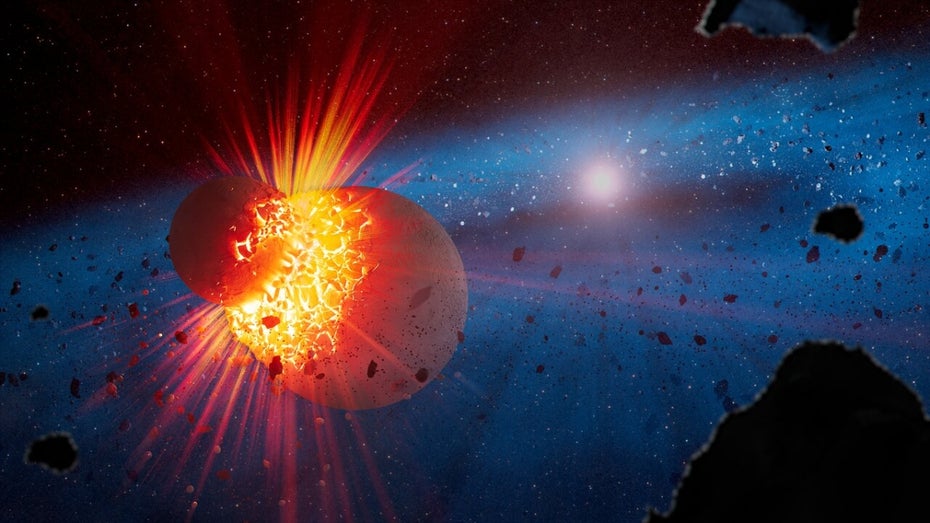
The presence of high silica content in roughly one-third of the samples provides a dramatic window into the physics of the early universe. Scientists conclude that such high concentrations are the signature of high-energy, high-velocity collisions between bodies of planetary mass—specifically objects the size of Mars. In these cataclysmic impacts, a substantial portion of the rocky material is vaporized upon contact, cooling later to form the specific silica-rich dust observed by Webb.
This provides a direct, albeit distant, analogy to the formation of our own Moon. According to the leading “Giant Impact Hypothesis,” the Earth-Moon system was forged approximately 100 million years after the birth of the Sun, when a Mars-sized protoplanet named Theia collided with the proto-Earth. The debris resulting from this colossal impact eventually coalesced to form the Moon. The JWST data suggests that this process is not a historical anomaly unique to our system, but a standard—if violent—rite of passage for terrestrial planets across the galaxy.
The remaining two-thirds of the analyzed disks, which are silica-poor, suggest a different, less destructive history. These are likely the result of lower-velocity, “grazing” collisions between smaller bodies, perhaps the size of our Moon, which do not generate the extreme heat required to vaporize and re-mineralize the debris into high-silica dust.
The Chronology of Planetary Construction
One of the most profound revelations of the study is the temporal mapping of these events. The JWST observations revealed that silica-rich disks—the sites of the most massive, Mars-sized collisions—are found exclusively around stars younger than 300 million years.
This window of time aligns perfectly with theoretical models of terrestrial planet formation. The period during which a system builds its inner planets is inherently unstable, characterized by the final, frantic sweep-up of “planetary embryos.” Once the major rocky planets have finished coalescing and cleared their orbital neighborhoods, the frequency of such catastrophic collisions drops precipitously.
Official Perspectives: Looking Through the Infrared
"This is the first time we have been able to compile enough systems to truly understand this subclass," stated lead author Kate Su in a press release from the European Space Agency (ESA). Prior to the deployment of the James Webb Space Telescope’s sophisticated infrared sensors, the scientific community had to rely on fragmented and rudimentary data. The chaotic nature of these young systems made them difficult to characterize; they were simply too far away and too small to observe directly.
Agnes Kospal, an astronomer at the Konkoly Observatory in Budapest and a co-author of the study, highlighted the necessity of infrared spectroscopy. "There is simply no other way to study planetary embryos directly," she explained. Because these bodies are dwarfed by the glare of their parent stars, researchers cannot image them directly. Instead, they must “read” the infrared signatures—the heat and light emitted by the dust clouds created during the smash-ups—to reconstruct the history of the objects that produced them.
Implications: Gas Giants and Late-Stage Instability
The study also offers a potential explanation for the behavior of older, silica-poor systems that continue to show high variability in brightness. The researchers hypothesize that this ongoing instability is driven by the late-stage migration of gas giants.
In our own solar system, the “Late Heavy Bombardment” is believed to have been triggered by the gravitational influence of shifting gas giants, which sent smaller icy and rocky bodies careening into the inner solar system. If the older, silica-poor disks observed by Webb are indeed undergoing similar orbital instabilities, it suggests that the “chaos phase” of a planetary system may be a prolonged, multi-stage process rather than a single, isolated event.
This builds upon previous observations, such as those of the exoplanet Beta Pictoris d. Earlier studies have already demonstrated the JWST’s uncanny ability to detect subtle gravitational perturbations. By combining these measurements of orbital shifts with the new spectral data on debris composition, astronomers are now able to connect the "cause" (gravitational instability) with the "effect" (massive, debris-producing collisions).
Future Outlook: A Larger Statistical Sample
While the current findings are revolutionary, the research team remains cautious. Attila Moor, also of the Konkoly Observatory, notes that while the current data set is the most robust to date, it is still statistically limited. The team’s goal is to expand the study to a broader range of star systems, particularly those that are older, to determine if the 300-million-year cutoff for high-energy collisions holds true across all galactic environments.
"We are currently working to refine our models," Moor stated. "The hypothesis that we will not find silica-rich, high-energy systems around older stars is a testable prediction. If we continue to observe older systems and find only silica-poor, low-energy debris, it will empirically validate our current understanding of the timeline of planet formation."
Conclusion: A Violent But Necessary Past
The findings from the James Webb Space Telescope serve as a humbling reminder of the violence inherent in the creation of habitable worlds. For life to potentially thrive on a planet, it must first survive the chaotic infancy of its home system. The "extreme debris disks" observed by Webb are not just cold, dusty rings of rock; they are the graveyards of planetary embryos and the nurseries of new worlds.
As the JWST continues its mission, it will undoubtedly provide even more granular detail on these cosmic collisions. By mapping the debris, measuring the mineralogy of the dust, and timing these events with the life cycles of stars, humanity is finally piecing together the tumultuous biography of our own origins. We now know that the Earth’s own violent birth was not a lonely accident, but a part of a grand, recurring, and essential script played out by the stars.