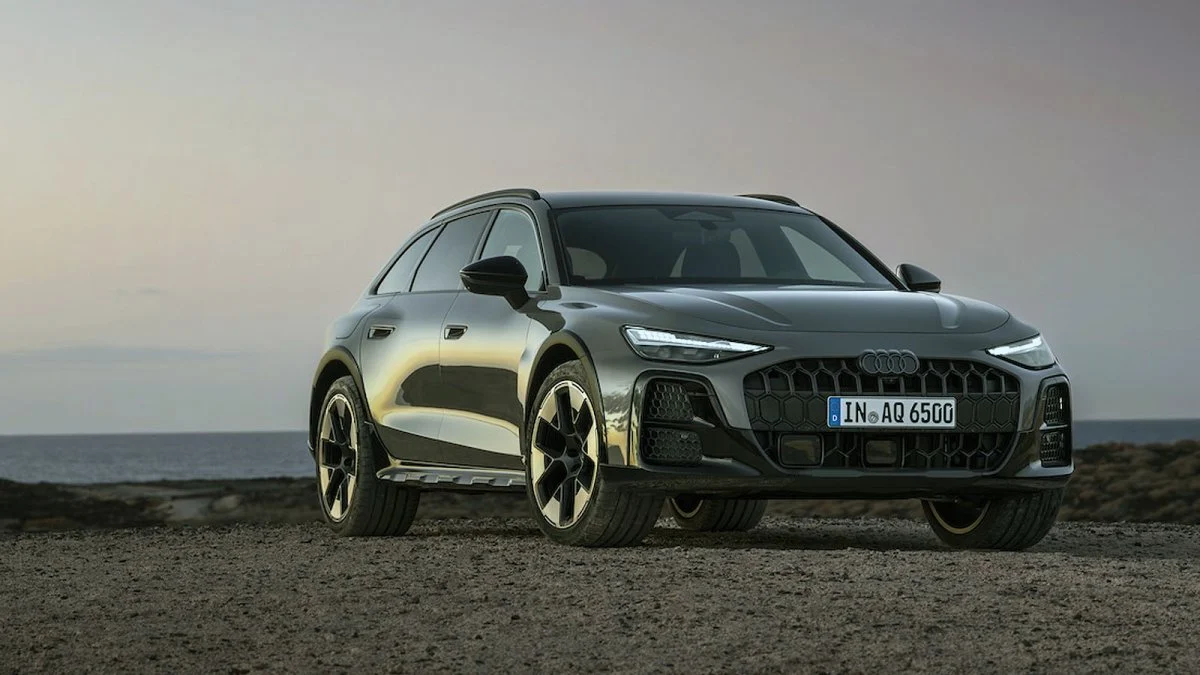
When Volvo introduced the Cross Country concept in the late 1990s, the automotive world was puzzled. Was it a station wagon? An SUV? A compromise? Audi responded in 1999 with the A6 allroad quattro, a vehicle that turned that initial skepticism into a cult-like following. Today, the "allroad" badge has become synonymous with a specific kind of luxury: the ability to traverse rough terrain without sacrificing the refined road manners of an executive estate. With the launch of the 2026 Audi A6 Allroad, the Ingolstadt-based manufacturer is doubling down on this legacy, proving that while the world may be obsessed with SUVs, there is still a sophisticated niche for the elevated wagon.
Main Facts: Refined Capability and Bold Aesthetics
The 2026 Audi A6 Allroad arrives with a clear mission: to offer more than just a standard A6 Avant while maintaining its pedigree as a long-distance cruiser. At its core, the vehicle remains an A6, but one that has undergone a significant visual and physical transformation.
The most notable change is the vehicle’s stance. Audi has equipped the 2026 model with an adaptive air suspension system that allows the driver to adjust the ride height at the touch of a button. The body can be lowered by 20 mm from its standard setting for high-speed efficiency or raised in two stages (15 mm or 35 mm) to navigate uneven terrain. In total, the A6 Allroad offers 34 mm more ground clearance than its standard wagon counterpart.
Visually, the vehicle has grown significantly in width—expanding by 11.1 cm to reach nearly two meters. While this provides a muscular, "RS-style" presence, it also presents practical challenges. In urban environments, the increased width makes maneuvering in tight parking garages or narrow city streets more cumbersome. It is a design choice that prioritizes aesthetic dominance over urban agility, reinforcing the notion that the Allroad is built for the open road rather than the tight confines of a city center.
Chronology: A Quarter-Century of Evolution
The journey of the A6 allroad is a testament to Audi’s ability to read shifting consumer preferences.

- 1999: The original A6 allroad is launched, featuring rugged, unpainted plastic cladding and pioneering air suspension. It was a bold answer to the rising tide of early SUVs.
- 2000–2010: The model solidifies its place in the market. While early iterations featured genuine off-road hardware meant for challenging trails, the marketing and engineering focus gradually shifted.
- 2010–2020: The "allroad" aesthetic—wider wheel arches, stainless steel underbody guards, and elevated ground clearance—becomes a fashion statement as much as a functional one. The target audience consistently proves they value the appearance of adventure more than the act of mud-plugging.
- 2026: The new generation arrives, embracing the philosophy of "luxury-first." It acknowledges that modern customers demand the premium technology of an A6 executive sedan, wrapped in the versatility of a high-riding, all-wheel-drive package.
Supporting Data: Technical Specifications and Performance
The 2026 A6 Allroad is not a light vehicle, and its performance metrics reflect a commitment to high-speed stability and long-range comfort.
Engine and Powertrain
At launch, the A6 Allroad is offered with two primary configurations:
- The V6 Diesel: A 3.0-liter turbocharged engine delivering 220 kW and a substantial 580 Nm of torque. As a mild-hybrid, it utilizes a 48-volt starter-generator that provides an additional 18 kW of power, smoothing out power delivery and improving efficiency during stop-start driving.
- The Plug-in Hybrid (PHEV): This powertrain combines a 2.0-liter four-cylinder engine (185 kW) with a 105 kW electric motor. The total system output is 270 kW. The 20.7 kWh battery allows for an impressive WLTP-rated electric range of up to 95 kilometers.
Dimensions and Practicality
Despite its five-meter length and a generous 2.93-meter wheelbase, the A6 Allroad faces a paradoxical issue: trunk space. Due to the packaging requirements of the hybrid systems and the suspension components, the trunk capacity under the cover ranges from a modest 404 to 466 liters. For context, many cars significantly smaller than the A6 offer similar or greater cargo volume. The maximum capacity of 1,497 liters is respectable, but it serves as a reminder that the Allroad prioritizes cabin comfort and design over pure utility.
Charging Constraints
A point of contention for potential buyers is the lack of DC fast-charging for the PHEV model. The vehicle relies on 11 kW AC charging, meaning a full recharge takes approximately 2.5 hours. While sufficient for home or office charging, it lags behind the rapid-charging capabilities seen in pure electric vehicles (BEVs) of similar pricing tiers.
Official Responses and Strategic Positioning
Audi’s strategy for the 2026 A6 Allroad is clear: they are catering to a loyal, affluent demographic that views the car as a lifestyle accessory. During press briefings, Audi representatives emphasized that the "allroad" is an evolution, not a revolution.

"We know our customers," an Audi spokesperson hinted. "They want the comfort of a high-end sedan and the confidence of an all-wheel-drive system that can handle a gravel road or a snowy driveway. They do not want a truck."
This is confirmed by the tire and wheel strategy. The vehicle comes standard with 19-inch wheels, with options up to 21 inches. These are performance-oriented tires designed for high-speed autobahn travel—not for mud or rock crawling. Audi has explicitly designed these tires for safety and noise reduction at speeds up to 250 km/h. When asked if they would provide a "rugged" tire option, Audi noted that they could adapt the vehicle quickly should the market demand it, but currently, the focus remains on "rasanz"—speed and poise.
Implications: The Luxury Market and Future Outlook
The release of the 2026 Audi A6 Allroad carries several implications for the automotive landscape:
The "SUV-ification" of Everything
The success of the A6 Allroad highlights the paradox of the modern automotive market. Even as the industry moves toward electrification, consumers remain obsessed with the "raised" aesthetic. Audi has successfully taken a sedan, added plastic cladding and an air suspension, and created a model that commands a significant premium over the base Avant. The A6 Allroad starts at €77,250, while the base A6 Avant with the same diesel engine is priced at €71,000. That €6,250 gap is paid almost entirely for the image and the added ride height.
The PHEV Dilemma
The inclusion of a 2.0-liter PHEV in a vehicle of this size indicates that Audi is attempting to balance fleet emission regulations with customer demand for powerful, long-range vehicles. However, by limiting the charging speed to 11 kW AC, Audi is betting that the majority of their customers will charge primarily at home or work, rather than relying on public charging infrastructure. This is a gamble that assumes a certain level of socioeconomic status among the owner base—those with private garages or dedicated charging points.

The Future of the Estate Car
Critics have long predicted the death of the station wagon, yet the A6 Allroad continues to thrive. Its survival is due to its ability to offer a "best of both worlds" proposition: it is not as cumbersome as a massive luxury SUV, yet it offers more road presence than a standard sedan. The 2026 model reinforces the idea that the station wagon can be a status symbol if marketed correctly.
Conclusion
The 2026 Audi A6 Allroad is a masterclass in positioning. It is a vehicle that recognizes its own limitations—it is not an off-roader, and it is not a cargo hauler—but it excels at being an elegant, capable, and highly desirable long-distance tourer. By maintaining the iconic rugged looks while leaning into modern hybrid technology and interior luxury, Audi ensures that the Allroad remains relevant in an era dominated by SUVs.
For the buyer who wants the prestige of an Audi A6 but demands a vehicle that stands out from the corporate parking lot, the 2026 Allroad is, quite literally, the peak of the mountain. It may not be the most practical choice, but it is certainly one of the most compelling.