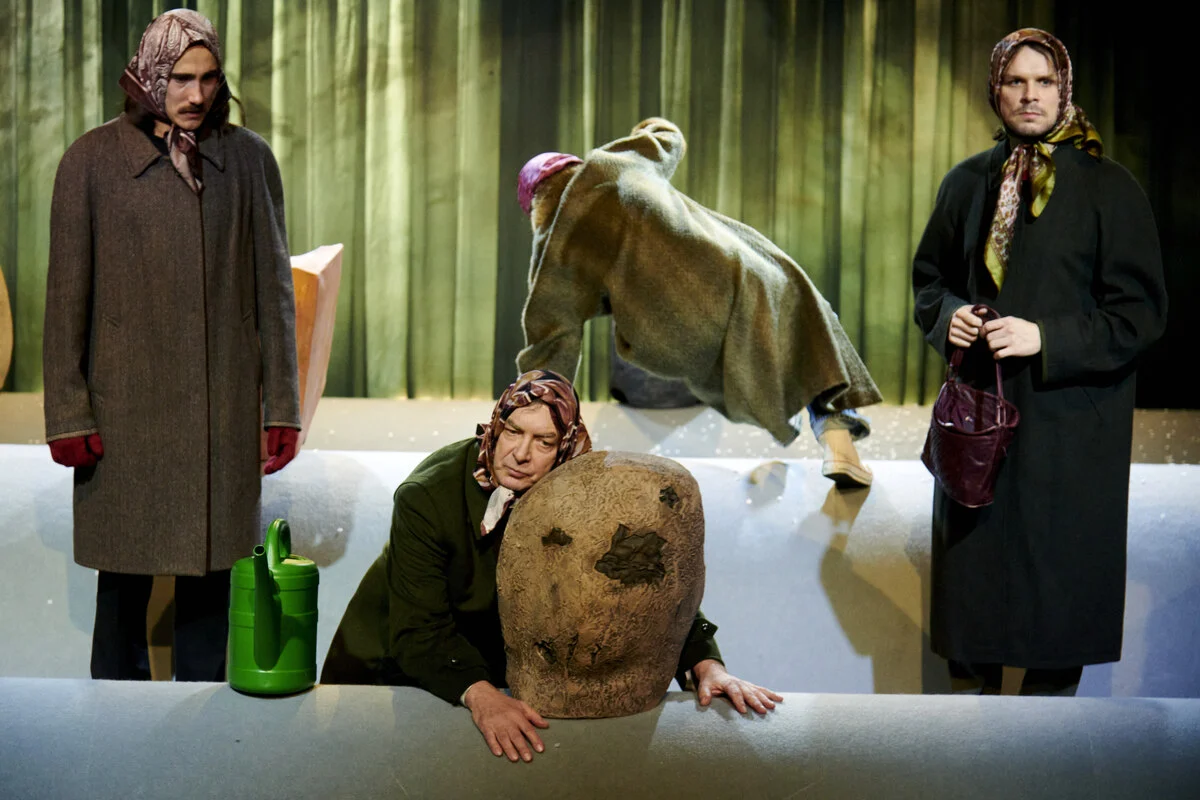
Osnabrück, Germany – The specter of the Yugoslav Wars, a conflict that tore through the Balkans in the 1990s, continues to cast long shadows over the present, its complexities and human cost resonating deeply in contemporary European discourse. These profound tremors are precisely what director Demjan Duran masterfully brings to the stage at the Theater Osnabrück with his adaptation of Saša Stanišić’s evocative collection of stories, notably featuring the titular narrative, "Möchte die Witwe angesprochen werden, platziert sie auf dem Grab die Gießkanne mit dem Ausguss nach vorne" (If the Widow Wishes to Be Addressed, She Places the Watering Can with the Spout Forward on the Grave). This production is not merely a theatrical interpretation but a vibrant, often unsettling, and ultimately hopeful exploration of identity, displacement, and the relentless human quest for belonging in a fragmented world.
At its core, the play grapples with the lingering trauma of war, seen through the eyes of those who fled it and found a new, often perplexing, home in Germany. Stanišić, a Bosnian-German author celebrated for his distinctive voice and poignant observations, imbues his narratives with a blend of sharp wit, deep empathy, and surreal humor. Duran’s staging acts as a potent amplifier for these themes, inviting audiences to confront uncomfortable truths while simultaneously being captivated by a theatrical inventiveness that pushes the boundaries of conventional storytelling. The production stands as a powerful testament to the enduring impact of historical events on individual lives and the vital role of art in processing, questioning, and ultimately, envisioning alternative futures.
The Author and His World: Saša Stanišić’s Literary Tapestry
Saša Stanišić is a literary phenomenon, born in Višegrad, Bosnia and Herzegovina, in 1978. He fled with his family to Germany during the Bosnian War in 1992, an experience that profoundly shaped his writing. His works, including the acclaimed novels "How the Soldier Repairs the Gramophone" and "Before the Feast," and the German Book Prize-winning "Where You Come From," are characterized by their intricate narratives, playful language, and profound engagement with themes of memory, identity, and the immigrant experience. Stanišić possesses a unique ability to weave together personal anecdotes, historical facts, and fantastical elements, creating a narrative fabric that is both deeply personal and universally resonant.
The collection of stories from which the Osnabrück production draws its material is a prime example of Stanišić’s distinctive style. While the longer, titular story, "If the Widow Wishes to Be Addressed…", serves as an anchor, the entire body of work delves into the absurdities and anxieties of life as an outsider, an observer navigating the nuances of a new culture. His characters often find themselves in liminal spaces, grappling with the echoes of a past that refuses to fade and the challenges of integrating into a present that doesn’t always understand them. Stanišić’s prose is not just descriptive; it is a meticulously crafted landscape of emotions, observations, and subtle societal critiques, all delivered with an underlying current of human resilience and the search for meaning.
The Director’s Vision: Demjan Duran’s Theatrical Transformation
Demjan Duran, like Stanišić, carries a personal connection to the legacy of the Yugoslav Wars, having also come to Germany in their wake. This shared biographical thread creates a palpable synergy between the director and the source material, lending an authentic and deeply informed perspective to the adaptation. Duran’s directorial approach is characterized by a bold willingness to experiment with form and an unwavering commitment to the emotional core of the narrative. Recognizing the inherent challenges of translating Stanišić’s dense, multi-layered prose to the stage, Duran embarked on a significant abridgment, condensing the original 256 book pages into a concise 49 pages of stage text. This surgical reduction, far from diminishing the work, sharpens its focus and highlights the most potent thematic elements.

Duran’s adaptation is a masterclass in theatrical storytelling, employing a fluid, dynamic style that blurs the lines between narrative modes. The production opens with text projected onto the stage – "On a hot vineyard afternoon in June 1994, Fatih throws a stone into the air…" – a direct nod to the literary origin. This textual presence is then gently transformed into spoken narrative by an actor, who seamlessly transitions from addressing the audience directly as a narrator to embodying the characters themselves. This constant morphing between direct address, character dialogue, and scenic play creates an immersive and highly engaging experience, mirroring the fragmented and fluid nature of memory and identity that Stanišić explores. It is an approach that respects the literary foundation while fully embracing the unique possibilities of live performance.
Navigating the German Landscape: Impressions of Displacement and Belonging
The play, much like Stanišić’s original stories, offers a series of vignettes from the perspective of an immigrant, lovingly imbued with satirical undertones. These are impressions of German provincial life, replete with its peculiar self-evident truths, quirky idiosyncrasies, and, at times, alarming developments. The author’s personal anxieties are laid bare, manifesting in a visceral feeling of being unable to "sleep safely." This unease is articulated through a powerful monologue that lists stark realities: "Hanau. The AfD. Struggle and hardship. Mother, silently crying in the kitchen while buttering bread before work. Feeling guilty in front of the cops without having done anything wrong."
This passage, delivered with raw honesty, encapsulates the multifaceted challenges faced by many immigrants: the trauma of violence (Hanau), the rise of right-wing populism (AfD), economic struggle, racial profiling, and the pervasive everyday racism that chips away at one’s sense of security and belonging. It’s a stark reminder that even in a country priding itself on its openness, systemic issues and prejudices persist, creating a climate of apprehension for those who are perceived as "other." Yet, despite this stark portrayal of tristesse, Stanišić’s stories, and by extension Duran’s staging, are suffused with an empathetic wit and wonderfully outlandish literary inventions. The narratives never descend into pure despair; instead, they find moments of levity, absurdity, and profound human connection, offering a nuanced view of resilience in the face of adversity. Duran, with playful earnestness, seeks out theatrical equivalents for these literary flourishes, creating a stage world that is both thought-provoking and often amusing.
Theatrical Innovations: Playful Means, Profound Messages
Duran’s direction is characterized by a bold embrace of theatricality, employing "crazy ideas" and "playful means" that, while not always overtly logical, are consistently entertaining and often deeply resonant. The stage becomes a canvas for imaginative expression, where physical comedy and symbolic gestures intertwine with serious thematic explorations.
One striking example involves performers, adorned with life jackets, rescue rings, or fishing nets, undulating across the stage’s uneven terrain like seals. This peculiar imagery can be interpreted as a metaphor for the precarious journey of migration, the struggle for survival in an unfamiliar environment, and the constant negotiation between land and water, safety and danger. Similarly, actors springing up mechanically like figures in a music box, only to vanish again, evoke the fleeting nature of presence and the sense of being controlled by unseen forces, perhaps reflecting the bureaucratic labyrinth faced by immigrants.

Another poignant scene features actors as rolling tulle balls, engaging in dialogue with the character Dilek. Dilek recounts her past as a goat herder in Turkey, celebrates her escape to Germany, and her current life as a cleaning lady, all while contemplating the possibility of returning or embarking on yet another journey. The ethereal, shifting forms of the tulle balls, combined with Dilek’s narrative of constant movement and re-evaluation, beautifully symbolize the fluidity of identity and the perpetual state of flux that defines the migrant experience.
The production does not shy away from confronting darker societal currents. A scene depicting a card game among "anti-woke" regulars at a pub is particularly potent. The characters initially wear full-head masks resembling pebbles, a visual metaphor for their hardened, unyielding perspectives. These masks are only removed when someone, with a chilling Hitler salute, greets a man in a Wehrmacht uniform who has just had a fully grown tank delivered to his doorstep. This satirical, yet deeply unsettling, sequence uses grotesque imagery to expose the insidious presence of right-wing extremism and historical revisionism in contemporary society, highlighting the ease with which dangerous ideologies can infiltrate the everyday.
While Duran prioritizes music in his staging, one particular musical interlude elicits a mixed response. A five-person ensemble performs "Kumbaya, my Lord" and "Amazing Grace" during a church service, encouraging audience participation through humming and clapping. While well-intentioned, the reviewer notes this interaction as "consequence-free," both thematically and aesthetically. It suggests that while music can be a powerful unifier, here it might have served more as a momentary diversion than a deeply integrated thematic element, perhaps lacking the narrative punch of other theatrical choices.
Shared Journeys: Director, Author, and the Search for Identity
A crucial aspect that elevates this production is the profound biographical connection between the director, Demjan Duran, and the author, Saša Stanišić. Both men arrived in Germany as a direct consequence of the Yugoslav Wars and grew up in their adopted homeland. This shared experience of displacement, of navigating two cultures, and of searching for a coherent identity between a country of origin that is often fractured by conflict and a new home that presents its own set of challenges, forms the emotional bedrock of the play.
Their artistic collaboration thus becomes a powerful dialogue on the universal human quest for identity – the struggle to reconcile one’s heritage with the realities of a new environment, to find a sense of belonging in a "foreign home." This shared journey infuses the production with an undeniable authenticity and emotional depth, allowing them to explore complex themes of cultural assimilation, generational trauma, and the continuous process of self-definition with nuance and sensitivity.

The figure of Heinrich Heine, the revolutionary romantic poet, emerges as a significant symbolic presence on stage, already woven into Stanišić’s original text. On stage, Heine becomes an almost tangible dialogue partner for Saša, a historical voice resonating with contemporary concerns. Through imagined encounters and exchanges, Saša grapples with concepts of freedom, fairy tales, exile, political awakening, and the pervasive feeling of marginalization. Heine, himself an exile and a keen observer of societal shifts, provides a historical mirror for Stanišić’s modern predicament, underscoring the timeless nature of these themes. The play argues that the struggles of displacement and the search for identity are not new, but rather part of a continuous human narrative, finding echoes across centuries.
Imagining Futures: Escaping the Present "Shittiness"
The production quickly aligns itself with Stanišić’s core message: to prevent the "shittiness" of the here and now from becoming the "shittiness of the future," a migrant clique proposes an ingenious solution – a "fitting room for life." This conceptual space invites individuals to "log in" and try on different versions of imaginable futures, to experiment with alternative life models. This fictional device is an ideal metaphor for the theatre itself, which, as a space of illusion and possibility, allows audiences to engage with alternative realities and consider different ways of being.
The idea of the "fitting room for life" is a radical proposition for agency. It challenges the fatalistic acceptance of present circumstances and instead champions the power of imagination and proactive engagement. It’s about recognizing that while one might not be able to change the past, the future is still unwritten and open to influence. Fatih, one of the characters, poses the poignant question: "You can’t afford the future, but now you know it’s possible. So what do you do in the present…?" This question serves as a direct provocation to the audience, urging them to consider their own capacity for shaping their realities.
From Biography to Self-Creation: The Call to Action
The response to Fatih’s question, offered by another character, Michel, is simple yet profound: "We make an effort?" Saša confirms this, stating, "The answer was correct and immediately obvious to everyone!" This exchange crystallizes the play’s ultimate call to action: to break free from the "prison of one’s own biography" and to actively engage in the self-creation of future scenarios. It’s a powerful endorsement of personal agency and the idea that one’s past does not entirely dictate one’s future. This isn’t an escape from reality, but rather an escape into a reality that is actively chosen and constructed.
The play offers two compelling examples of this transformative process. Firstly, there is Widow Gisela herself. True to the book’s title, she places a watering can with the spout forward on her husband’s grave – a clear, symbolic gesture of her openness to new relationships, a willingness to embrace new life beyond grief and convention. Her act is a quiet revolution, a personal declaration of continued existence and hope. Secondly, there is Saša, the author figure, who reads and reads and reads, initially perhaps as a refuge in the literature of others. But ultimately, through this immersion, he transforms himself, becoming a writer in his own right, creating his own narratives and thereby his own future. His journey from consumer of stories to creator of stories embodies the very essence of self-empowerment.

Critical Reception and Lasting Implications
While the production naturally condenses the intricate source material and, as a result, does not always bring every plot thread and character arc to a definitive conclusion within its episodic dramaturgical structure, its strengths far outweigh any minor shortcomings. The characters, despite the rapid role changes performed by the five-person ensemble, blossom with warm, precise portrayals. Each performer maintains a distinct "Duktus," a unique manner of expression, allowing for seamless transitions between roles and contributing to the play’s vibrant energy. The constant shifting of roles underscores the multifaceted nature of identity and the idea that we all play many parts throughout our lives.
The "Mutmacherthese" – the encouraging thesis at the heart of Stanišić’s work – is delivered with palpable theatrical impact. It transcends mere intellectual discourse, arriving "over the ramp" as a genuine animation to action. The play’s core message is not just about understanding the complexities of migration and identity but about actively engaging with them, about finding the courage to imagine and build better futures.
The Osnabrück production of Saša Stanišić’s stories, under Demjan Duran’s insightful direction, is more than just a theatrical event; it is a vital cultural intervention. It confronts the lingering specters of war and displacement, the insidious rise of xenophobia, and the anxieties of a fragmented society. Yet, it does so not with despair, but with an insistent, imaginative hope. By encouraging audiences to envision and actively pursue alternative life models, the play serves as a powerful reminder of human resilience, the transformative power of art, and the collective responsibility to shape a more inclusive and equitable future. It is a resounding call to action, urging us all to participate in the "fitting room for life" and to craft narratives of possibility from the "shittiness" of the present.