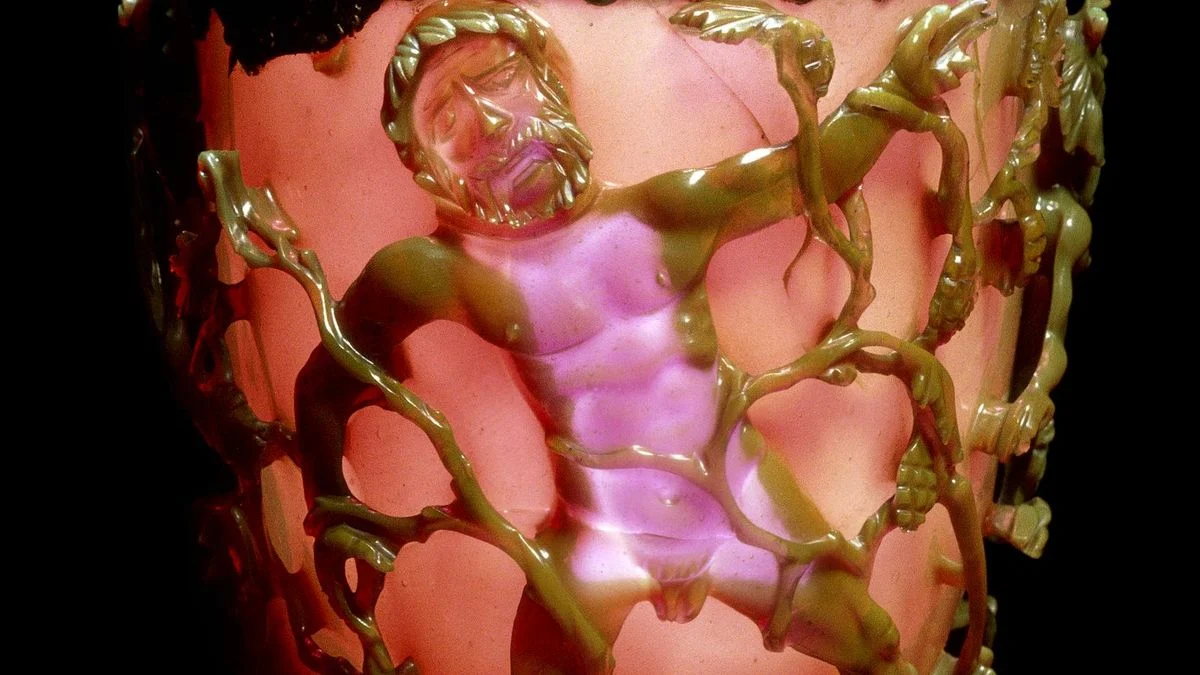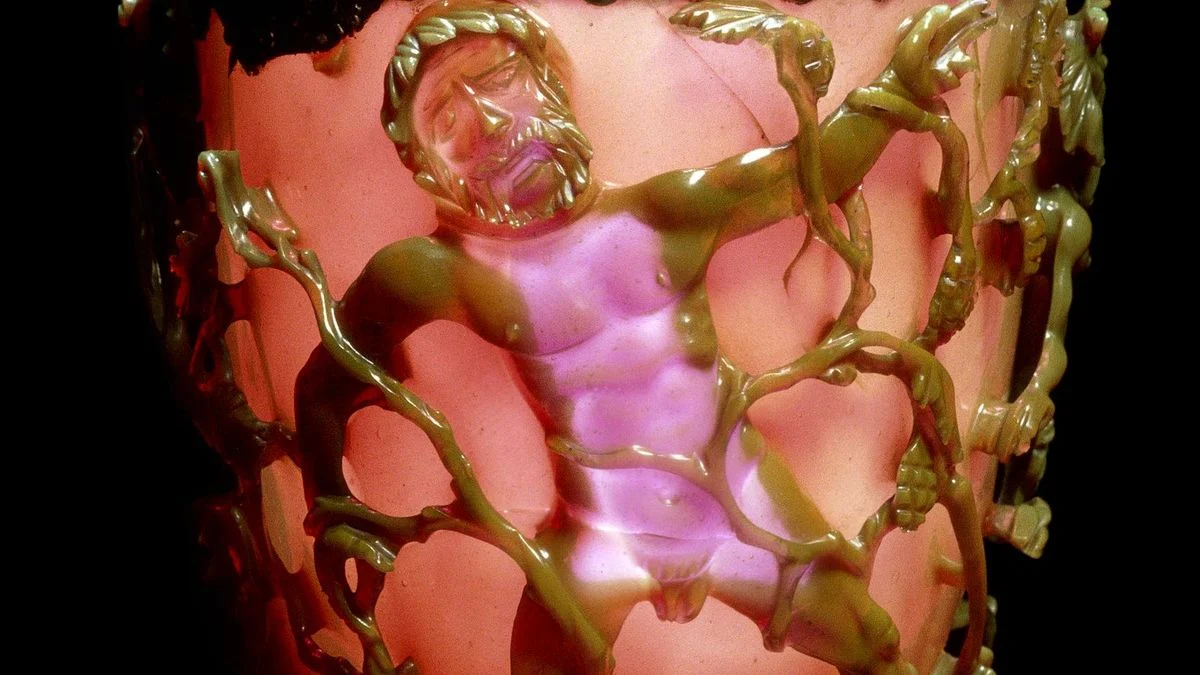
For over 1,600 years, the Lycurgus Cup has stood as a silent, shimmering sentinel of antiquity, a masterpiece of Roman glassmaking that has defied explanation and mocked modern attempts at replication. Like a chameleon frozen in time, the vessel possesses an uncanny, almost supernatural ability: it changes color depending on the direction of the light. When illuminated from behind, the glass glows with a deep, pulsating ruby-red; when lit from the front, it appears as an opaque, jade green.
For centuries, this optical phenomenon remained a subject of intense debate among historians, chemists, and glassmakers. Now, a breakthrough study by researchers at the University of Sheffield, as reported by The Guardian, has finally cracked the code, allowing scientists to replicate the precise "color trick" that once mystified the ancient world.
The Masterpiece of the Fourth Century
Housed in the hallowed halls of the British Museum, the Lycurgus Cup is not merely a feat of chemistry; it is a narrative work of art. Standing approximately 16 centimeters tall and weighing roughly 700 grams, the cage-cup—or diatretum—features intricate, high-relief carvings depicting a scene from Greek mythology. In the scene, the god of wine, Dionysos, triumphs over King Lycurgus, who is ensnared by a vengeful grapevine.
The cup is reinforced by a gilded silver rim and foot, adorned with delicate vine leaves. Since 2022, it has been officially recognized as one of the "Seven Glass Wonders of the World." Beyond its aesthetic grandeur, the cup serves as a profound puzzle. Ian Freestone, an emeritus professor of archaeological materials at University College London, has long posited that the color shift was intentional. He suggests the transition from green to red may have been designed to symbolize the ripening of grapes—a sophisticated play on the cup’s function as a vessel for wine.
Chronology of a Scientific Pursuit
The history of the Lycurgus Cup is a narrative of obsession. Since its discovery and eventual entry into the British Museum’s collection, scholars have struggled to understand how a civilization without the benefit of microscopes, electron beams, or modern chemical synthesis could achieve such precise molecular control.
- 4th Century AD: The cup is crafted in the Roman Empire, likely by a master artisan using techniques lost to time.
- 19th Century: The arrival of the cup in Western museums triggers intense scientific curiosity. Early theories suggested the inclusion of precious stones or pigments.
- 1990s: Advanced microscopy confirms the presence of "nanoparticles" within the glass matrix, sparking the realization that the Romans were accidental, if not intentional, pioneers of nanotechnology.
- 2024–2025: Researchers at the University of Sheffield undertake a rigorous experimental project to recreate the cup’s properties using contemporary manufacturing techniques.
- October 2026: Findings are published, detailing the successful replication of the dichroic effect, effectively closing a 1,600-year-old investigation.
The Nanotechnology of Antiquity
The secret behind the Lycurgus Cup lies in the sub-microscopic realm. To achieve the color-shifting effect, the Roman glassmakers integrated silver and gold particles into the glass—particles roughly a thousand times smaller than a single grain of sand.
These gold and silver nanoparticles interact with light in a way that modern physics identifies as "surface plasmon resonance." When light passes through the glass from the inside, the particles scatter the light such that only the red and orange wavelengths penetrate, effectively filtering out the blue and green. Conversely, when light hits the surface from the outside, it is reflected and scattered by the metallic particles, creating the distinct jade-green appearance.
The process of recreating this was described by Lisa Hollands, a technician at the University of Sheffield’s Faculty of Engineering, as a "herculean task" and a "labor of love." Previous attempts by various laboratories had yielded only moderate success, often resulting in muddy colors or inconsistent transitions. The breakthrough in Sheffield required meticulous control over the furnace environment, ensuring that the metallic particles were dispersed with the exact density and uniformity required to trigger the optical shift.
Official Perspectives: Humility in the Face of Genius
The success of the Sheffield team has brought a renewed sense of humility to the scientific community. Despite our advanced technology, replicating the Roman technique required an intimate understanding of high-temperature chemistry that the ancients seemingly mastered through intuition and trial-and-error.
"For me, it is magic," said Lisa Hollands. She noted that the process was fraught with difficulties, highlighting how dependent the success was on the specific placement of the glass within the kiln.
Perhaps the most poignant moment of the research occurred when the team stood before the results of their labor. Reflecting on the sheer ingenuity of the Roman artisans, Hollands remarked: "If the Romans could have watched me experimenting, they would have likely laughed and asked: ‘Why doesn’t she know how to do this?’"
This sentiment is shared by many in the field. The project serves as a stark reminder that "modern" scientific advancement is often just a rediscovery of knowledge that was lost to the collapse of civilizations. The Roman artisans were not merely blowing glass; they were conducting controlled nanotechnology experiments, albeit without the nomenclature of the 21st century.
Implications for Material Science and Archaeology
The implications of the Sheffield study extend far beyond the history of decorative arts. By understanding the precise conditions required to embed metallic nanoparticles into a glass matrix, researchers are gaining insights into the development of new, functional materials.
1. Advanced Optoelectronics
The principles governing the Lycurgus Cup’s color-shifting properties are directly applicable to the development of modern optical sensors and color-changing coatings. The ability to manipulate light at the nanoscale level could lead to more efficient filters, advanced data storage devices, and even smart windows that regulate heat and light intensity based on solar orientation.
2. Historical Methodology
The study provides a new lens through which we view Roman manufacturing. It suggests that the Roman glass industry was far more technologically advanced than previously assumed. If a master craftsman could manipulate gold and silver at a nanometer scale, what other hidden technologies might be waiting to be "rediscovered" in the archaeological record? The Sheffield team’s success proves that we can reverse-engineer ancient "lost" technologies to inform current industrial practices.
3. Preservation of Cultural Heritage
The replication project also underscores the importance of physical artifacts in science. By using a small fragment of a Roman original as a reference point, the researchers were able to calibrate their experiments against an authentic baseline. This highlights the vital importance of museum collections not just as repositories of beauty, but as essential libraries of chemical and physical data that can guide future discovery.
Conclusion: A Bridge Across Millennia
The Lycurgus Cup remains a testament to human ingenuity. It is a bridge between the ancient world and the modern, proving that the laws of physics are the same, whether observed in a Roman workshop in the 4th century or a high-tech laboratory in 2026.
While we can now replicate the "magic" of the cup, we are still left in awe of the original creators. They did not have the vocabulary of "nanotechnology" or the equations of "plasmon resonance," yet they possessed an empirical mastery that allowed them to command light and matter. As we look forward to the applications of these materials in modern engineering, we do so with a newfound respect for those who, centuries ago, turned sand, gold, and silver into a vessel of light.
The Lycurgus Cup is no longer just an enigma; it is a masterclass in the intersection of art and science—a lesson that true innovation often lies at the boundary where the impossible becomes the beautiful.