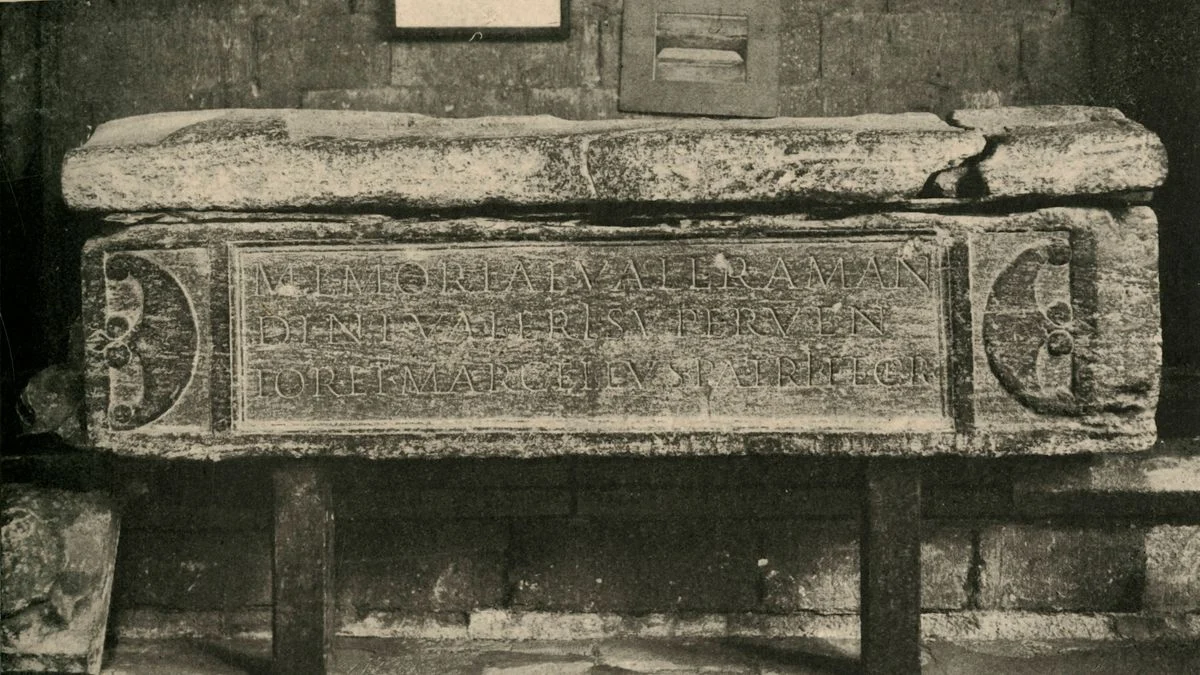
Westminster Abbey stands not merely as a masterpiece of Gothic architecture, but as the pulsating heart of British history. For nearly a millennium, it has served as the stage for the coronation of monarchs, the site of royal weddings—including the globally televised union of Prince William and Catherine Middleton—and the final resting place for the luminaries who shaped the destiny of the United Kingdom. Beneath the hallowed floors of this London landmark, kings, queens, poets, and scientists lie in perpetual repose. Yet, tucked away within this tapestry of history is an enigma that has confounded scholars for two centuries: a Roman-era sarcophagus that tells two stories at once.
The Dual Identity of an Ancient Relic
The artifact in question is a heavy, imposing stone sarcophagus dating back approximately 1,700 years. For years, the inscription on its surface suggested a clear provenance: it purportedly belonged to Valerius Amandinus, a wealthy citizen of Londinium—as London was known during the Roman occupation—who lived between 300 and 400 AD.
However, archaeological scrutiny has long suggested that this label was a historical red herring. The physical evidence presented a contradiction: while the stone chest itself is undeniably Roman, the lid features a distinctively medieval cross. This religious iconography suggests the sarcophagus was repurposed centuries after its original manufacture, likely during the 10th or 11th century. The question that has haunted archaeologists is simple yet profound: if the original Roman occupant was long gone, who was the high-ranking individual deemed worthy of burial in such a prestigious vessel during the Anglo-Saxon period?
Chronology of a Mystery
To understand the weight of this discovery, one must look at the timeline of the sarcophagus’s journey through history:
- 300–400 AD: The stone sarcophagus is crafted, likely for a Roman citizen of status, such as Valerius Amandinus.
- 10th–11th Century: The sarcophagus is unearthed or repurposed. A cross is carved into the lid, signaling its transition into a Christian burial container for a medieval dignitary.
- 1820: The sarcophagus is rediscovered by workers during construction projects within the Abbey. In a moment of historical misfortune, the laborers accidentally shatter the lid into six fragments.
- 1869: Nearly half a century later, the broken fragments are recovered and professionally restored, though the identity of the occupant remains a subject of intense academic speculation.
- Modern Era: Advances in radiocarbon dating and forensic archaeology provide the breakthrough that links the skeletal remains to the monastic hierarchy of the Abbey.
The Archæological Breakthrough: Identifying the Abbot
Warwick Rodwell, a distinguished archaeologist who has spent years studying the structural and funerary history of Westminster Abbey, believes he has finally solved the puzzle. According to research published in the Journal of the British Archaeological Association, the bones housed within the Roman stone are not those of a Roman official, but rather a prominent medieval monk.
Rodwell’s analysis points to two primary candidates who held significant sway over the Abbey when it functioned as a Benedictine monastery. The first is Aelfwig, an abbot who died around 1020 AD. The second is his successor, Wulnoth, who passed away in 1049 AD.
"Both candidates would fit the profile perfectly," Rodwell noted in his analysis. "The evidence suggests that the individual was someone of immense spiritual and administrative authority. Aelfwig, having been a monk at Westminster for a considerable duration, is a particularly strong candidate for such a distinguished burial."
The physical evidence reinforces this theory. Forensic examination of the nearly complete skeleton reveals a man who stood approximately 1.75 meters tall and died between the ages of 35 and 49. Crucially, radiocarbon dating places the date of death between 987 and 1052 AD—a timeframe that aligns perfectly with the tenures of Aelfwig and Wulnoth.
Recycling the Sacred: The "Re-use" Culture of the Middle Ages
The practice of "recycling" Roman sarcophagi was not uncommon in medieval England. As the Roman infrastructure of Londinium crumbled, the massive, durable stone containers left behind became status symbols. For an abbot of a burgeoning monastery, being interred in an ancient Roman sarcophagus provided a sense of continuity and prestige, bridging the gap between the classical past and the burgeoning Christian present.
The burial process was deliberate. The individual was originally interred in a wooden coffin, which was then carefully placed inside the repurposed Roman stone chest. This indicates that the burial was an act of high honor, likely sanctioned by the church hierarchy to commemorate a leader whose influence was felt across the region. The carving of the cross was the final touch, "baptizing" the Roman vessel for its new Christian occupant.
Official Responses and Preservation
The Church of England and the authorities at Westminster Abbey have welcomed the research, viewing it as a vital contribution to the Abbey’s ongoing preservation of its own history. The sarcophagus is currently on display, serving as a silent witness to the layers of history that exist beneath the Abbey’s floorboards.
"Every piece of evidence like this allows us to tell a more complete story of the Abbey," a spokesperson for the Dean and Chapter of Westminster stated. "By using modern science to look at ancient artifacts, we are not just identifying a set of bones; we are reconnecting with the individuals who built the foundation of this institution."
The discovery has also sparked interest in further non-invasive scans of the Abbey’s under-floor burials. As technology improves, there is hope that other "unidentified" burials might reveal their secrets, potentially identifying other early monastic figures who helped shape Westminster long before it became the site of royal coronations.
Implications for Historical Understanding
The resolution of the "Amandinus mystery" has broader implications for how historians view the transition from Roman to Anglo-Saxon Britain. For decades, the presence of Roman artifacts in medieval settings was often dismissed as mere happenstance or stylistic imitation. However, this study proves that there was a conscious, organized effort to reclaim and utilize the past to legitimize the present.
The identification of the occupant as a medieval abbot underscores the power of the Benedictine monks in pre-Conquest England. It reveals a community that was not only intellectually sophisticated but also deeply conscious of its place within a historical continuum.
Furthermore, the research serves as a cautionary tale for archaeologists regarding the reliability of inscriptions. An inscription—even one that appears to name a specific individual—is not an absolute truth. It is a product of its time, and in this case, the inscription was merely a label for a previous occupant, discarded by history and overwritten by the needs of a new era.
Conclusion
The saga of the Westminster sarcophagus is a testament to the persistence of memory. From the Roman artisan who first carved the stone, to the medieval monk who carved the cross, and finally to the 19th-century laborers who broke it and the 21st-century scientists who finally identified its occupant, the sarcophagus has been a conduit for human identity for nearly two millennia.
As visitors walk through the hallowed aisles of Westminster Abbey today, they may pass by the stone chest with only a cursory glance. Yet, the story of Aelfwig or Wulnoth—the man who lay in a Roman box for a thousand years—serves as a reminder that history is never truly buried. It is a living, evolving narrative that continues to reveal itself, one fragment at a time. The mystery of the Roman sarcophagus may have been solved, but the Abbey undoubtedly holds many more secrets in its cold, stone depths, waiting for the right moment—and the right technology—to emerge into the light once more.