Introduction: A Fragile Balance
In the sprawling, glass-clad greenhouses of the Dutch province of Zeeland, the rhythm of life is traditionally dictated by the human hand. For Jeffry Van Noord, a farmer managing nine hectares of land—roughly the size of twelve football fields—the daily operation is a monumental task. His team of 25 workers manages an incredible harvest: three thousand tons of cocktail tomatoes and eight million cucumbers annually.
Yet, beneath the surface of this agricultural success, a quiet crisis is brewing. "Our labor costs are rising every year," Van Noord admits, a sentiment echoed by farmers across Europe. As inflation, rising energy costs, and a tightening labor market squeeze profit margins, the price of vegetables at the supermarket shelf is failing to keep pace with the mounting overheads of production. It is a precarious balancing act that threatens the viability of traditional family-owned farms.
Enter Eternal, a Cologne-based Agri-Tech startup that is looking to shift the paradigm of modern agriculture through artificial intelligence and autonomous robotics.
Main Facts: The Rise of the "Harvester"
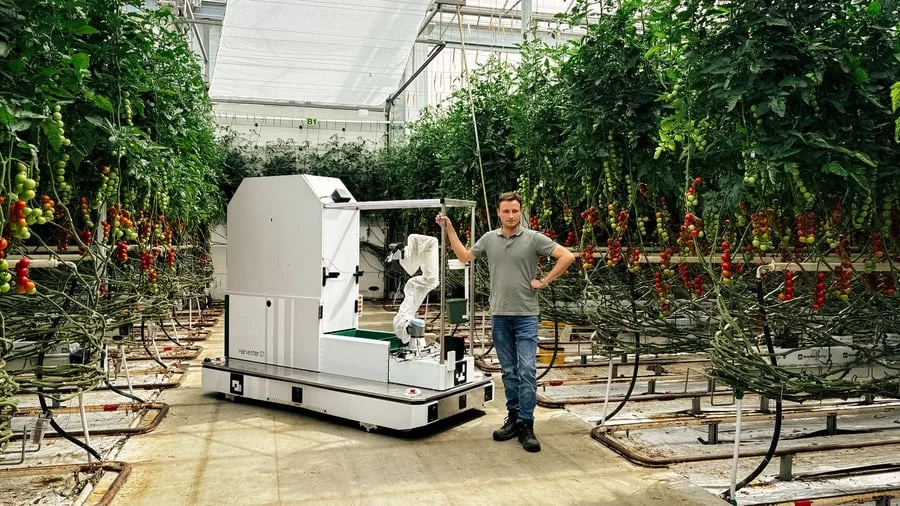
The solution being deployed in Van Noord’s greenhouses is the Harvester, an AI-driven robot capable of navigating the complex, narrow aisles of indoor farms. Measuring up to 100 meters in length, these aisles were once the exclusive domain of human harvesters. Today, they are the testing ground for a new era of automation.
The Harvester functions with surgical precision. Utilizing advanced computer vision, the robot identifies clusters of vine-ripened tomatoes, carefully maneuvers its robotic arm to snip the stems, and places the delicate produce into collection boxes. Once a box is full, the robot autonomously transports the load to the packing station.
For farmers like Van Noord, the technology offers two critical advantages: consistent productivity and operational stability. Unlike human workers, who are subject to fatigue, the need for breaks, and potential illness, the Harvester represents a tireless workforce.
Chronology: From Failure to Innovation
The birth of Eternal is not a story of overnight success, but one of resilience and lessons learned in the crucible of entrepreneurship.
- The Early Years: Renji John, a 43-year-old engineer with a background in management consulting at the Boston Consulting Group, grew up immersed in the agricultural industry on his family’s spice and herb farm in India. This foundational experience gave him a unique perspective on the inefficiencies plaguing global farming.
- The Setback: For several years, John focused on developing autonomous harvesters. His first venture, Honest, was a bold attempt to solve the labor problem. However, the complexity of the task and the harsh economic realities of the robotics market led to the company’s insolvency in 2023.
- The Pivot: Rather than abandoning his vision, John took the hard-won insights from Honest and partnered with his cousin, Sherry Kunjachan, a seasoned robotics expert. Together, they founded Eternal in 2025.
- The Breakthrough: Within just one year of the company’s inception, Eternal has successfully deployed twelve autonomous robots to early-adopter customers. This rapid transition from a failed startup to a functional, market-ready enterprise underscores the speed at which AI-driven hardware is currently evolving.
Supporting Data: Scaling for the Future
The expansion plans for Eternal are ambitious. The company has already mapped out a roadmap to scale its operations, with over 100 electronic "helpers" planned for deployment by 2027.
The economic justification for this scale-up is rooted in the current agricultural labor landscape. In the Netherlands, as in much of the European Union, the reliance on seasonal migrant labor has become increasingly difficult due to changing immigration policies and the rising cost of living. By automating the harvest, Eternal is positioning itself to fill a void that human labor can no longer sustainably occupy.
Furthermore, the company has secured significant backing from venture capital firms. This investment is not merely a financial vote of confidence; it is an industry signal that the "Agri-Tech" sector is maturing. Investors see in Eternal a scalable solution to a global problem: how to feed a growing population with fewer human resources.
Official Responses and The "Human" Perspective
When asked about the future of his workforce in the face of such rapid automation, Jeffry Van Noord remains pragmatic. He views the Harvester not as a replacement for his team, but as a necessary evolution to ensure the farm’s survival. "The robot doesn’t get sick, and it doesn’t need a day off," he notes.
Renji John, CEO of Eternal, frames the development in similar terms. "Our Harvester is a tool for resilience," John says. He emphasizes that the goal of Eternal is to support the farmer, not to eliminate the human element entirely. The transition is designed to shift the human role from repetitive, physically demanding labor to the oversight and maintenance of high-tech infrastructure.
Implications: The Future of Farming
The integration of AI into the greenhouse is part of a broader trend known as "Precision Agriculture." The implications of this shift are profound and multifaceted:
1. Economic Sustainability
By stabilizing labor costs, farmers can better predict their margins, potentially leading to more stable food prices for consumers. As Eternal continues to refine its technology, the cost of the robots is expected to decrease, making the technology accessible to smaller, family-run operations, not just large-scale industrial farms.
2. Technological Diversification
The vision for Eternal extends well beyond tomatoes. The company is currently exploring ways to adapt its robotic platforms for other crops, such as cucumbers and potentially various fruits. The ability to harvest different types of produce will be the true test of the Harvester’s adaptability—moving from a single-task machine to a versatile agricultural assistant.
3. The Ethical Debate
As with all automation, the shift toward robotics in agriculture invites ethical questions. What happens to the seasonal labor market? How does this technology impact the rural economies that have relied on manual labor for generations? Proponents argue that by keeping farms profitable in high-cost regions like Western Europe, the technology actually preserves the agricultural heritage of these areas, preventing them from being abandoned or outsourced to regions with lower labor standards.
4. Global Scalability
With both John and Kunjachan having deep roots in both Indian agriculture and European engineering, Eternal is uniquely positioned to bridge the gap between global agricultural needs and high-end robotic solutions. If the technology can prove its reliability in the controlled, high-tech environments of Dutch greenhouses, the potential to scale the technology for diverse climates and farming styles globally is immense.
Conclusion: A New Season
As the Harvester rolls silently down the 100-meter rows of Van Noord’s greenhouse, it represents more than just a piece of hardware. It is a symbol of a turning point. The agricultural industry is often characterized by its resistance to change, yet the challenges of the 21st century—labor shortages, climate volatility, and the need for greater efficiency—are forcing a rapid, necessary transformation.
For Eternal, the mission is clear. They have moved past the "fail-fast" stage of their initial venture and are now in a "scale-fast" phase of development. With the support of investors and the validation of early adopters, the company is not just automating the harvest; it is cultivating a future where the partnership between man and machine ensures that the supply of fresh, healthy food remains constant, regardless of the challenges the world may face.
As the sun sets over the Zeeland greenhouses, the robots continue their work. They do not tire. They do not sleep. And in their steady, precise movements, we see the blueprint for the next revolution in how we grow, harvest, and sustain our global food supply.