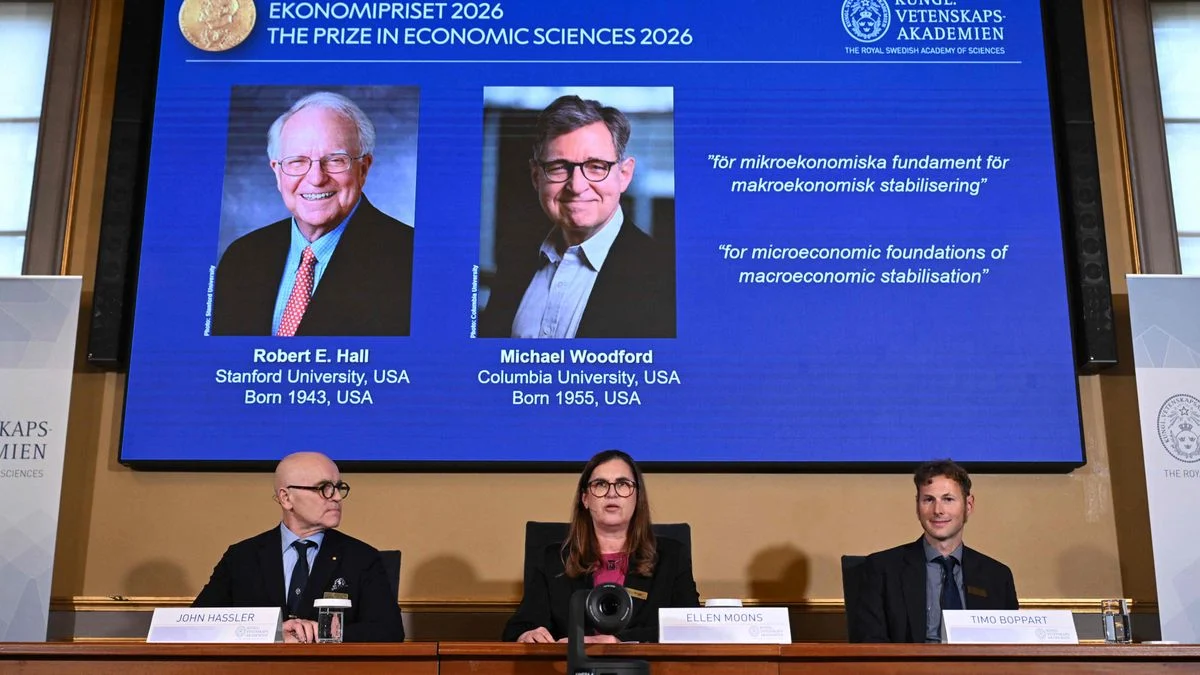
In a landmark decision that underscores the vital intersection of theoretical research and real-world policy, the Royal Swedish Academy of Sciences has awarded the 2024 Nobel Memorial Prize in Economic Sciences to two distinguished American scholars: Robert Hall of Stanford University and Michael Woodford of Columbia University.
The recognition honors their foundational contributions to modern macroeconomic modeling, which have provided central banks and government treasuries with the intellectual scaffolding required to navigate the volatile currents of the global economy. By refining the mechanisms through which fiscal and monetary policy influence market cycles, Hall and Woodford have effectively equipped policymakers with the tools to dampen the extremes of "boom-and-bust" trajectories.
The Core Achievement: Refining the Engine of Macroeconomics
At its heart, the work of Hall and Woodford represents a paradigm shift in how we understand the relationship between individual decision-making and aggregate economic performance. Their research has provided the bedrock for "New Keynesian" models, which are currently the gold standard used by institutions ranging from the U.S. Federal Reserve to the European Central Bank.
Understanding the Mechanism
The Academy noted that the primary contribution of the laureates lies in their ability to model the "friction" within the economy—specifically, why prices and wages do not adjust instantaneously to changes in supply and demand. By incorporating these rigidities into formal mathematical frameworks, Hall and Woodford helped policymakers understand that interventions are not merely reactive; they are essential stabilizers.
"The laureates have provided us with the tools to smooth out the peaks and troughs of the economic cycle," the Nobel Committee stated in its official announcement. Their models allow for a more nuanced application of fiscal and monetary levers, ensuring that stimulus packages or interest rate adjustments are calibrated to the specific structural realities of the current economic environment.
Chronology of Influence
To understand the weight of this award, one must look at the evolution of economic theory over the last four decades.
- The 1980s and 90s: The Foundations of Rationality: During this period, the profession was grappling with the limitations of classical models that assumed perfect market clearing. Robert Hall’s early work on the "random walk" of consumption and the labor market provided the necessary empirical rigor to challenge these assumptions.
- The Turn of the Millennium: Woodford’s Synthesis: Michael Woodford’s seminal work, particularly his 2003 treatise Interest and Prices, synthesized the new consensus. He moved beyond the basic "IS-LM" models taught in introductory textbooks, creating a dynamic framework that integrated price stability with central bank policy.
- The Global Financial Crisis (2008): The Acid Test: When the global financial system teetered on the brink of collapse, the models developed by Hall and Woodford were the primary guides for unconventional monetary policies, including quantitative easing and forward guidance.
- Present Day: Global Implementation: Today, the "Hall-Woodford" approach is standard training for central bankers worldwide, providing the theoretical justification for inflation targeting and transparency in policy communication.
Supporting Data: Why Their Work Matters
The impact of the laureates’ research can be quantified by observing the shift in how central banks communicate. Before the widespread adoption of their models, central bank policy was often shrouded in secrecy. Woodford, in particular, championed the idea that the "management of expectations" is as important as the manipulation of interest rates.
Data from the Bank for International Settlements suggests that since the adoption of these modern, model-based frameworks, the volatility of inflation—the "troughs and peaks" mentioned by the Committee—has significantly decreased compared to the turbulent periods of the 1970s. By anchoring inflation expectations, policymakers have created a more predictable environment for investment and long-term planning, fostering sustainable growth.
Official Responses and Reflections
The announcement, delivered from Stockholm, was met with global acclaim. John Hassler, the chair of the Committee for the Nobel Prize in Economic Sciences, emphasized the practical utility of the laureates’ contributions:
"The work of the laureates has provided us with a stable theoretical foundation for the models that are used by central banks and governments all over the world today. It is not just theoretical exercise; it is the operating system of modern economic governance."

For Michael Woodford, receiving the call in New York, the news was a moment of profound reflection. "It is an enormous honor, and it is a surprise," he said during a brief interview with the committee. "The field of economics is a collective endeavor, and to be recognized for work that aims to make the world a more stable place for everyone is deeply humbling."
Robert Hall, long a fixture at Stanford University, has been a leading voice in understanding the intricacies of the labor market and its relationship to the broader business cycle. His influence extends into the halls of the Hoover Institution, where he has long argued that the efficiency of the labor market is the true determinant of a nation’s long-term prosperity.
A Legacy Beyond the Testament
It is important to note that the Prize in Economic Sciences holds a unique position in the Nobel ecosystem. It is the only award not established by the 1895 will of Alfred Nobel. Instead, it was created in 1968 by the Swedish Central Bank (Sveriges Riksbank) in memory of Alfred Nobel.
This distinction often leads to technical discussions about the prize’s "official" status, yet in terms of prestige and impact, it is unequivocally the highest honor an economist can receive. It serves as a testament to the fact that, in the 21st century, economic stability is viewed with the same level of societal importance as advances in medicine, physics, or peace.
The prize ceremony, held annually on December 10th—the anniversary of Alfred Nobel’s death—will see Hall and Woodford honored in Stockholm. They join a prestigious lineage of laureates who have attempted to decode the complexities of human interaction and resource allocation.
Implications for Future Policy
The selection of Hall and Woodford sends a clear signal to the global community: the path toward future prosperity lies in the synthesis of data-driven policy and institutional transparency. As the world faces new challenges—ranging from the inflationary pressures of post-pandemic recovery to the integration of artificial intelligence into the workforce—the models developed by these two laureates remain more relevant than ever.
The Challenge of Modernity
Critics of modern macroeconomics often argue that models can become too detached from the lived reality of citizens. However, the work of Hall and Woodford remains resilient precisely because it prioritizes "microfoundations"—the idea that macroeconomic policies must be grounded in an understanding of how households and firms actually behave.
As central banks globally begin to pivot away from the extraordinary measures of the last decade, they will rely heavily on the frameworks provided by the 2024 laureates to ensure that the transition is smooth, predictable, and devoid of unnecessary systemic shock.
In conclusion, the 2024 Nobel Prize in Economic Sciences is more than an acknowledgment of academic achievement; it is a recognition of the architects of our modern economic stability. Through their rigorous intellectual efforts, Robert Hall and Michael Woodford have ensured that when the storms of economic volatility arrive, the ship of the global economy has a compass—and the knowledge of how to steer.