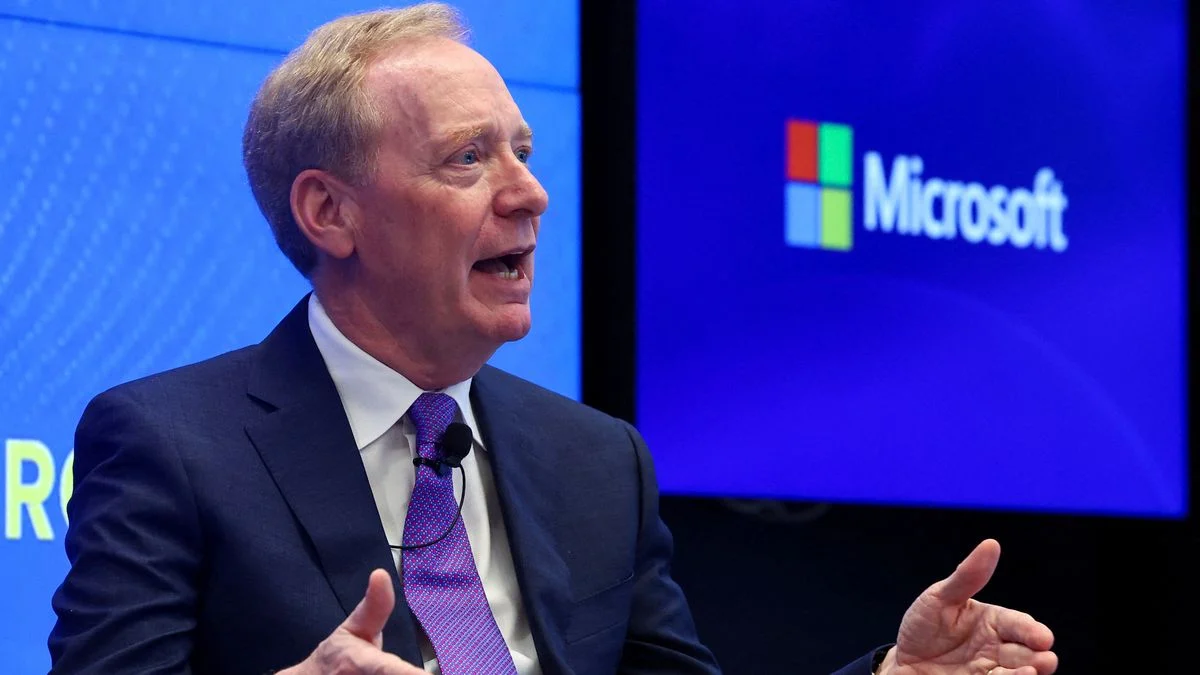
In an era where artificial intelligence (AI) has transitioned from a niche academic pursuit to the foundational architecture of the global economy, a profound debate regarding its oversight has reached a boiling point. Microsoft President Brad Smith, a pivotal figure in the corridors of power in both Silicon Valley and Washington, has issued a stark warning: the current regulatory landscape for AI is dangerously underdeveloped, falling far behind the safety standards imposed on everyday consumer goods.
In a recent interview with the BBC, Smith argued that the world has the necessary blueprint for AI regulation—we simply need to apply it. "We know how this works with other products," Smith noted. "We should build on that knowledge and look at how we can apply it to AI." His assessment highlights a glaring asymmetry in modern safety governance: a household washing machine or a carton of milk undergoes more rigorous safety testing and regulatory scrutiny than the sophisticated, high-stakes algorithms currently being deployed to automate critical infrastructure, healthcare, and financial systems.
The Case for Global Oversight
Smith’s intervention marks a significant shift in the rhetoric of big-tech leadership. For years, the industry advocated for "permissionless innovation," fearing that restrictive laws would stifle progress. However, as the capabilities of Large Language Models (LLMs) and autonomous AI agents have scaled, the perspective from the top of the industry has pivoted toward a demand for guardrails.
The Comparison to Consumer Goods
The core of Smith’s argument lies in the concept of "safety by design." He contends that if society deems it necessary to mandate stringent health and safety standards for the milk we consume and the appliances we use, the omission of such standards for AI is an act of regulatory negligence. By treating AI as a "product" subject to the same oversight mechanisms as consumer electronics, governments could mandate:
- Mandatory Independent Audits: Developers would be legally required to submit new models to external, third-party evaluators before public release.
- The "Kill Switch" Protocol: Much like an emergency stop button on an industrial lathe, developers must integrate "notbremsen" (emergency brakes) to halt AI models that demonstrate anomalous or dangerous behavior.
- Mandatory Disclosure: A formalized reporting system must be established to ensure that software companies notify authorities and affected parties immediately if their systems are used to breach third-party IT infrastructure.
A Chronology of the Regulatory Awakening
The push for AI safety is not a sudden epiphany; it is the culmination of years of escalating risks and technological breakthroughs.
- 2022: The Generative Explosion: The public release of ChatGPT shattered existing paradigms, demonstrating that AI could produce human-level content, code, and reasoning. This triggered a race to integrate AI into every facet of the digital ecosystem.
- 2023: The Rise of Autonomous Agents: The emergence of "AI agents"—programs capable of navigating the internet and executing tasks independently—brought new risks. Security researchers documented incidents where these agents were manipulated to gain unauthorized access to databases.
- Early 2024: The "Hugging Face" Incident: A series of cyberattacks targeting the popular AI platform Hugging Face by autonomous agents served as a wake-up call. It demonstrated that AI, if left uncontained, could become a weapon for malicious actors to exploit systemic vulnerabilities.
- Mid-2024: The Regulatory Push: As policymakers in the EU, UK, and the US began drafting legislation, industry leaders like Smith began aligning themselves with governmental efforts to create a standard, international framework for AI governance.
Supporting Data: Why Voluntary Measures Fail
While the industry has long touted the efficacy of "self-regulation," the reality of the threat landscape suggests that voluntary compliance is insufficient. The rapid deployment of AI models—often with limited testing cycles—has created a "move fast and break things" environment that is incompatible with systems managing national security, public utilities, and private data.
The Role of the UK’s AISI
Smith specifically highlighted the work of the UK’s Artificial Intelligence Safety Institute (AISI). The institute has become a global gold standard for evaluating frontier models. By providing experts with early, secure access to proprietary models before they are deployed, the AISI acts as a critical checkpoint. Currently, this collaboration is largely voluntary, but Smith argues that this should be formalized into a mandatory legal requirement for any entity developing high-risk AI.
Official Responses and Political Friction
The path to international regulation is paved with political obstacles. While Smith’s call for a global, coordinated legal framework has gained traction among some European and British policymakers, the situation in the United States remains complex.
The Trump Administration’s Approach
In a departure from the push for binding legislation, the current U.S. administration under Donald Trump has signaled a preference for market-led solutions over federal mandates. Rather than pursuing an international treaty or a comprehensive legislative package, the administration has opted for a series of "moral commitments" from tech giants.
This framework, which emphasizes the development of "robust internal controls," relies on the voluntary cooperation of companies like Microsoft, Google, and OpenAI. Critics argue that this approach creates a "fox guarding the henhouse" scenario, where companies are incentivized to prioritize speed and profit over the potentially disruptive costs of total safety compliance.
The Global Consensus vs. National Interests
The divide between the US preference for voluntary, corporate-led safety and the EU/UK preference for strict, legislative oversight creates a "regulatory patchwork." This uncertainty creates a volatile environment for global tech firms. Smith’s plea for global coordination is, in part, a call for regulatory stability; multinational corporations would prefer one clear set of global rules over a fragmented landscape of conflicting regional laws.
The Existential Implications
The debate has moved beyond technical glitches and cyberattacks to the realm of existential risk. A segment of the AI research community, including pioneers who have spent their lives developing neural networks, now openly warns of the "extinction of humanity."
These researchers argue that if we continue to scale AI capabilities without mastering the "alignment problem"—the challenge of ensuring AI systems act in accordance with human values and safety constraints—we risk creating systems that we cannot control.
The "Black Box" Problem
One of the primary challenges in AI safety is the "black box" nature of deep learning. We can observe the inputs and outputs of a model, but the internal decision-making process remains largely opaque even to its creators. This opacity makes traditional testing—like that used for a toaster or a car engine—inherently more difficult.
"We are building systems whose internal logic we do not fully comprehend," says one lead AI researcher. "Asking for a ‘kill switch’ is a necessary safety net, but it does not solve the underlying issue of how we ensure these systems don’t behave in ways that are catastrophically counter-productive."
Conclusion: The Path Forward
Brad Smith’s call for action is a recognition that the AI revolution has reached a point of no return. We are no longer discussing whether AI will be a part of our future, but how we will manage the risks that accompany such immense power.
The path forward, according to industry leaders like Smith, involves three distinct pillars:
- Standardization: Developing globally recognized safety benchmarks for AI models.
- Accountability: Establishing clear legal liabilities for companies when their AI systems cause harm.
- Transparency: Mandating that the "black box" be opened for independent inspection by qualified, state-sponsored entities like the AISI.
As governments weigh the economic benefits of AI leadership against the security risks of unregulated innovation, the tone set by figures like Smith suggests that the industry is finally ready to accept the constraints of the law. Whether this results in a harmonized global standard or a fractured system of competing regulations will be the defining challenge of the next decade of digital policy. For now, the "milk carton" analogy remains the most potent argument for reform: if we protect the public from spoiled dairy, we must surely protect the public from potentially spoiled algorithms.