LEIPZIG, Germany – The historic district of Connewitz in Leipzig, long known as a flashpoint for social and political activism, became the site of renewed civil unrest on Sunday evening. What began as a quiet summer night was shattered when a group of approximately 100 individuals engaged in violent confrontations with law enforcement, leading to arson, property damage, and a direct assault on a local police facility.
The events have prompted a formal investigation by the Saxon state authorities, who are treating the incident as a case of Landfriedensbruch—a serious charge of breach of the peace. As the city attempts to return to normalcy, questions are mounting regarding the underlying catalysts for this violence, the security of local infrastructure, and whether the night’s festivities provided a backdrop for more organized, radicalized agendas.
Main Facts: A Night of Escalation
The unrest materialized late Sunday evening on the Wolfgang-Heinze-Straße and the Basedowstraße, two thoroughfares central to the Connewitz neighborhood. According to reports confirmed by the Saxony State Police, the crowd, estimated at around 100 people, began systematically erecting barricades.
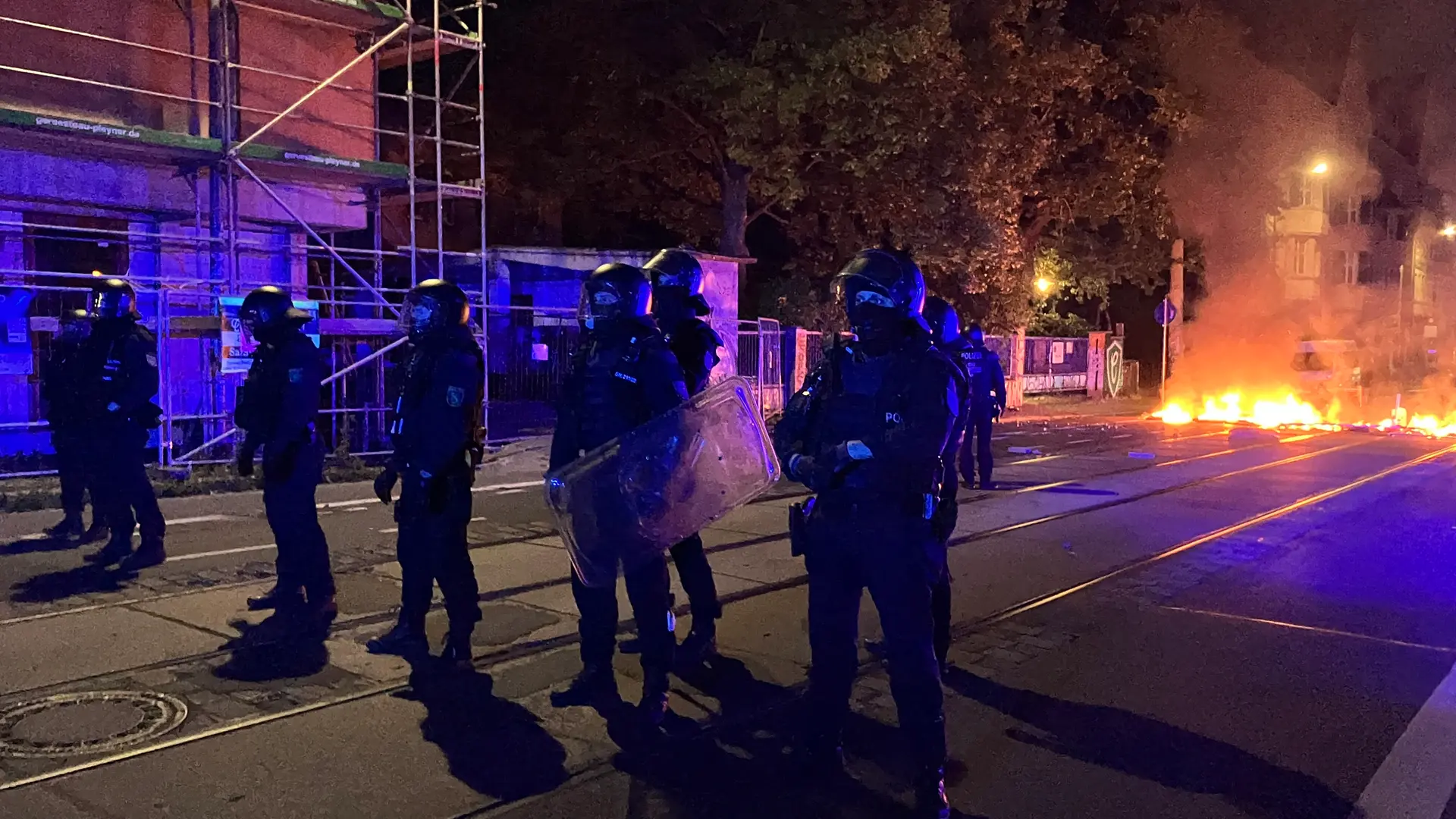
The situation rapidly deteriorated as these makeshift blockades—composed of various street furniture and debris—were set ablaze. The thick plumes of smoke and the sight of flames against the urban backdrop signaled the beginning of a coordinated disruption.
Following the initial arson, a splinter group of approximately 30 individuals detached themselves from the larger crowd and marched toward a nearby police outpost. The aggression was immediate and targeted. The station, as well as an adjacent medical practice and a stationary transport vehicle, were subjected to a barrage of stones and projectiles. While the authorities have not yet finalized a full assessment of the financial damage, the destruction is described as significant, affecting both public property and private local businesses.
Chronology of the Events
The timeline of the evening reflects a strategic shift from public disruption to direct confrontation:
- 18:00 – 20:00: The neighborhood was host to the "Fête de la Musique," a global music festival celebrating the summer solstice. The streets were filled with residents enjoying live performances and the temperate evening weather.
- 20:30: Initial reports indicate the assembly of approximately 100 individuals on Wolfgang-Heinze-Straße and Basedowstraße. This group quickly began moving debris into the street to obstruct traffic and emergency access.
- 21:15: The barricades were set on fire, creating a perimeter of flames that hindered initial police containment efforts.
- 22:00: A subset of the group, identified by law enforcement as approximately 30 people, moved toward the local police facility.
- 22:15: The assault on the station commenced. Windows were shattered, and the exterior of the building was damaged by stone-throwing. The medical practice next door and a transport vehicle were hit by collateral damage.
- 23:00: Law enforcement units moved to disperse the crowd and secure the area, effectively ending the most intense period of the riot.
A Question of Context: The Fête de la Musique
A critical component of the ongoing police investigation is determining whether the timing of the violence was purely coincidental or strategically chosen to camouflage the rioters within the crowds of the "Fête de la Musique."
The festival, which draws thousands of music lovers, is traditionally a peaceful, community-oriented event. However, local authorities have acknowledged that the density of the crowds during such festivals can make it difficult to isolate perpetrators from ordinary civilians. Despite this, the police remain cautious. A spokesperson for the Saxony police stated that, while the proximity in time and space is undeniable, there is currently no hard evidence to confirm that the rioters were participants or organizers of the musical event.
This uncertainty has left local residents and business owners frustrated, as the violence threatens to overshadow the cultural significance of the festival and deepen the divide between the neighborhood’s diverse population and the authorities.
The Persistent Conflict: A History of Tensions
The attack on the Connewitz police station is not an isolated incident. The station has historically been a symbol of state authority, and consequently, a target for radicalized groups operating within the district. Over the past decade, Connewitz has seen a series of clashes that typically stem from ideological differences regarding policing, gentrification, and the implementation of state laws.
Many analysts point to the current debates surrounding the Polizeigesetz (Police Act) in Saxony as a primary driver of the current climate. The proposed updates to the legislation, which seek to grant the police more extensive surveillance and intervention powers, have been met with fierce criticism from various left-wing and civil liberties organizations.
On Saturday, the day before the riots, several left-leaning and autonomous groups had organized a demonstration in the neighborhood to protest these legislative changes. While that demonstration remained within legal bounds, the violence on Sunday is being examined by intelligence services to see if it was a direct spillover or a reactionary escalation from the political atmosphere created by the weekend’s protests.

Official Responses and Political Implications
The incident has triggered a wave of condemnation from political leaders. Interior Ministry officials have emphasized that the rule of law must be upheld, particularly when public safety infrastructure, such as a police station, is directly attacked.
"The violence displayed in Connewitz is an assault on the community at large," said one official. "We are committed to identifying every individual involved, and we will ensure that those who believe they can operate outside the law face the full consequences."
Local government representatives are now under pressure to address the underlying security concerns. There is a delicate balance at play: the need for effective police presence in a neighborhood that often views such presence with suspicion. The risk, observers note, is that an aggressive increase in police patrols could lead to a cycle of escalation rather than de-escalation.
Sociological Perspectives: Gentrification and Alienation
To understand the volatile nature of Connewitz, one must look at the structural changes in the neighborhood. Over the last two decades, Connewitz has transformed from a low-rent district into a trendy, gentrifying urban hub. This shift has created a stark contrast between newer residents and long-standing radicalized subcultures who feel pushed out by rising costs and the "sanitization" of their streets.
This socio-economic tension creates an environment where, in the eyes of some, the police become the literal embodiment of the "system" they are fighting. When a protest against a new law is combined with the underlying resentment against the state’s role in urban development, the threshold for violence drops significantly.
Economic and Human Cost
While the physical damage is the most immediate concern, the economic impact on the local businesses in the Wolfgang-Heinze-Straße area cannot be ignored. The medical practice that was damaged serves the local community, and its closure for repairs represents a tangible harm to the neighborhood’s residents.

Furthermore, the "human cost" is found in the climate of fear. For many living in the area, the sight of burning barricades is a traumatic reminder of the neighborhood’s reputation. Small business owners, who rely on a safe and welcoming environment to thrive, are now forced to consider security measures that further isolate them from the community they serve.
The Path Forward: Investigation and Dialogue
The Saxony State Police have launched a comprehensive investigation, utilizing video footage from public and private cameras to identify the individuals responsible for the riots. They are also calling for witnesses to come forward, though they recognize that in a neighborhood characterized by a deep-seated distrust of law enforcement, cooperation may be limited.
Beyond the immediate police action, there is a growing call from civil society groups for a broader dialogue. Proponents of this approach argue that policing alone cannot solve the radicalization of certain segments of the population. They suggest that the state must engage more effectively with the community to address grievances—whether they be related to housing, the new police laws, or the lack of democratic participation.

As Leipzig enters the coming weeks, the situation in Connewitz remains fragile. The city is at a crossroads: it must decide whether to continue a path of confrontation, which has historically yielded little in the way of long-term peace, or to invest in a multi-pronged approach that combines robust law enforcement with serious social outreach.
For now, the smoke has cleared from the streets of Connewitz, but the fires of political and social discontent continue to smolder beneath the surface. The incident on Sunday serves as a stark warning that in a polarized society, the line between peaceful protest and violent anarchy is thinner than ever.
This report is based on preliminary information provided by the Saxony State Police and the MDR news network. Further updates will be provided as the investigation into the perpetrators and the extent of the damages continues.