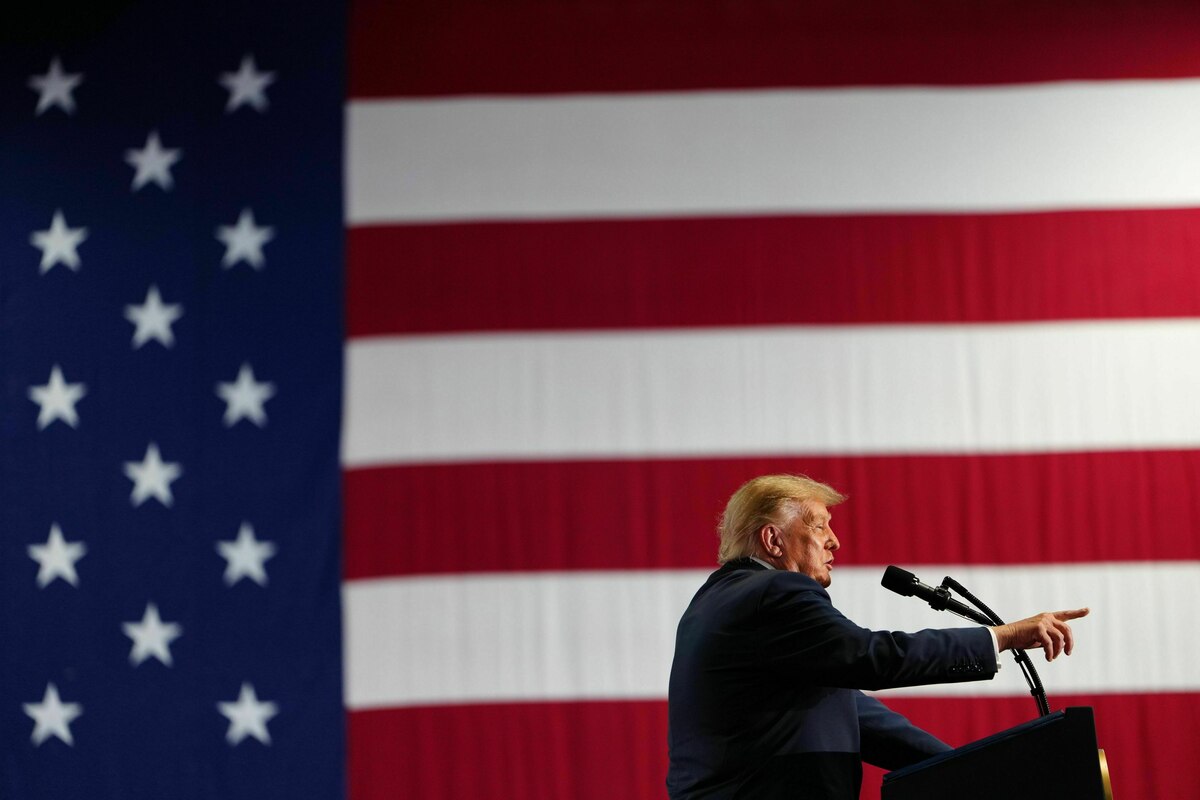
Washington D.C. – In the weeks leading up to the pivotal US midterm elections, former President Donald Trump appears increasingly agitated, displaying a pattern of erratic behavior that analysts suggest reflects a profound sense of vulnerability. With poll trends indicating a potential setback for the Republican Party, Trump’s actions have grown more desperate, creating a volatile political environment both domestically and on the global stage. This mounting nervousness, while perhaps predictable for a figure of his temperament, bodes ill not only for his immediate political circle but also for the broader international community, raising concerns about the stability of US policy and its democratic institutions.
Bernd Pickert, a seasoned foreign editor for taz, encapsulates the sentiment, observing that Trump has become ensnared by the very policies he championed, leaving him flailing without a clear path forward. This state of political entrapment has led to a series of impulsive and contradictory statements and policy suggestions, indicative of a leader struggling to maintain control amidst mounting pressure.
The Looming Midterm Elections: A Reckoning for Trump?
The upcoming midterm elections, traditionally a referendum on the incumbent administration, are shaping up to be a critical test for the Republican Party and, by extension, for Donald Trump’s enduring influence. As the election cycle enters its final, frenetic phase, the narrative surrounding Trump’s role has shifted dramatically, reflecting a palpable unease within his own party.
Political Landscape and Polling Trends
Historically, midterm elections often see the party out of power gain seats, yet the current cycle presents unique challenges for the Republicans, despite the typical headwinds faced by the party holding the White House. While generic ballot polling can fluctuate, recent trends suggest a tighter contest than many Republicans had hoped for, with a significant number of races too close to call. Crucially, the issues dominating the campaign trail—from economic anxieties to social policy debates—are proving difficult for the Republican message to cut through effectively, especially when tied to Trump’s more controversial stances.
The initial optimism following a perceived "red wave" possibility has been tempered by a series of electoral outcomes and shifting voter priorities. Independent voters, often the deciding demographic, appear to be reacting strongly to certain issues, including concerns about democratic processes and economic stability, placing the Republican platform under intense scrutiny. This has created an environment where the traditional advantages of being the opposition party are not materializing as anticipated, leaving many strategists within the GOP anxious about the final tally.
Trump’s Self-Inflicted Wounds
A significant portion of the current Republican predicament can be traced directly to Trump’s own policy choices and his characteristic refusal to accept responsibility. His administration’s aggressive posture towards Iran, which some observers have termed an "Iran war" due to its bellicose rhetoric and economic warfare, has had far-reaching consequences. The unilateral withdrawal from the Joint Comprehensive Plan of Action (JCPOA), coupled with a "maximum pressure" campaign of sanctions, destabilized global oil markets. While the stated goal was to cripple Iran’s economy and force renegotiation, a significant side effect was the upward pressure on international energy prices.
For American voters, this translates directly to higher costs at the gas pump and increased utility bills, tangible economic burdens that directly impact their daily lives. Republican strategists, acutely aware of the sensitivity of kitchen-table economics during an election year, have undoubtedly seen these anxieties reflected in their internal polling data. The connection between foreign policy decisions and domestic economic discomfort is rarely so stark, and it has provided potent ammunition for opposition campaigns.
A Geopolitical Quagmire: Energy Prices and Foreign Policy Shifts
Trump’s foreign policy approach, characterized by a transactional and often unilateral style, has inadvertently set traps for his own political ambitions. The ripple effects of these decisions are now manifesting as significant domestic vulnerabilities, further fueling his increasingly agitated public persona.
The "Iran War" and Global Energy Markets
The notion of an "Iran war" under Trump, while not a conventional armed conflict, accurately captures the intensity of his administration’s confrontation with Tehran. From withdrawing from the landmark nuclear deal in 2018 to reimposing crippling sanctions, Trump’s strategy aimed to isolate Iran and force concessions. However, this aggressive stance inadvertently tightened global oil supplies by restricting Iran’s ability to export, contributing significantly to price volatility. Oil futures, sensitive to geopolitical instability, reacted sharply to every escalation in the Persian Gulf, from tanker attacks to drone incidents.
The economic repercussions were felt worldwide, but particularly acutely by American consumers. Rising gasoline prices become a salient political issue, directly impacting household budgets and voter sentiment. For many working-class Americans, a few extra dollars per tank can mean the difference between financial comfort and strain. This economic pressure point, a direct consequence of a foreign policy gambit, has become a millstone around the neck of Republican candidates striving to differentiate themselves from the former president’s more controversial positions. The irony is that a policy designed to project American strength abroad has, in part, contributed to domestic economic hardship, thereby weakening the party’s electoral prospects at home.

The Ukraine-Russia Conundrum
In a bewildering display of political expediency, Trump has sought to deflect blame for rising energy costs by targeting Ukraine. He has astonishingly declared Ukrainian attacks on Russian refineries as the culprit for escalating global energy prices. This narrative not only contradicts established economic analyses but also directly undermines US support for Ukraine amidst its ongoing conflict with Russia. Going further, Trump has reportedly demanded the removal of the Ukrainian president, a sovereign leader, and expressed a desire to purchase diesel from Russia’s Vladimir Putin—a direct affront to the stringent sanctions imposed by the US Congress and its international allies against Moscow following its aggression.
This audacious proposal to buy Russian fuel would not only bypass the very sanctions enacted to punish Russia but would also provide a lifeline to Putin’s regime, effectively legitimizing its actions and jeopardizing the united front presented by Western democracies. Such a move would send shockwaves through the NATO alliance and other international coalitions, suggesting a dramatic reversal of US foreign policy priorities. The implications are profound: it could weaken Ukraine’s defensive capabilities, embolden authoritarian regimes, and fracture critical alliances, leaving the US isolated on the global stage. This policy suggestion, seemingly born out of a desperate attempt to scapegoat and find a quick fix for domestic economic woes, underscores the depth of Trump’s current political disarray.
Domestic Fallout: Cracks in the Republican Foundation
The reverberations of Trump’s increasingly erratic behavior are now causing unprecedented fissures within the Republican Party itself, signaling a potential shift in the party’s dynamics. For the first time since his ascendancy, his once-unquestioned dominance is showing signs of strain.
Unprecedented Rejection
A truly remarkable development in the current election cycle is the growing reluctance of Republican candidates to be seen campaigning alongside Donald Trump in their respective districts. This phenomenon is virtually unprecedented in the era of Trump’s political dominance. Since he effectively took control of the Republican Party, transforming it in his image, his endorsements and rallies have been considered indispensable assets for any candidate seeking electoral success. His rallies, drawing fervent crowds, were once guaranteed media spectacles and powerful mobilizers of his base.
Now, however, a noticeable number of GOP candidates, particularly those in swing states or districts with a significant moderate voter base, are actively distancing themselves. They recognize that while Trump’s base remains loyal, his brand of divisive politics and his ongoing legal challenges may alienate the broader electorate crucial for victory. This calculated avoidance speaks volumes about the perceived toxicity of the "Trump effect" in certain electoral contexts, indicating that his personal brand, once an undeniable electoral force, is now, for some, a liability. It represents a significant crack in the monolith of his control over the party and a potential harbinger of a post-Trump Republican landscape.

The "Lame Duck" Phenomenon
As the second half of a president’s second term traditionally approaches, US presidents often enter a phase colloquially known as the "lame duck" period. This term refers to the diminished power and influence of a president who is either nearing the end of their final term or has lost significant political capital, making it difficult to pass legislation or implement major policy initiatives. For a figure like Donald Trump, whose political identity is intrinsically linked to perpetual motion, confrontation, and being the center of attention, the prospect of being labeled a "lame duck" is anathema.
His personality thrives on perceived strength, dominance, and an unwavering spotlight. The very idea of reduced influence, or of being seen as politically enfeebled, is likely to provoke an even more aggressive and unpredictable response. This psychological dimension suggests that any perceived loss of power or attention will trigger a disproportionately fierce reaction, making him, in the words of some observers, a "lame duck with a gun"—a leader stripped of traditional political leverage but still wielding significant informal power and a platform for incendiary rhetoric. This portends a period of heightened political instability, as Trump attempts to reassert his relevance through increasingly extreme means, potentially further alienating allies and exacerbating domestic divisions.
Assault on International Institutions: The ICC Example
Beyond domestic political maneuvering, Trump’s confrontational approach has extended to international legal frameworks, notably his administration’s unprecedented assault on the International Criminal Court (ICC). This aggressive stance marks a significant departure from previous US policy and raises serious questions about America’s commitment to global justice.
Historical US Stance on the ICC
The United States has historically maintained a complex and often skeptical relationship with the International Criminal Court. While supportive of accountability for war crimes and genocide, successive US administrations have resisted full ratification of the Rome Statute, which established the ICC, primarily due to concerns about potential jurisdiction over American military personnel and officials. The prevailing US position has been that American citizens should only be subject to US law and courts. To avoid the ICC’s jurisdiction, the US simply refrained from becoming a member state, thereby not recognizing its authority. In practice, this meant that while the US did not actively cooperate with the ICC, it generally avoided outright confrontation. The practical consequence for US citizens accused of crimes under the ICC’s purview was mainly limited to avoiding travel to countries that are signatories to the Rome Statute, where they could potentially face arrest. Critically, despite intense lobbying from human rights organizations, the ICC has never, to date, formally indicted or prosecuted an American citizen, demonstrating a degree of de facto respect for US sovereignty even without formal recognition.
Trump’s Destructive Approach
Under the Trump administration, this long-standing policy of non-recognition transformed into an active campaign of hostility and sabotage. Rather than merely ignoring the ICC, Trump sought to actively dismantle and delegitimize it. His administration imposed sanctions on ICC officials, including its chief prosecutor, and threatened travel bans against those involved in investigating alleged war crimes by US forces in Afghanistan or by Israel. This aggressive posture was unprecedented. No previous US administration, regardless of its stance on the ICC, had ever resorted to such direct, punitive measures against an international judicial body.

This destructive approach aligns perfectly with Trump’s broader pattern of undermining institutions, both domestic and international, that he perceives as threats to his authority or interests. Just as he has frequently clashed with the US judiciary and federal agencies, he extended this confrontational attitude to the global legal architecture. His administration’s actions were not merely a rejection of the ICC’s jurisdiction but a direct attempt to incapacitate its operations and deter future investigations.
Implications for International Law
The implications of Trump’s assault on the ICC are far-reaching and deeply concerning for the future of international law and global accountability. When a major global power like the United States actively seeks to undermine a court designed to prosecute the most heinous crimes—genocide, war crimes, and crimes against humanity—it sets a dangerous precedent. It signals to other nations, particularly those with authoritarian tendencies, that they too can defy international legal norms with impunity.
This erosion of respect for international institutions weakens the global framework for justice, making it harder to hold perpetrators of atrocities accountable. It also damages the US’s moral standing and credibility as a champion of human rights and the rule of law. By prioritizing short-term political expediency and a narrow interpretation of national sovereignty over universal principles of justice, Trump’s actions risk ushering in an era where international law is increasingly viewed as optional, subject to the whims of powerful states. This ultimately makes the world a more dangerous place, where accountability for mass atrocities becomes harder to achieve, and victims are left without recourse.
The Shadow of Impeachment
Amidst the current political turmoil and the prospect of a shift in congressional control, the specter of impeachment once again looms large over Donald Trump, raising the unprecedented possibility of a third such proceeding against a former or current president.
Precedent and Possibility
Donald Trump has already been impeached twice by the House of Representatives during his presidency, a historical anomaly. The first impeachment in 2019 centered on his alleged abuse of power related to Ukraine, while the second in 2021 followed the January 6th Capitol insurrection. While both attempts resulted in acquittal by the Senate, they established a significant precedent regarding the types of actions Congress might consider impeachable. The process of impeachment involves the House drafting and passing articles of impeachment, essentially formal charges, which then move to the Senate for a trial. A two-thirds majority in the Senate is required for conviction and removal from office. Even if the immediate goal of removal might be difficult to achieve, impeachment serves as a powerful political censure and can have lasting historical implications.

The Democratic Mandate
Should the Democratic Party succeed in regaining control of the House of Representatives in the upcoming midterm elections, they would find themselves in a challenging but potentially compelled position to initiate a third impeachment process. The litany of controversies surrounding Trump, including his ongoing legal battles, his alleged attempts to interfere with the 2020 election results, and more recently, his incendiary statements regarding Ukraine and the ICC, could provide new grounds. The argument would be that his actions, whether as a former president or a leading political figure, continue to undermine democratic institutions, obstruct justice, or threaten national security interests. A Democratic-controlled House would face immense pressure from its progressive base and a significant segment of the electorate to hold Trump accountable for what they perceive as a continuous pattern of abuses. To not act, some would argue, would be to normalize behavior deemed unconstitutional or detrimental to the republic.
Trump’s Response and Quest for Attention
For Donald Trump, the initiation of another impeachment process, far from being a deterrent, would likely be perceived as an opportunity. As a master of political theater and media manipulation, Trump thrives on being the center of attention, particularly when he can frame himself as a victim of a politically motivated "witch hunt." An impeachment inquiry would guarantee him an unparalleled platform, allowing him to rally his base, launch counter-attacks against his political opponents, and further solidify his narrative of being targeted by the "deep state" or the "establishment."
He would likely leverage the proceedings to fundraise, campaign, and reinforce his image as a defiant figure fighting against a corrupt system. While an impeachment trial would undoubtedly consume significant political oxygen in Washington, for Trump, it would offer the ultimate spectacle—a dramatic stage upon which to perform his grievances and reaffirm his hold over his most loyal supporters. The prospect of a third impeachment, therefore, represents not just a legal and political challenge but also a unique opportunity for Trump to recapture the national spotlight and re-energize his political movement, regardless of the ultimate outcome.
Broader Implications and the Future of US Politics
The current trajectory of Donald Trump’s influence and the Republican Party’s response carries profound implications that extend far beyond the immediate electoral cycle. His erratic behavior, coupled with the party’s ongoing internal struggles, points to a period of sustained instability for American politics and its global standing.
Erosion of Norms
Trump’s tenure and continued political activity have undeniably contributed to a significant erosion of democratic norms and institutional trust in the United States. His repeated challenges to electoral integrity, his attacks on the judiciary, his questioning of intelligence agencies, and his disregard for established political conventions have chipped away at the foundational principles of American democracy. When a prominent political figure openly defies traditional standards of conduct and governance, it creates a precedent that can be difficult to reverse. The consequences include increased polarization, a diminished capacity for bipartisan cooperation, and a growing cynicism among the populace regarding the fairness and efficacy of their political system. This erosion not only impacts domestic governance but also makes the US a less reliable and predictable actor on the international stage.

Party Realignment
The Republican Party is currently in the throes of a profound identity crisis, grappling with its future in a post-Trump (or perpetual-Trump) era. The former president’s enduring popularity among a significant segment of the base means that any candidate seeking national office must either align with his populist ideology or risk his ire and the loss of his supporters. This dynamic has stifled internal dissent and prevented the party from fully recalibrating its platform to appeal to a broader demographic. The tension between the traditional conservative wing and the populist, nationalist faction loyal to Trump continues to shape candidate selection, policy positions, and messaging. The long-term effects could lead to a significant realignment of American political parties, potentially creating new ideological divides or exacerbating existing ones, with consequences for generations to come.
Global Standing
The image of the United States as a beacon of democratic stability and a reliable global leader has been severely tested by Trump’s political style and foreign policy decisions. His "America First" doctrine, characterized by a transactional approach to alliances and a skepticism towards international institutions, alienated many traditional partners. The perception of an unpredictable and internally fractured America weakens its diplomatic leverage and complicates efforts to address pressing global challenges, from climate change to geopolitical conflicts. Allies question the consistency of US commitments, while adversaries may be emboldened by perceived American disunity. The current erratic behavior, particularly regarding sensitive issues like the war in Ukraine or international legal bodies, further exacerbates these concerns, making it difficult for the US to rally international support or project a unified front on critical global issues.
In conclusion, Donald Trump’s increasingly nervous and erratic conduct ahead of the US midterm elections is not merely a personal spectacle but a symptom of deeper structural challenges facing American democracy and its global role. His self-imposed political traps, from foreign policy missteps impacting domestic economics to his unprecedented attacks on international legal bodies, highlight a leader grappling with diminishing control. The potential for a Republican defeat in the midterms, coupled with the unprecedented possibility of a third impeachment, underscores a critical juncture in US political history. Regardless of the immediate outcomes, the long-term implications for democratic norms, party alignment, and America’s global standing are profound, signaling a period of continued uncertainty and transformation.