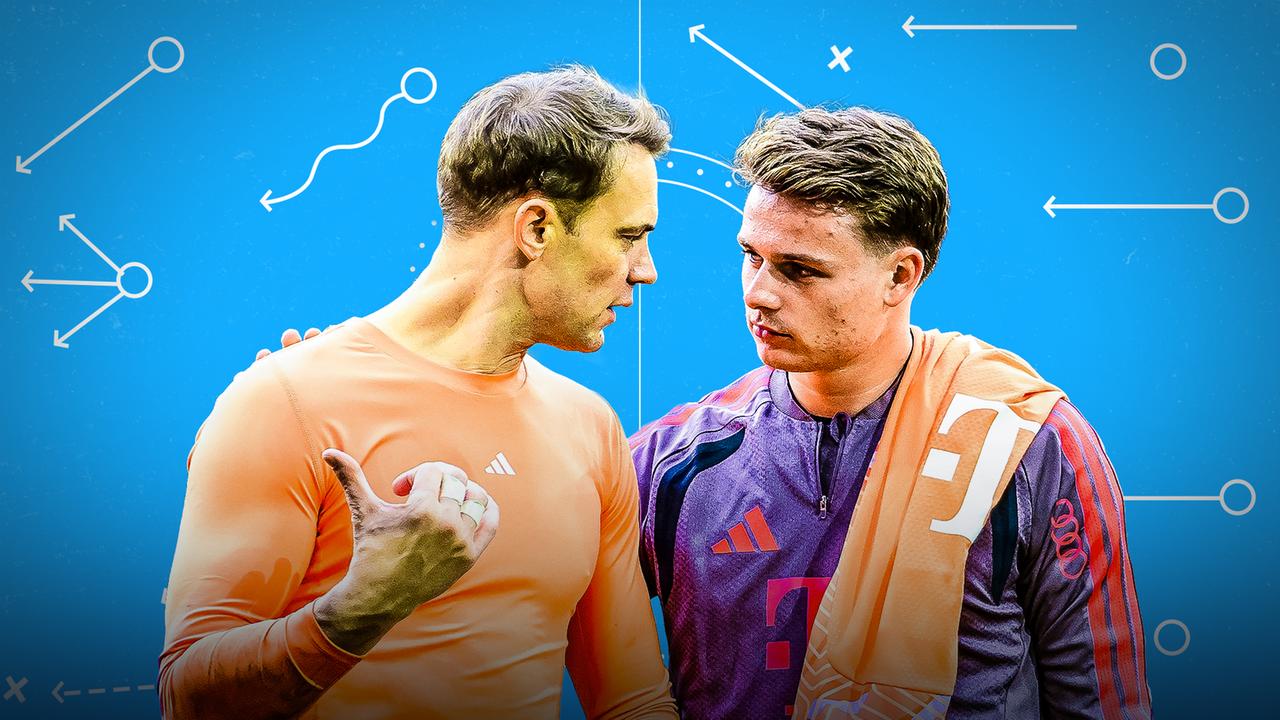
The aura of invincibility that has defined Manuel Neuer’s career for over a decade is beginning to fracture. Once universally hailed as the definitive "sweeper-keeper" and the gold standard for goalkeeping excellence, the Bayern Munich legend now finds himself at the center of a brewing storm. Following a disastrous performance against FC Augsburg that saw the veteran goalkeeper concede the fastest goal in Bundesliga history, the debate surrounding the Bavarian throne has reached a boiling point.
The question is no longer whether Manuel Neuer can recover his form, but whether the club’s future—personified by the young and hungry Jonas Urbig—has arrived.
The Augsburg Debacle: A Statistical Nightmare
The events of the recent Bundesliga fixture in Augsburg were not merely a bad day at the office; they were a symbolic inflection point. It took exactly 8.4 seconds for Manuel Neuer to be beaten. From the opening whistle, the Bayern defense appeared caught in a trance, but it was Neuer’s hesitation that proved fatal. Augsburg’s Robin Fellhauer, showing immense composure, intercepted an initial back-pass and engaged a startled Neuer in a duel that ended with the ball in the back of the net.
This goal did not just shatter the record books—marking the quickest strike in the history of the German top flight—it also punctured the veneer of security Neuer usually provides. To make matters worse, Neuer looked shaky throughout the remainder of the match, failing to inspire confidence in a defense that looked disjointed and panicked. For a player who has made a career out of being the most proactive, calm presence on the pitch, the Augsburg match was a jarring departure from his usual standard.
Chronology of a Diminishing Return
To understand the current tension, one must look at the trajectory of the 2026 season. Throughout the early stages of the campaign, the coaching staff at Säbener Straße has attempted a delicate balancing act: "load management." By rotating between the established icon, Neuer, and the emerging talent, Jonas Urbig, Bayern has attempted to transition gracefully.
However, the "job-sharing" experiment is beginning to show cracks. While Urbig has impressed during his appearances in both the Bundesliga and the DFB-Pokal, exhibiting the reflexes and distribution skills reminiscent of a young Neuer, the veteran’s presence has become a point of friction.
- Pre-Season: Speculation grew that the club would look to solidify a succession plan. Urbig was signed with the explicit understanding that he was the future.
- Early Season: Neuer retained the starting spot for high-profile clashes, but his distribution statistics—long his greatest asset—began to fluctuate.
- The Augsburg Match: The catalyst for the current crisis. Neuer’s errors directly contributed to a dropped result, emboldening critics.
- Current Status: With the Champions League campaign looming, the management faces a binary choice: trust the legacy or embrace the youth.
Supporting Data: The Case for a Changing of the Guard
While six goals conceded in the current Bundesliga season may not seem catastrophic on paper, the context is what haunts the Bayern hierarchy. Advanced metrics suggest that Neuer’s "Post-Shot Expected Goals" (PSxG) numbers—a statistic measuring how likely a goalkeeper is to save a specific shot based on its placement—have dipped compared to his career averages.
Conversely, Jonas Urbig’s performances have been characterized by high-percentage interventions. In his limited appearances, he has shown a superior command of his penalty area during set-piece situations and a quicker reaction time to high-pressing attackers—the very scenario that undid Neuer against Augsburg.
Podcast hosts Anne Hilt and Jens Walbrodt, speaking on the Sportschau "Bundesliga Update," highlighted the psychological component of this dilemma. "Neuer is so ambitious and his self-confidence is so immense that he likely perceives himself as more capable than he currently is," noted Walbrodt. This internal belief is both his greatest strength and his current liability. For a veteran of his stature, accepting a reduced role is not merely a tactical adjustment; it is an existential challenge.
The Philosophy of the Goalkeeper Position
One of the core arguments against the current "job-sharing" model is the nature of the position itself. Unlike outfield positions, where tactical shifts can accommodate various players, the goalkeeper role is built on rhythm, intuition, and the non-verbal understanding with the back four.
"The goalkeeper position is entirely dependent on rhythm and trust," argues Walbrodt. "You need to build a subconscious rapport with your defenders. When you rotate the man between the sticks, you disrupt the defensive axis. Load management is a luxury that doesn’t apply well to the goalkeeper. You either have a clear number one, or you have a problem."
Anne Hilt, while acknowledging the utility of having a mentor like Neuer, believes the transition is overdue. "Neuer is struggling to let go," she observes. "It’s a comfortable situation for Urbig to learn under a legend, but at some point, the legend must step aside for the sake of the team’s evolution. Neuer’s inability to fully relinquish the spotlight is hindering the development of the defensive unit."
Official Stance and the Road Ahead
Despite the mounting pressure, Bayern Munich’s leadership has maintained a public stance of support for their captain. The club’s internal philosophy is to reward loyalty and experience, especially when the Champions League knockout stages are on the horizon.
However, the upcoming Champions League fixture against Viking Stavanger will be the ultimate litmus test. If the coaching staff elects to start Urbig, it will signal that the "Neuer era" has effectively ended. If they stick with Neuer, they are betting that his big-game temperament outweighs his current dip in form.
The Broader Implications: A Club at a Crossroads
The situation at Bayern mirrors a broader trend in modern football: the difficulty of managing the final act of a legendary career. Neuer is not just a player; he is an institution at Bayern Munich. His departure—or even his benching—carries significant emotional weight for the fanbase and the locker room.
Yet, the professional reality is cold. Bayern Munich exists to win trophies, not to maintain the status quo. If the technical staff concludes that Neuer’s reflexes are failing him, the delay in benching him could cost them silverware. Furthermore, there is the risk of alienating Jonas Urbig. If a talent of his caliber feels that he is being held back by sentimentality rather than performance, he may look for an exit, potentially leaving Bayern without either a veteran anchor or a rising star.
As the team prepares for the trek to Stavanger, the atmosphere is one of nervous anticipation. The Augsburg result has opened a door that cannot be closed. Whether Neuer manages to silence his critics with a vintage performance or whether the "Urbig era" begins in earnest, the result will define the remainder of Bayern’s season.
The transition from a titan to a successor is never smooth, but for a club as demanding as Bayern, the timeline is dictated by results, not sentiment. Manuel Neuer has given everything to the jersey, but in the unforgiving world of professional football, the question is always the same: What can you do for us today? On Tuesday, we will have our answer.