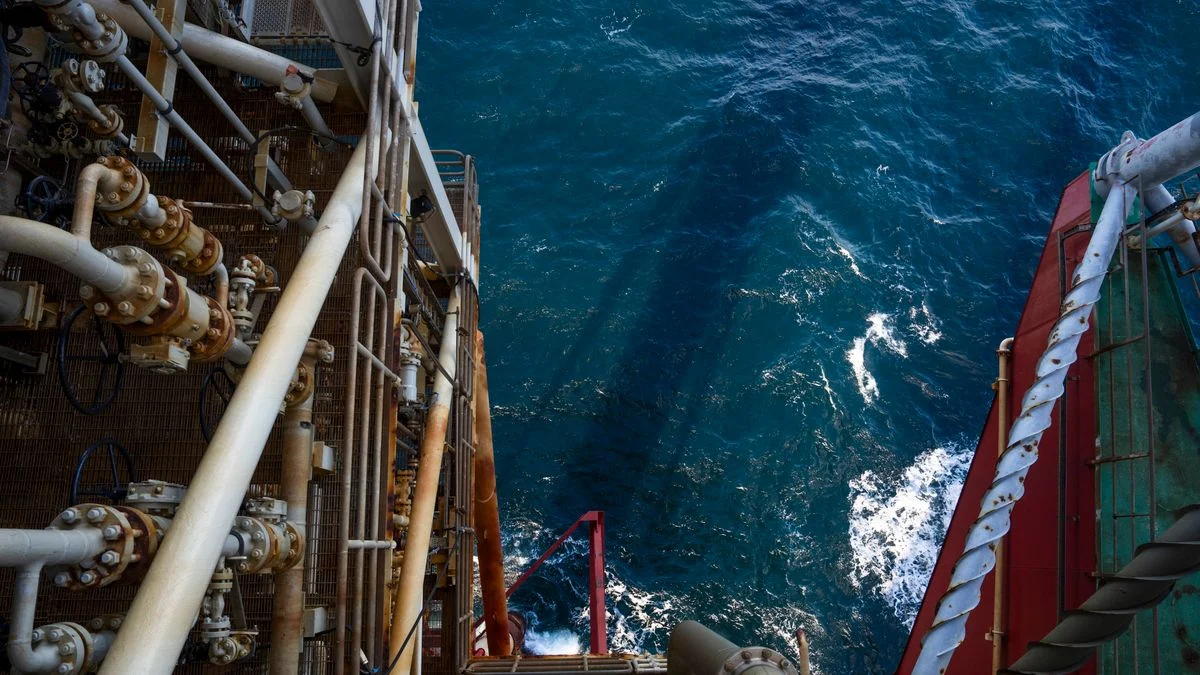
The vision of a climate-neutral Germany, bolstered by the massive underground sequestration of carbon dioxide beneath the North Sea, has suffered a significant setback. Recent data released by the scientific research consortium Geostor suggests that the storage potential for climate-damaging $CO_2$ in the German North Sea is substantially lower than earlier, more optimistic estimates had projected.
As the German government moves toward finalizing its "Carbon Management Strategy," this sobering assessment threatens to derail political expectations. What was once heralded as a cornerstone of the nation’s decarbonization path—Carbon Capture and Storage (CCS)—is now being viewed with heightened caution by experts, who warn that the technology may be less of a miracle cure and more of a complex, expensive, and limited instrument.
The Shrinking Capacity: From Billions to Millions
For years, policymakers and industry leaders have pointed toward the North Sea as an ideal repository for the carbon emissions generated by Germany’s heavy industry. The Geostor project, which has been tasked with mapping these sub-seabed geological formations, published an updated report in late September that has sent shockwaves through the climate policy community.
According to the new findings, the estimated storage capacity for $CO_2$ off the German coast has been slashed. Researchers now project that only 0.5 to 1.5 billion tons of $CO_2$ can be safely sequestered. To put this in perspective, just two years ago, the same researchers estimated a capacity range of one to six billion tons. Even when considering the upper end of the new estimate, the potential capacity has effectively been reduced to roughly one-quarter of the previous projections.

The primary culprit for this drastic reduction is "competing usage." The North Sea is a crowded space; the seabed and the waters above are already heavily contested by offshore wind farms, established shipping routes, military training zones, and vital marine protected areas. Furthermore, the infrastructure required to pump $CO_2$ into the earth—including pipelines and drilling platforms—occupies significant physical space, further limiting where storage can occur.
A Chronology of a Disillusioned Technology
The history of CCS in Germany is one of extreme peaks and valleys.
- 2004–2013: Germany’s first major foray into the technology occurred in Ketzin, Brandenburg, where researchers from the GeoForschungsZentrum (GFZ) Potsdam successfully pumped approximately 67,000 tons of $CO_2$ into sandstone formations. It remains the only real-world test of the technology on German soil to date.
- 2022: Early Geostor reports provided an optimistic outlook, suggesting that the North Sea could serve as a vast, almost bottomless reservoir for the nation’s industrial carbon footprint.
- 2024: The shift in scientific consensus. Researchers began to emphasize the lack of real-world site exploration. As Klaus Wallmann, head of the Geostor project, noted, "We are fishing in the dark." The need for expensive, industry-led site exploration became clear, with companies like ExxonMobil beginning to file the first formal applications for site investigation.
- 2025: The passage of the Carbon Dioxide Storage and Transport Act (KSpTG) set the legislative framework, though it remains a subject of intense debate due to its "technology-open" approach, which allows for the use of CCS even in contexts linked to natural gas—a move that critics argue undermines the transition to renewable energy.
The Economic and Environmental Reality Gap
The Geostor report does not just highlight a capacity crisis; it draws attention to the daunting economic and environmental hurdles that make large-scale CCS implementation highly improbable without massive, long-term state intervention.
The Cost Barrier
The financial math remains brutal. Researchers estimate the cost of the entire carbon disposal chain—from capture to transport to long-term storage—at approximately 150 to 250 euros per ton. In contrast, the current European carbon market price (ETS) hovers around 74 euros per ton. This gap implies that, without heavy government subsidies, CCS projects are currently economically unviable. This reality has drawn sharp criticism from environmental organizations like Greenpeace, which argue that the government’s proposed multi-billion-euro subsidies would essentially be pouring tax money into a bottomless pit that could prolong the life of fossil-fuel-dependent industries.

The Environmental Risks
The latest research has also become significantly more transparent about the dangers of deep-sea storage. The report warns of potential leaks, micro-earthquakes, and the physical deformation of the seabed. A catastrophic leak could lead to localized acidification of bottom waters, posing a severe threat to marine ecosystems. Furthermore, the noise generated during the construction and operation of these facilities could disrupt the habitats of marine mammals, such as the porpoise, which are already struggling with the impact of offshore wind farm construction and heavy maritime traffic.
Official Responses and Political Implications
The German government’s "Carbon Management Strategy" is currently in its final stages, with parliamentary hearings reflecting a deep divide.
The Geostor researchers, including Klaus Wallmann, have taken a firm stance: CCS should be restricted exclusively to "unavoidable" industrial emissions, such as those produced during cement manufacturing. They argue that using CCS for natural gas power plants or "blue hydrogen" (hydrogen produced from fossil gas) is a strategic error.
However, the current legislative environment, driven by a desire for "technology openness," clashes with this expert advice. Critics like Karsten Smid of Greenpeace argue that the strategy is built on the ruins of over-optimistic projections. "The Carbon Management Strategy is heading toward a disaster," Smid stated, "simply because it was developed on the basis of inflated forecasts for $CO_2$ storage capacities."

The political tension is further exacerbated by the emerging interest in "on-shore" storage. Following the passage of the federal KSpTG, states like Baden-Württemberg and, more recently, the state government of Brandenburg have expressed interest in utilizing the "state opening clause" to allow for carbon storage within their borders. This signals that the debate over where to put the nation’s carbon is shifting from the remote North Sea to local, inland territories, likely sparking new waves of public opposition.
Conclusion: A Dangerous "Fig Leaf" for Climate Action?
As Germany looks toward 2045, the discrepancy between the required storage capacity—estimated between 8.5 and 70 million tons per year—and the newly calculated maximum capacity of 23 million tons per year is stark.
The consensus among many experts is shifting toward a cautionary conclusion: If Germany limits the expansion of renewable energy and relies too heavily on the hope that expensive, unproven, and limited CCS technology will bridge the gap, it risks failing its climate goals. As Klaus Wallmann poignantly remarked, "CCS risks becoming a fig leaf for stalled climate action."
The dream of a subterranean carbon tomb beneath the North Sea is not dead, but it is certainly smaller, more expensive, and more fraught with risk than it appeared just two years ago. The path forward will require not only geological exploration but a fundamental re-evaluation of whether CCS is a genuine solution or merely a costly distraction from the urgent necessity of systemic energy transformation.