

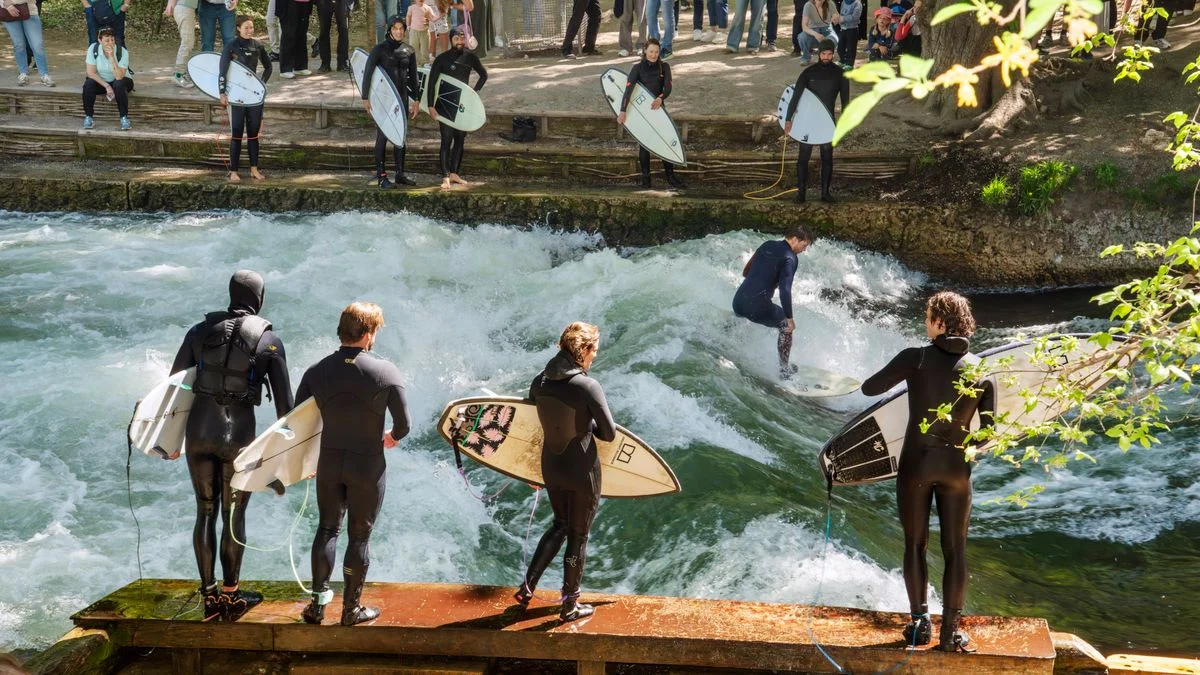
For decades, the Eisbachwelle has served as more than just a hydraulic phenomenon in the heart of Munich’s English Garden; it is a cultural totem, a symbol of the city’s unique juxtaposition of Bavarian tradition and modern, unconventional sport. After a tumultuous year defined by a tragic loss of life, administrative closures, and the inexplicable disappearance of the wave itself, the surf is back. The return of the legendary standing wave marks a moment of relief for the local community, yet the path forward is paved with new safety protocols and a solemn reflection on the risks inherent in this urban oasis.
A Symbol of Munich’s Spirit Restored
"I am delighted that surfing the Eisbach is finally possible again," said Krause, a prominent voice within the local surfing community. For enthusiasts, the return of the wave is not merely a return to a sport; it is the restoration of a vital component of Munich’s social fabric. "The forces of nature have finally aligned, and the wave has returned," Krause added, emphasizing that the Eisbachwelle is inextricably linked to the "Münchner Lebensgefühl"—the specific, vibrant, and multifaceted quality of life that defines the Bavarian capital.
The Eisbach, an artificial side arm of the Isar River, has drawn international acclaim, turning a nondescript urban waterway into a global destination for river surfers. Its return to form, however, comes after a period of intense scrutiny and emotional hardship for the community that calls these banks home.
Chronology of a Turbulent Year
The recent history of the Eisbachwelle is a timeline of extremes, swinging from the heights of popularity to the depths of tragedy and physical absence.
The Tragedy of April 2025
In April 2025, the community was shaken by the death of a 33-year-old woman. The incident, which occurred during a night surfing session, resulted in a fatal accident that shocked the city. Despite an exhaustive investigation by local authorities, a definitive cause for the tragedy could not be established. The inability to pinpoint a specific mechanical failure or human error created a vacuum of uncertainty, leading the city to shutter the site immediately.
The Regulatory Interlude
Following the closure, the city administration faced the difficult task of balancing public safety with the cultural preservation of the site. It was not until late June 2025 that the wave was reopened, albeit under a rigorous framework of new safety conditions. This period served as a trial, demonstrating the fragility of the status quo when dealing with an unpredictable natural-mechanical hybrid.
The Disappearance of the Wave
The situation took a bizarre turn in October 2025. Following the annual "Bachauskehr"—a routine maintenance procedure where the riverbed is drained and cleared of silt, debris, and sediment—the wave failed to reform. The loss of the wave was more than a logistical inconvenience; it triggered an existential crisis among local surfers who feared that the engineering balance required to create the standing wave had been permanently disrupted.
The Christmas Intervention
Desperation drove some to take matters into their own hands. During the 2025 Christmas season, unidentified individuals clandestinely installed a makeshift wooden ramp in the riverbed in an attempt to manually recreate the standing wave. While the initiative showcased the passion of the surfing community, it was deemed a safety hazard and an unauthorized intervention. Authorities removed the structure just days later, leaving the Eisbach silent once more.
The Engineering and Physics of the Eisbach
To understand why the wave is so temperamental, one must look at the delicate physics of the Eisbach. The wave is not a naturally occurring tidal bore or ocean swell; it is a standing wave created by a specific water velocity and a submerged concrete step that forces the water to surge upward.
When the riverbed is cleared during the annual maintenance, the flow dynamics change significantly. The accumulation of sediment over the year actually assists in the creation of the wave by subtly altering the river’s bed profile. When the city performs the "Bachauskehr," they effectively reset the system, often inadvertently breaking the precise hydraulic conditions required to maintain the standing wave. This "reset" is a point of constant contention between the city’s maintenance crews and the surfing community, highlighting the difficulty of managing a wild, flowing system for recreational purposes.
Official Responses and Safety Implications
The city of Munich, working in conjunction with safety experts and hydrologists, has implemented a series of permanent adjustments aimed at mitigating the risks associated with the sport. The primary concern, underscored by the tragic death in 2025, is the danger of being trapped in the "washing machine"—the turbulent water behind the wave—or becoming entangled in equipment.
New Regulatory Framework
Moving forward, the city has established strict operational windows and equipment requirements:
- Restricted Hours: Surfing is now legally permitted only between 5:30 AM and 10:00 PM. This restriction is designed to ensure that in the event of an accident, help can be summoned quickly and the environment is visible to observers.
- Mandatory Safety Equipment: The use of "self-opening" leashes is now a primary requirement. Standard leashes have been known to trap surfers in the powerful current if they snag on underwater debris; the new mandate aims to prevent surfers from being pinned beneath the surface by their own boards.
- Surveillance and Enforcement: While the English Garden remains a public space, authorities have increased the presence of park security during peak surfing hours to ensure compliance with the new safety guidelines.
The Broader Implications for Urban Sport
The saga of the Eisbachwelle serves as a microcosm for the challenges faced by major cities as they integrate extreme sports into public infrastructure. As urban populations grow and the demand for unconventional recreation increases, municipal governments are increasingly forced to act as regulators of "wild" spaces.
The Balancing Act
The Eisbach is a unique case because it is a hybrid of nature and engineering. Unlike a skate park, which is entirely human-made, or a beach, which is largely natural, the Eisbach requires a constant, delicate management of hydraulic flow. The city’s decision to keep the wave active is a testament to the influence of the surfing community and the recognition that the wave has become a core element of Munich’s brand identity.
The Psychological Impact
For many, the Eisbach is a sanctuary. In a city known for its high cost of living and traditional values, the surf spot offers a democratic, accessible outlet for expression. The anxiety caused by the disappearance of the wave in late 2025 highlighted how vital these spaces are for the mental well-being of the youth and the alternative sports community. When the wave vanished, it felt to many like a part of the city’s soul had been switched off.
Conclusion: A Future Defined by Caution
As the water flows once again over the concrete step, creating that familiar, rhythmic roar in the heart of the English Garden, the mood in Munich is one of cautious optimism. The return of the Eisbachwelle is not a return to the past, but the beginning of a new chapter—one where the thrill of the ride is tempered by a sobering awareness of the risks involved.
The surfing community, the city administration, and the visitors who line the banks to watch have all learned a hard lesson over the last year. The Eisbach is not a playground to be taken for granted; it is a powerful, unforgiving force of nature that requires respect, preparation, and regulation.
As Krause noted, the wave is indeed a "part of the Munich lifestyle." By embracing the new safety protocols, the city has ensured that this lifestyle can endure, even in the face of tragedy and mechanical failure. The Eisbachwelle stands as a reminder that even in the most civilized, urbanized environments, there is still room for the wild, provided we are willing to learn how to live with it responsibly. The wave is back, and for now, that is enough.







Leave a Reply