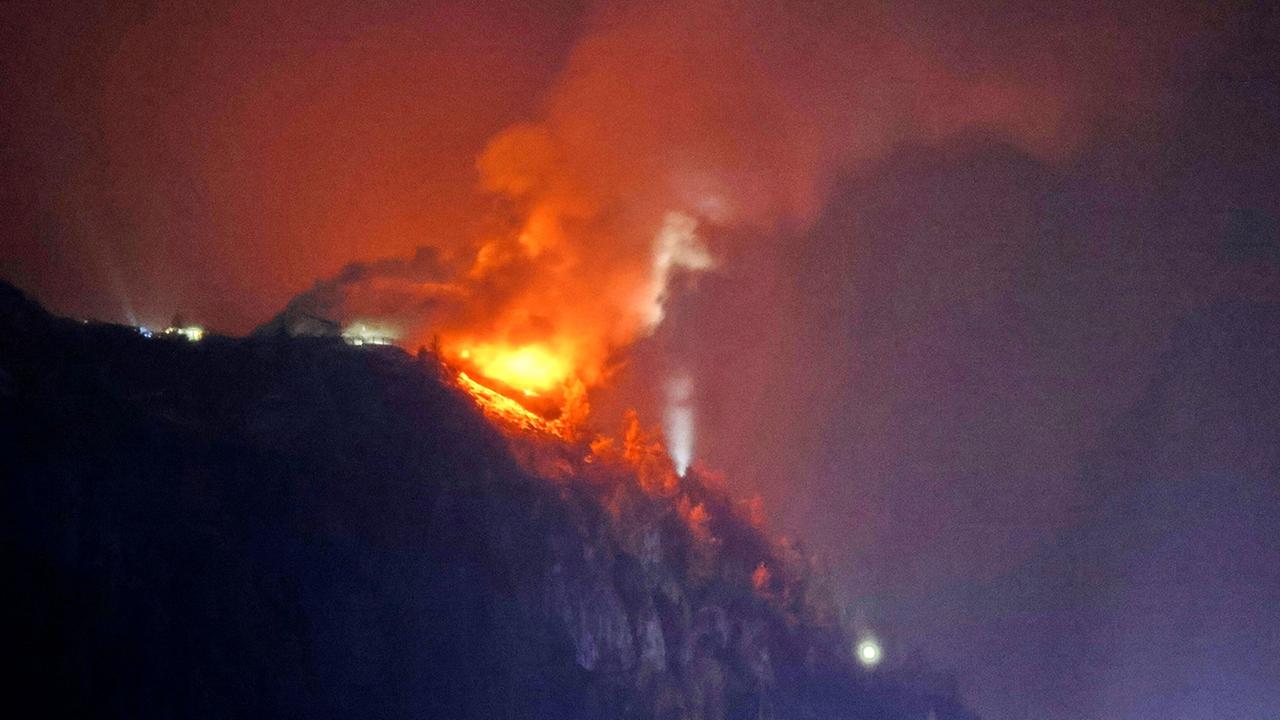
BERCHTESGADEN, Germany – A significant blaze erupted late Friday evening at the Kehlsteinhaus, the historic mountaintop retreat situated on the Obersalzberg near Berchtesgaden. The structure, globally known as the "Eagle’s Nest," is a site of immense historical sensitivity and a prominent tourist destination. While emergency crews battled the inferno throughout the night, law enforcement authorities have confirmed that they have taken a suspect into custody, as initial forensic findings point toward deliberate arson.
The Incident: A Night of Crisis
The emergency call reached the Oberbayern Süd Police Headquarters at approximately 9:52 p.m. on Friday. Reports of smoke and flames emanating from the structure, perched precariously at an elevation of 1,834 meters, triggered an immediate, large-scale emergency response.
Over 200 personnel, including specialized mountain firefighting units, local volunteer fire departments, and emergency medical teams, were mobilized to the scene. The geography of the site presented immediate logistical nightmares for the responders. The Kehlsteinhaus is accessible via a narrow, winding mountain road and a legendary elevator shaft carved into the rock, making the deployment of heavy fire suppression equipment and water tankers an exceptionally difficult task.
By early Saturday morning, the police confirmed that the fire had been contained, though the extent of the structural damage remains under assessment. Fortunately, initial reports indicate that the building was empty at the time of the ignition, preventing any loss of life or injury.
Chronology of the Emergency
The timeline of the disaster reflects the speed at which the situation escalated:
- 21:52 (Friday): First responders alerted to the fire at the 1,800-meter-high mountain restaurant.
- 22:30 (Friday): Arrival of the first fire crews at the summit, encountering extreme difficulty in maneuvering equipment due to the terrain.
- 01:00 (Saturday): Confirmation of a containment perimeter; the fire continued to burn through the interior structure.
- 03:00 (Saturday): Police authorities confirmed the detention of an individual found in the vicinity of the site, establishing the primary lead in the ongoing investigation.
- 08:00 (Saturday): The fire was officially brought under control, though smoldering hot spots remained.
Official Responses and Security Measures
The Police Presidium of Upper Bavaria South has taken charge of the investigation. While the authorities were initially cautious, the announcement that a suspect was apprehended near the crime scene has shifted the investigation’s focus toward criminal intent.
"We are currently reviewing the evidence and the proximity of the suspect to the origin point of the fire," a spokesperson for the police stated during a morning briefing. "The investigation is being treated with the highest priority, given the cultural and historical significance of the site."
Local government officials, including representatives from the Zweckverband Bergerlebnis Berchtesgaden (the tourism association responsible for the site), have expressed profound shock. The Kehlsteinhaus was scheduled to remain open for the remainder of the tourist season until November 8. The abrupt closure and the potential destruction of the site have left local tourism leaders grappling with the logistical and reputational fallout.
Historical Significance: The "Eagle’s Nest"
The Kehlsteinhaus is not merely a mountain restaurant; it is a monument to a dark chapter in European history. Completed in 1938, the building was constructed as a satellite of the Berghof, Hitler’s secondary residence in the Obersalzberg.
During the Third Reich, the site served as a secluded, high-altitude venue for diplomatic receptions and elite meetings. Often referred to by the Allies as the "Eagle’s Nest"—a name the Nazi regime never used itself—the site has served as a place of historical reflection since 1952.
The Zweckverband Bergerlebnis Berchtesgaden maintains the site as a space for public education. An exhibition currently housed within the building chronicles the construction of the site by the regime and the forced labor often associated with the Nazi development of the Obersalzberg area. Although the site’s political importance during the war was arguably peripheral compared to the main administrative hub of the Obersalzberg, it has become a focal point for modern historical tourism.
The Challenges of Mountain Firefighting
The fire at the Kehlsteinhaus highlights the extreme vulnerability of historic sites located in high-alpine environments. Traditional firefighting methods are largely ineffective when the infrastructure—such as water pressure systems and road width—is designed for tourism rather than emergency disaster management.
"When you have a fire at nearly 2,000 meters, you are essentially fighting against gravity and limited access," explained an expert in heritage fire safety. "Even with modern equipment, the sheer time required to transport fire engines up the mountain allows a fire to spread significantly before full-scale suppression can begin."
The structure itself, constructed with significant amounts of timber and traditional insulation materials from the late 1930s, is highly susceptible to rapid fire spread. The loss of such a structure would be an irreparable blow to historical preservation efforts in the region.
Implications for Historical Preservation
The incident raises urgent questions regarding the security and protection of historical sites that are also active commercial venues. Balancing the need for public access with the security required for a site of such notoriety is a complex challenge for the Bavarian authorities.
- Security Protocols: The arrest of a suspect suggests a potential security lapse. The region, which attracts thousands of visitors annually, may now face increased surveillance and stricter access controls to prevent future vandalism or acts of extremism.
- Restoration Hurdles: Should the structural damage prove severe, the process of restoration will be painstaking. German law regarding the preservation of historic monuments is rigorous, requiring that any reconstruction adheres strictly to original specifications and materials, which may be costly and technically demanding.
- Educational Impact: The fire has sparked a broader national conversation about how Germany protects its "sites of guilt." For decades, the Obersalzberg has been carefully managed to prevent it from becoming a site of pilgrimage for neo-Nazis, while simultaneously serving as a site for historical education. Any act of arson at such a location is viewed not just as a property crime, but as an attack on the collective memory of the nation.
Looking Ahead
As the sun rises over the Alps, the fire-ravaged Kehlsteinhaus remains under heavy police guard. Forensics teams are expected to begin their sweep of the interior as soon as the structure is deemed stable.
The arrest of the suspect is the first step in a long legal process. Meanwhile, the community of Berchtesgaden faces the grim reality of losing a landmark that has defined its skyline for nearly nine decades. Whether the damage is cosmetic or structural remains the primary concern for heritage authorities. For now, the Kehlsteinhaus stands silent, its future uncertain, as investigators work to determine how a symbol of a fallen regime became the target of a modern-day crime.