In the lush, verdant heart of West Sussex, England, stands the 17th-century estate of the Duke of Richmond. For four days each year, the quiet serenity of Goodwood House is shattered by the roar of engines—or increasingly, the futuristic hum of high-performance electric motors. The Goodwood Festival of Speed has evolved from a niche gathering for vintage motoring enthusiasts into the most significant automotive event on the British calendar. With over 200,000 pilgrims descending upon the estate, the event serves as a microcosm of the modern automotive industry: a paradoxical blend of deep-rooted British heritage and the aggressive, high-tech encroachment of global manufacturers, particularly from China.
The Shifting Landscape: MG and the New Era of "British" Motoring
The case of MG is perhaps the most poignant illustration of the industry’s transformation. A brand with over a century of history, MG is now firmly under the ownership of China’s SAIC Motor. The gap between the brand’s storied past—typified by classic roadsters—and its present is stark.
At this year’s festival, MG showcased its future through two concept vehicles: the MG Go and the MG Cyber. Designed by MG’s London-based studio, the MG Go is a B-segment hatchback, while the MG Cyber—a striking SUV finished in classic racing green—targets the D-segment. Both are slated for production in 2027.

Marketing vs. Reality: The Burden of Heritage
MG’s management is eager to tether these modern electric vehicles (EVs) to the brand’s history. According to Design Director Carl Gotham, the MG Cyber draws inspiration from the MG EX 181, the streamliner in which Stirling Moss achieved a staggering 395 km/h in 1957. Simultaneously, the MG Go is positioned as a spiritual successor to the MG B GT.
However, industry observers suggest this is primarily the work of marketing departments. The MG Go bears a closer resemblance to a contemporary Renault 5 or a Mini than the classic sports coupes of the mid-20th century. Similarly, the MG Cyber requires a significant leap of imagination to connect its SUV architecture to the record-breaking, low-slung EX 181. It serves as a reminder that in the current market, "heritage" is often a label applied to justify brand continuity in an era where the underlying technology and corporate ownership have moved on entirely.
The Ascendance of Chinese Manufacturing: BYD’s Grand Entrance
If MG represents the transition of a British nameplate, BYD represents the new vanguard of global power. Shenzhen-based BYD, currently the world’s largest producer of electric vehicles, has turned the Goodwood estate into its own personal showcase. This year, they erected the festival’s largest three-story pavilion, displaying eight vehicles across three brands: BYD, Denza, and Yangwang.

The spectacle was as much about branding as it was about product. BYD even opened a fully functional fan shop on-site—a development that would have been considered unthinkable just five years ago.
The Technology Gap
The centerpiece of the BYD exhibit was the Denza Z, showcased in both cabriolet and coupe formats. The premium arm of the conglomerate also brought the Z9 GT, the Bao 5 off-roader, and the D9 minivan. Most impressive, however, was the Yangwang U9 Xtreme. This electric supercar, which recorded a blistering 496.22 km/h at the Papenburg test track in late 2025, represents the current state-of-the-art in electric performance, signaling that the "Great Wall" of automotive innovation has shifted eastward.
The "Hillclimb" Culture: Performance in the Modern Age
While the Festival of Speed is globally recognized for its competitive spirit, the reality of the event is more theatrical than professional. The famous "track" is a 1.86 km stretch of paved road that climbs 93 meters, winding through the estate.

When the current Duke of Richmond founded the event in 1993, he was denied permission to use the historical circuit of a nearby former airbase. He improvised by using his own driveway. Today, the narrow road, lined with precarious straw bales, remains a test of nerves rather than a venue for setting lap records. The true spectacle happens directly in front of Goodwood House, where drivers perform "donuts" and burnouts to the delight of the grandstands before accelerating up the hill.
This year, a massive sculpture featuring three Porsche 911s—a tribute to the meticulous restoration work of Singer Design—stood as a monument to the festival’s enduring love for the mechanical soul, even as the cars on the track become increasingly digital.
Global Manufacturers and the Electric Pivot
The festival serves as a high-stakes marketing battlefield for established European brands attempting to pivot to electrification.

- Renault: The French automaker brought a collection of heritage-inspired EVs, including the Twingo E-Tech and the Renault 5 Turbo 3E, alongside the Renault 4 Plein Sud.
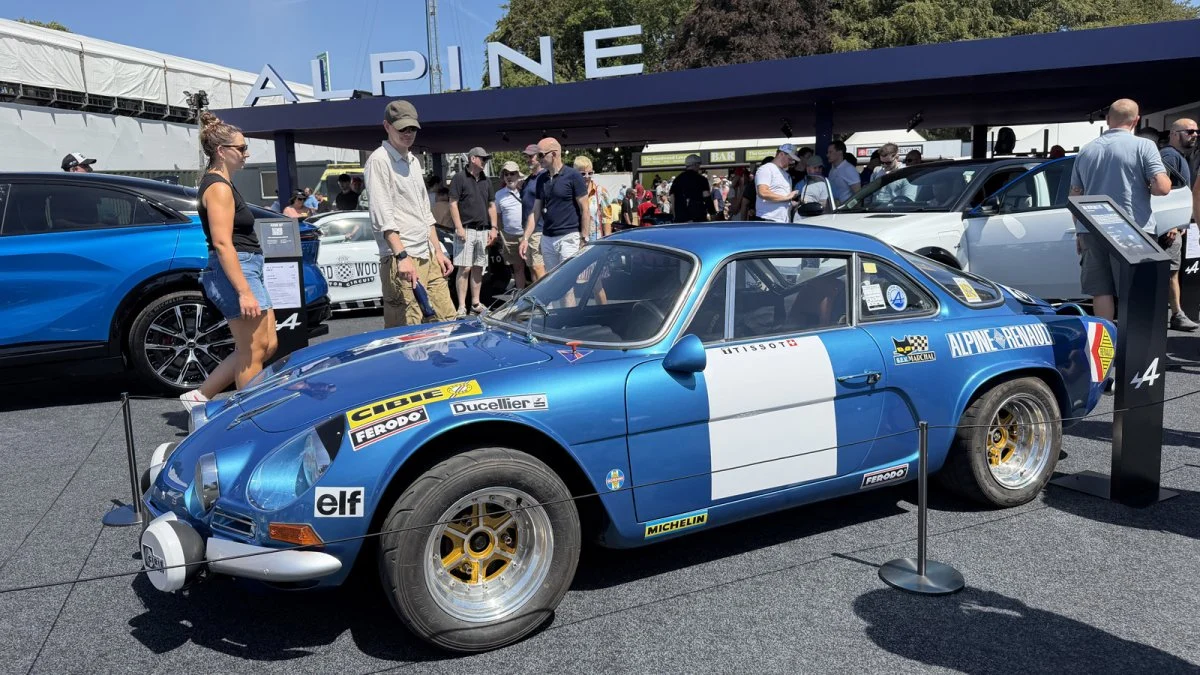
- Alpine: As a look into the future, Alpine showcased its A110 on the new Alpine Performance platform.
- Mercedes-AMG: The brand made a massive statement by unveiling the Mercedes-AMG CLA 45. With three electric motors delivering 500 kW and a top speed of 270 km/h (with the Dynamic Plus package), it is a direct retort to the electric performance challenge posed by Chinese competitors.
- Cupra: Making its debut, Cupra focused on the Kiro Race (Formula E) and the Raval electric city car, emphasizing a youthful, aggressive design language.
Implications: The Death of the Traditional Auto Show
The success of the Goodwood Festival of Speed highlights a fundamental shift in how the industry communicates with its customers. As traditional trade shows in cities like Frankfurt, Paris, and Geneva struggle for relevance, Goodwood has filled the vacuum.
Logistics and the "Hub-and-Spoke" Economy
The infrastructure required to support this event is immense. Because the estate is located in a rural region with narrow village roads, the festival has become a logistical exercise in extreme efficiency. For the wealthy elite, it is a helicopter-access event; for the general public, it is a marathon of walking.
However, the organizers have mastered the "guest experience." From water stations to sanitary facilities and the seamless integration of high-speed fiber for media, the effort reflects a professionalization of the event that rivals any corporate trade fair. The takeaway is clear: the modern consumer does not want a sterile exhibition hall. They want the sensory experience—the smell of rubber, the sound of the engine, and the sight of history meeting the horizon.

Conclusion: A Window into 2030
The 2026 Goodwood Festival of Speed proves that while the industry is in a state of flux, the hunger for automotive excellence remains constant. Brands like MG and BYD are no longer just participating; they are defining the terms of the conversation. The transition to electric power is no longer an abstract goal for the future—it is the present reality. As the crowds leave West Sussex, they carry with them the image of a future that is faster, more connected, and undeniably Chinese-led, yet one that still pays deep, if sometimes performative, respect to the traditions of the road.
For the automotive sector, Goodwood is no longer just a garden party; it is the most critical proving ground in the world.