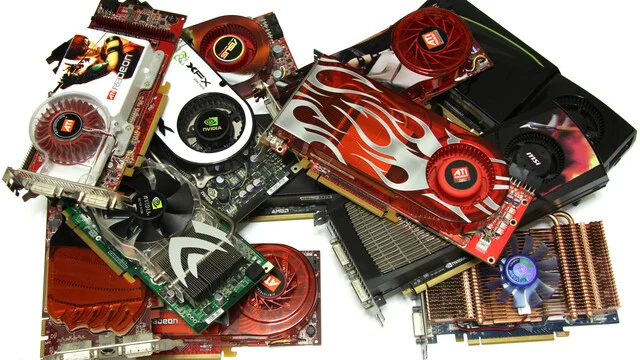
In October 2011, the tech landscape was vastly different from today. To understand the trajectory of graphical processing, we conducted an ambitious, comprehensive benchmark test pitting 14 iconic graphics cards from ATi/AMD and Nvidia against one another. Spanning six years of rapid hardware innovation, this study measured how far technology had progressed from the mid-2000s to the dawn of the 2010s, utilizing a test bench powered by an Intel Core i7-2600K overclocked to 4.5 GHz.
The findings were not merely a collection of numbers; they told the story of an industry in the midst of a technological explosion. While the leap between the oldest and newest models was massive, the results revealed that some architectures were so fundamentally ahead of their time that they remained relevant for years after their release.
Chronology of Hardware: From the X1800 XT to the GTX 580
The test cohort consisted of eight ATi/AMD Radeon cards and six Nvidia GeForce models. The oldest representative was the Radeon X1800 XT (2005), while the contemporary powerhouses of the time, the Radeon HD 6970 (2010) and the GeForce GTX 580 (2010), represented the cutting edge.
Initially, the selection process included the legendary GeForce 6800 Ultra (2004) and the 7800 GTX (2005). However, these cards failed the test of time in a literal sense: they proved incompatible with the Windows 7 environment, suffering from catastrophic driver issues and an inability to render the desktop environment properly. Consequently, they had to be retired from the benchmark, highlighting the first of many hurdles in legacy hardware testing.
The remaining lineup was put through a rigorous gauntlet of 14 titles, ranging from 2005 classics like F.E.A.R., Oblivion, and Half-Life 2: Episode 2 to the graphically demanding modern titles of the time, such as Dirt 3 and The Witcher 2. To ensure a level playing field, the benchmark was restricted to the DirectX 9 API.
Supporting Data: The Widening Performance Gap
The performance metrics collected in 2011 painted a vivid picture of exponential growth. In the standard performance rating without anti-aliasing (AA), the GeForce GTX 580 achieved a near-perfect score of 99.2 percent, whereas the GeForce 7900 GTX (2006) managed only 12.2 percent. This confirmed that the 2010 flagship was more than eight times faster than its 2006 predecessor.
The disparity deepened significantly when we applied modern graphical stress tests, specifically 4x anti-aliasing and 16x anisotropic filtering. Under these conditions, the GeForce GTX 580 maintained its dominance, losing almost no relative performance (99.3 percent), while the GeForce 7900 GTX collapsed to a mere 6.0 percent. The performance lead of the GTX 580 grew to more than 16-fold over the aging 7900 GTX.

Incremental Gains vs. Architectural Leaps
The data also allowed us to analyze shorter-term progression. The GeForce GTX 280 (2008) outperformed the GeForce 8800 GTX (2006) by 61 percent, and the Radeon HD 6970 (2010) saw a 56 percent jump over the Radeon HD 4890 (2009). However, a notable trend emerged: the R&D cycles began to lengthen, and the time required to achieve significant generational performance jumps increased as silicon manufacturing hit physical thermal and electrical limits.
The Anomaly: Why the GeForce 8800 GTX Defied Expectations
One card stood out as a historical outlier: the GeForce 8800 GTX. Released at the end of 2006, it was not merely an iteration; it was a revolution. In our testing, the 8800 GTX achieved roughly three times the performance of the 7900 GTX, despite both being released in the same year.
Even five years later, the 8800 GTX remained a formidable piece of hardware. When using anti-aliasing, it actually outperformed the Radeon HD 4850 (2008), a card released two years later. The 8800 GTX’s longevity was attributed to the industry-wide shift toward the Unified Shader architecture, introduced by Nvidia’s G80 chip. By moving away from separate pixel and vertex shaders and incorporating 768 MB of VRAM on a 384-bit bus, Nvidia had created a "future-proof" product that effectively bridged the gap between early 2000s hardware and the modern era.
Conversely, the Radeon HD 2900 XT (2007) proved less resilient. It struggled to show significant gains over the older Radeon X1950 XTX, illustrating that not every "new" generation resulted in a meaningful leap in user experience.
The Witcher 2: The Modern Hardware Killer
If any title served as a benchmark for the "new era" of gaming in 2011, it was The Witcher 2. This game essentially acted as a filter for the old guard.
- GeForce 8800 GTX: Managed 16.4 FPS at 1680×1050 (a struggle, but playable for some).
- Radeon HD 4890: Achieved 29.5 FPS (the threshold of playability).
- GeForce GTX 580: Delivered 59.1 FPS (fluid, modern performance).
The oldest cards, such as the Radeon X1800 XT, hit a wall, outputting a slideshow-like 3.6 FPS and exhibiting severe graphical corruption. For the GeForce 7900 GTX, the game was entirely unplayable, failing to even launch—a stark reminder that software optimization and feature requirements often render older hardware obsolete faster than raw processing power alone.
Implications: How GPU Aging Has Transformed
Looking back from the vantage point of the present day, the 2011 study reveals how profoundly the nature of graphics card development has shifted.

The Resolution and Memory Inflation
In 2011, we tested at a resolution of 1680×1050. Today, that resolution accounts for barely a fraction of the pixels in a standard 4K output. The memory requirements have scaled even more aggressively; the GTX 580’s 1.5 GB of VRAM was considered massive in 2011, yet modern equivalents like the RTX 5090 now offer 32 GB of VRAM. We have moved from a world where raw throughput was the only metric to a world where memory capacity and high-resolution texture streaming define the limits of hardware.
The Death of Native Performance Metrics
Perhaps the most significant implication is that a direct, simple benchmark test is no longer possible. In 2011, we could measure performance based on native rendering and simple anti-aliasing. Today, that is insufficient. Modern GPUs rely on:
- Upscaling (DLSS/FSR): Reconstructing images from lower render resolutions.
- Frame Generation: AI-driven interpolation that creates frames without traditional rendering.
For a modern comparative test, one would have to categorize results by native performance, upscaling performance, and AI-assisted frame generation. We have moved from an era of "brute force" rendering to an era of "intelligent" reconstruction.
Final Thoughts
The 2011 comparison showed that while hardware can age, the quality of the initial architecture—like that of the 8800 GTX—can keep a card relevant for years beyond its expected lifecycle. However, the rapidly shifting requirements of modern game engines, combined with the emergence of AI-based upscaling, suggest that the future of GPU longevity is no longer just about the silicon—it is about the software ecosystem.
As we look back, the primary lesson remains: while resolution and frame rates change, the fundamental cycle of hardware innovation remains one of the most volatile and exciting sectors of the technology industry. The cards of 2011 may seem like artifacts today, but they provided the necessary stepping stones for the hyper-realistic, AI-accelerated visuals we enjoy in 2025.