The ambitious decarbonization of Germany’s public transport sector is teetering on the edge of a significant setback. As federal budget planners finalize the financial framework for 2027, a drastic reduction in subsidies for electric buses (e-buses) has sparked alarm among transport operators, environmental advocates, and industrial stakeholders. What was once heralded as a flagship policy for Europe’s climate leadership is now facing a “funding cliff” that threatens to stall the transition, jeopardize climate targets, and undermine the domestic automotive industry.
Main Facts: A Budgetary About-Face
The core of the crisis lies in the federal government’s draft budget for 2027, which signals a massive retraction in financial support for the electrification of local bus fleets. Current funding, which supports the higher capital expenditure (CAPEX) required for electric models, stands at approximately €403 million. Under the new proposals, this figure is slated to plummet to roughly €130 million.
For transport companies, this is not merely a budgetary line item; it is a fundamental shift in business viability. The federal government’s subsidies are the primary mechanism that bridges the gap between the cost of a traditional diesel bus and its significantly more expensive electric counterpart. Without this financial scaffolding, municipal transport authorities—many of which are already struggling with high operational costs—face an impossible choice: pause the transition or pass the ballooning costs onto passengers through ticket price hikes.
Chronology: From Momentum to Stagnation
To understand the current crisis, one must look at the trajectory of the last five years.
- 2019–2021: Germany begins an aggressive push toward fleet electrification, bolstered by federal subsidies and the implementation of the EU’s Clean Vehicles Directive.
- 2022–2023: Significant progress is made. By the end of 2023, approximately 6,000 emission-free buses are in operation nationwide, accounting for about 12% of the total fleet. Nearly 50% of all new bus registrations in Germany were electric during this period.
- Early 2024: The "Climate-Allianz Deutschland" and the Association of German Transport Companies (VDV) begin warning of a potential funding gap as fiscal tightening becomes a priority for the federal coalition.
- Late 2024: The publication of the 2027 budget draft confirms fears of a near-70% funding cut, triggering an immediate outcry from industry associations and environmental NGOs.
Supporting Data: The Cost of Transition
The economic argument for e-buses is a tale of two horizons: high upfront investment versus lower long-term operational costs. However, the immediate barrier remains the price tag.
According to an analysis by PwC, commissioned by the VDV and the Klima-Allianz, a battery-electric bus (depot charger) carries a lifecycle cost approximately 30% higher than that of a diesel-powered equivalent over a 12-year lifespan (assuming 55,000 kilometers driven per year). While the cost of electricity is lower than diesel fuel, this benefit is currently offset by several factors:
- Lower Energy Density: Because electric buses have lower range-per-charge compared to diesel vehicles, operators often need to purchase more buses to maintain the same level of service.
- Infrastructure: The massive investment required for depot charging stations and grid upgrades is not always fully covered by the vehicle purchase subsidies.
- Procurement Premiums: Despite production scaling, the specialized technology remains inherently more expensive than the mature, mass-produced internal combustion engine (ICE) technology.
While the "cost gap" is expected to narrow over time as battery prices fall, the current funding cut arrives exactly when the industry needs stability to scale production, not a withdrawal of support.
The Industrial Perspective: A Threat to Domestic Manufacturing
A critical, often overlooked aspect of this funding debate is the impact on the German and European manufacturing sector. The VDV report highlights that the transition to e-mobility is a cornerstone of Germany’s industrial strategy.
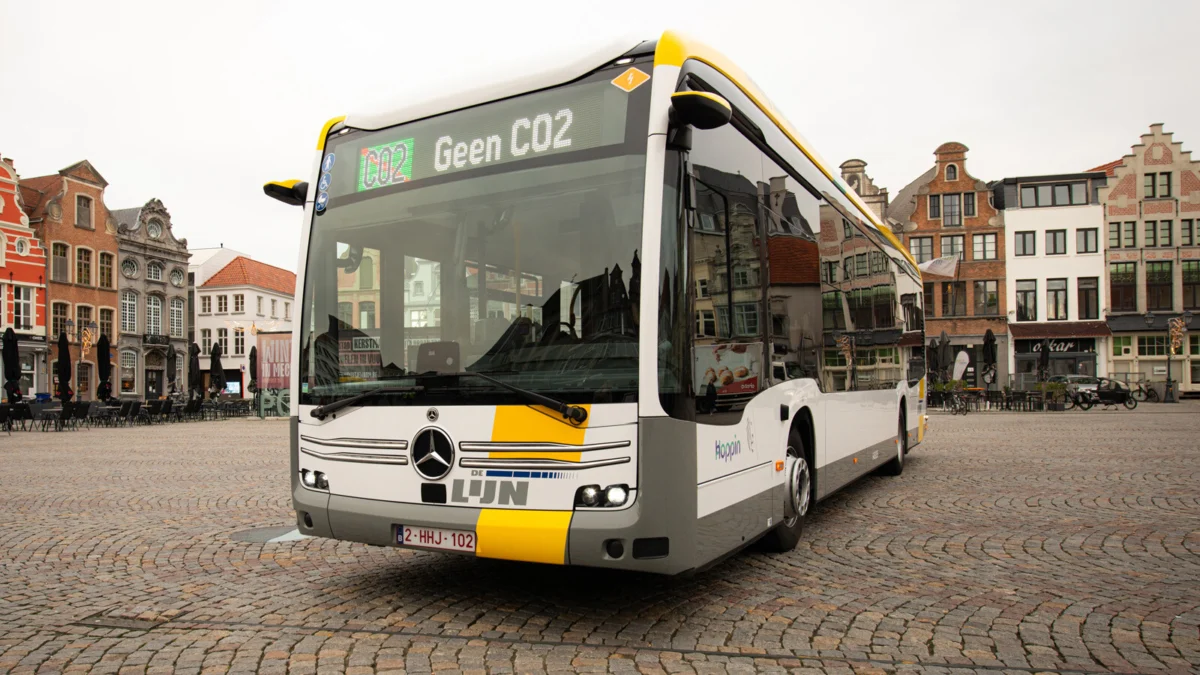
Nearly 75% of electric buses currently operating in Germany are sourced from domestic manufacturers. Industry giants like Daimler Buses and MAN are not just suppliers; they are anchors for a complex value chain that sustains roughly 12,600 jobs in Germany.
The threat is twofold. First, a sudden drop in domestic demand allows foreign competitors—specifically those from China—to gain a foothold in the German market. Chinese manufacturers, often backed by their own state-level subsidies and established battery supply chains, are increasingly competitive in price. Second, if domestic demand shrinks, German manufacturers may lose the economies of scale necessary to drive down their own production costs, creating a downward spiral for the “Made in Germany” brand in the global e-bus market.
Official Responses and Strategic Implications
The VDV and the Klima-Allianz have been vocal in their criticism. Their joint analysis concludes that if the funding cuts proceed, the EU’s mandatory targets for "clean" public transport will become unreachable. Under EU law, at least 65% of newly procured city buses must be "clean" by 2026–2030, with at least half of those being zero-emission.
"We are essentially setting ourselves up for failure," a spokesperson for the VDV noted. "If the federal government cuts these funds, we are essentially forced to choose between breaking the law or keeping old, polluting diesel buses on the road for years longer than intended."
The Regional Disparity
The urgency of this transition is further highlighted by the stark regional inequalities identified by the German Environmental Aid (DUH). Their recent study reveals that while some cities are leading the charge, others remain heavily reliant on legacy diesel technology.
In Germany’s 39 largest cities, diesel propulsion still accounts for roughly 70% of the fleet. Even when including "mild hybrids"—which use a small electric motor to assist the combustion engine—the share of fossil-fuel dependency sits at a staggering 77%.
However, success stories exist. Cities in Baden-Württemberg have become models for the rest of Europe. Mannheim leads the nation with 60.6% of its fleet operating on battery-electric power. Freiburg and Karlsruhe follow closely with 51.7% and 51.6% respectively. These cities prove that a rapid transition is possible, but they also serve as a reminder that the momentum is highly dependent on regional commitment and sustained financial support.
Looking Ahead: The Strategic Crossroads
The decision facing the federal government is more than a budgetary choice; it is a decision about the future of German mobility. By cutting the e-bus subsidy, the government risks:
- Climate Failure: Falling short of national and EU-wide climate goals for the transport sector, which is already the laggard in Germany’s decarbonization efforts.
- Economic Weakness: Eroding the competitive advantage of Germany’s automotive manufacturers in a rapidly growing global market for electric heavy-duty vehicles.
- Public Transit Regression: Forcing municipalities to extend the life of aging, higher-maintenance diesel fleets, which will ultimately cost the taxpayer more in the long run through repairs and fuel inefficiencies.
As the budget debate continues, the pressure is mounting on Berlin to reconsider. The transition to electric buses is not merely an environmental project; it is a structural transformation of the urban landscape. To abandon the financial support now, while the industry is still in the "scale-up" phase, would be to forfeit the progress made over the last decade and surrender the future of public transit to outdated technology and international competitors.
The coming months will be decisive. Whether Germany chooses to stay the course and solidify its position as a leader in sustainable urban mobility, or retreat into a short-sighted austerity measure, will be written in the final 2027 budget. For now, the transit operators, manufacturers, and citizens are left in a state of precarious anticipation, waiting to see if the green promise of the modern bus fleet will remain on the road or be consigned to the depot of failed policy experiments.