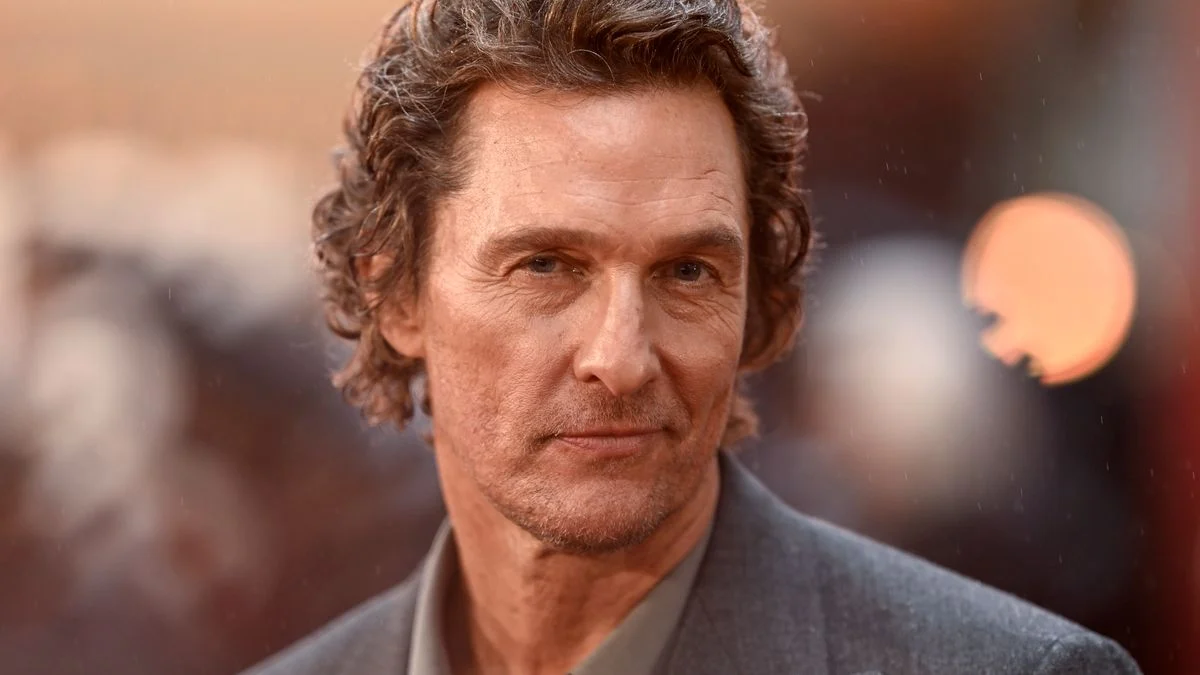
In the glittering, often unforgiving ecosystem of Hollywood, few actors have navigated the transition from romantic lead to critical darling as successfully—and as intentionally—as Matthew McConaughey. Now 56, the Texas-born star has spent decades under the intense scrutiny of both the public and the professional press. Yet, in a recent appearance on the podcast Build or Break, the Academy Award winner revealed that despite his longevity, the weight of professional critique remains a formidable force. To cope, McConaughey has developed a practice that is as unconventional as it is revealing: he retreats to the silence of the desert to confront his harshest reviews head-on.
The Desert Crucible: A Reckoning with the Past
For most performers, negative reviews are things to be ignored or dismissed as the opinions of those who "don’t get it." For McConaughey, they are data points. In a recent, candid conversation, he detailed a self-imposed exile to the desert, where he brought with him a comprehensive collection of every review he had received over the last two decades.
For two grueling days, the man who brought Ron Woodroof to life in Dallas Buyers Club sat in solitude, doing nothing but reading the most scathing assessments of his career. "It was hard," he admitted, describing the experience not as a form of self-flagellation, but as a systematic dissection of his own artistic output. By immersing himself in the negative, McConaughey sought to filter the signal from the noise, creating a psychological barrier between his identity and his public perception.
A Career of Extremes: From "Rom-Com King" to Oscar Glory
To understand the breadth of the criticism McConaughey faced, one must look at the trajectory of his career. His path has been anything but linear.
The Rom-Com Era
In the early 2000s, McConaughey was the undisputed face of the romantic comedy. Films such as How to Lose a Guy in 10 Days and Failure to Launch cemented his status as a charming, effortlessly charismatic leading man. While these films were box-office successes, they also pigeonholed him in the eyes of many critics, who viewed his performances as repetitive, surface-level, and overly reliant on his natural, laid-back "Texas charm."
The "McConaissance"
The pivotal shift, often referred to by industry insiders as the "McConaissance," began in the early 2010s. McConaughey began to shed the rom-com skin, opting for darker, more challenging roles in independent and character-driven cinema. His collaboration with Martin Scorsese in The Wolf of Wall Street and his turn as the enigmatic Cooper in Christopher Nolan’s Interstellar showcased a range that audiences had previously ignored.
The apex of this transformation was his visceral performance in 2013’s Dallas Buyers Club. Portraying a man battling HIV in the mid-80s, McConaughey underwent a radical physical transformation, losing significant weight and stripping away the veneer of the "movie star" to reveal raw, human desperation. This performance earned him the Academy Award for Best Actor in 2014, silencing many of his long-standing critics.
The Duality of Failure
Yet, the shadow of the past remained. Even as he was lauded for his dramatic range, his earlier, less critically acclaimed projects—such as the widely panned Serenity or The Sea of Trees—continued to draw fire. In fact, his performance in the 2019 thriller Serenity earned him a nomination for a Golden Raspberry Award (the "Razzie"), serving as a stark reminder that in Hollywood, the distance between critical acclaim and total failure is often just one script choice away.
The Mechanics of Criticism: Filtering the Real from the False
The most striking takeaway from McConaughey’s desert experiment was his ability to categorize feedback. He realized that not all criticism is created equal. He identified two distinct types of negative reviews:
- The Ad Hominem Critique: These, he noted, were rooted in personal bias. He could recognize when a writer or critic had an inherent distaste for his persona, his background, or his specific "vibe." These critiques, he concluded, were about the critic’s perception of him rather than the work itself.
- The Constructive Mirror: Conversely, there were reviews that hit home. In these instances, he realized, "This person is right." These reviews highlighted genuine flaws in his performance, his choices, or the narrative structure of the film. By separating the personal attacks from the professional insights, McConaughey was able to use the latter as a tool for growth.
Navigating the "Hollywood Mirage"
McConaughey’s philosophy extends beyond reviews; it is a fundamental approach to surviving the artificiality of celebrity culture. He argues that the primary challenge for an actor is the evolution from being a "personality" to becoming a "star," and finally, to remaining a human being.
"I have only told four people in my life that I love them," he shared during the podcast. This statement serves as a critique of the performative nature of Hollywood, where expressions of love, admiration, and loyalty are thrown around with reckless abandon. In a town where professional relationships are often masked as deep friendships, McConaughey maintains a strict boundary between his private life and his public persona. He views the industry’s hyperbole—the constant praise, the transactional relationships, and the superficial validation—with a healthy dose of skepticism.
Implications for Modern Celebrity
McConaughey’s approach offers a masterclass in psychological resilience for public figures. In an era where social media allows every viewer to be an amateur critic, the volume of feedback has reached an unprecedented decibel level. By choosing to "own" his critics—by inviting them into his space in the desert rather than hiding from them—he effectively neutralized their power.
His method suggests that true confidence isn’t the absence of criticism, but the ability to filter it. For the aspiring actor or any professional in the public eye, his journey underscores a vital truth: you are not your reviews. Your failures, whether in a rom-com or a flop, are not definitions of your character, but rather segments of a larger, evolving narrative.
Conclusion: The Star as a Student
As Matthew McConaughey enters his late fifties, his focus has clearly shifted from chasing the next hit to refining his own internal compass. The desert is no longer just a backdrop for his films; it is his sanctuary for self-reflection. By treating his career as a long-form study in character development—both on and off-screen—he has managed to survive the fickle nature of the industry.
He remains a reminder that even those at the pinnacle of success are not immune to the sting of judgment. Yet, through his radical honesty and his willingness to sit with the uncomfortable, he has found a way to thrive in a town that is often more interested in the mask than the man. In the end, McConaughey’s greatest performance may not be in a film at all, but in his ability to remain grounded in a world that thrives on the ephemeral.