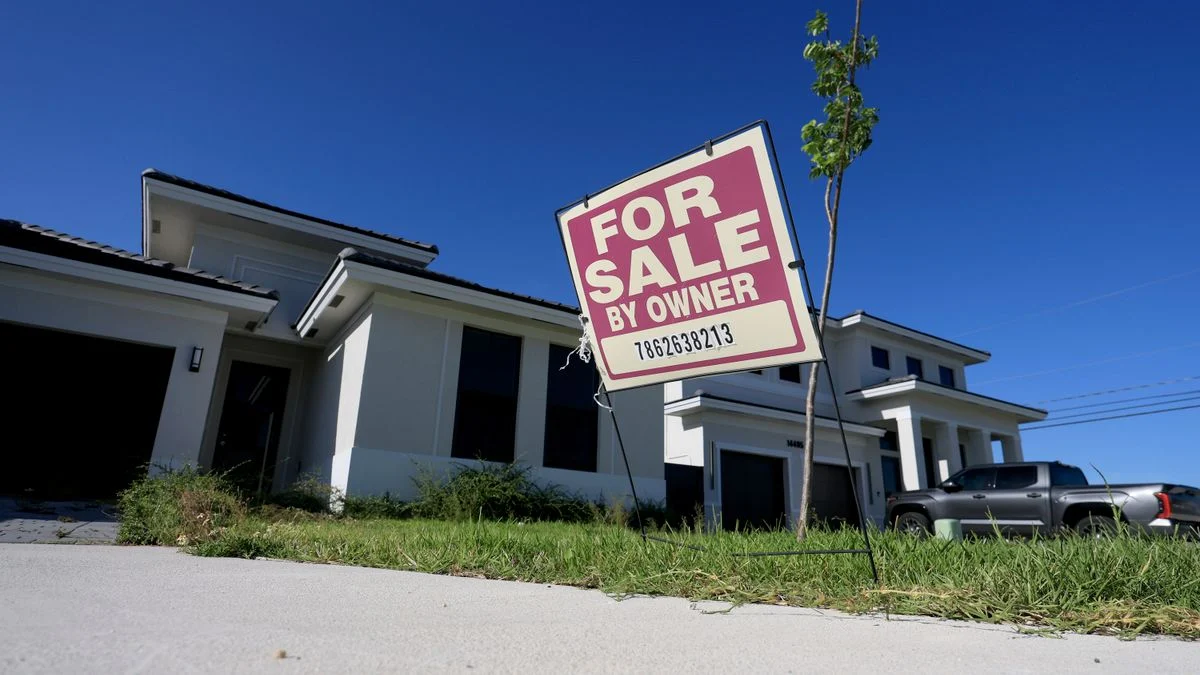
The American housing market, long considered the bedrock of the middle-class economy, is currently facing its most formidable headwinds in recent memory. According to the latest data released by the Mortgage Bankers Association (MBA), the average interest rate for a 30-year fixed-rate mortgage has surged to 7.49 percent. This figure represents the highest level witnessed in nearly three years, signaling a period of profound stagnation and cooling demand that is rippling through the broader financial landscape.
As borrowing costs climb, the "American Dream" of homeownership is becoming increasingly elusive for first-time buyers and families alike. The sudden spike in rates is not merely a statistical anomaly but a reflection of deep-seated geopolitical tensions, persistent inflationary pressures, and a central bank caught between the need for stability and the reality of a volatile market.
The Chronology of a Market Shift
To understand the current crisis, one must look at the rapid acceleration of these costs over the past several months. The ascent of mortgage rates has been sharp and unrelenting, particularly since the escalation of international conflicts.
Since late February, when the United States and Israel initiated joint operations in the Middle East, mortgage interest rates have climbed by approximately 1.4 percentage points. This period of geopolitical instability has acted as a catalyst for market nervousness, leading to a flight toward safer investments and driving up the yields on government bonds, which serve as the benchmark for mortgage rates.
This trend did not occur in a vacuum. Throughout the summer and into September, the economic data consistently pointed toward an overheating economy. With inflation clocking in at 3.4 percent in August—significantly above the Federal Reserve’s stated target of two percent—the central bank has been forced to maintain a hawkish stance. While the Federal Reserve signaled a potential further rate hike before the year’s end following their September meeting, market analysts currently remain skeptical, predicting a pause at the upcoming October session as policymakers wait to gauge the impact of current restrictive measures.
The Impact on Prospective Homebuyers
The immediate consequence of this interest rate environment has been a measurable decline in activity. The MBA reported that mortgage application volume fell by 4.2 percent in just one week, as potential buyers were effectively priced out of the market.
"Only very few homeowners have an incentive to refinance at these interest rates," noted Joel Kan, the deputy chief economist at the MBA. "The sudden surge in borrowing costs has pushed many potential buyers out of the market, leading to a significant contraction in mortgage origination volume."
For the average household, the math is sobering. A home that might have been affordable at a 3 percent or 4 percent interest rate now requires a monthly payment that consumes a significantly larger portion of the average household income. This "affordability gap" has led to a stalemate: sellers are reluctant to list their homes for fear of losing their own historically low mortgage rates, while buyers are sitting on the sidelines, waiting for a correction that shows little sign of arriving.
Political Implications: The Weight of the Economy
The state of the housing market is not merely an economic issue; it has become a central pillar of political discourse. With congressional elections approaching on November 3rd, the economic climate is exerting immense pressure on the administration of President Donald Trump.
A joint survey released by Reuters and the Ipsos Institute identified the rising cost of living as the primary concern for voters. This sentiment is directly impacting political approval ratings. President Trump’s approval rating, currently hovering at a historically low 32 percent, is widely attributed by analysts to the public’s frustration with inflation, high grocery prices, and the prohibitive costs associated with housing and financing.
Political strategists note that when the average citizen feels their standard of living slipping—as is the case with current mortgage trends—the incumbent party inevitably faces a backlash at the ballot box. As the election draws near, the housing crisis has transformed from a fiscal issue into a defining electoral challenge.
A Comparative Perspective: The German Experience
While the American market is struggling under the weight of high rates, it is not an isolated phenomenon. Germany, the economic engine of Europe, is experiencing a similar, albeit distinct, trajectory.
According to data provided by the financial analysis firm Barkow Consulting, interest rates for ten-year fixed-rate mortgages in Germany have climbed to approximately 4.25 percent annually. This is the highest level observed in the country since May 2011.
The parallels between the U.S. and German markets are striking. In both nations, the era of "cheap money" that characterized the post-2008 financial recovery has come to an abrupt end. The European Central Bank, like the U.S. Federal Reserve, has been forced to navigate the difficult path of curbing inflation without triggering a full-scale recession. For German homebuyers, who have traditionally valued the security of long-term fixed-rate financing, the sudden jump in rates has necessitated a major re-evaluation of their financial planning.
Deepening the Analysis: The "Lock-in" Effect
A secondary, yet equally critical, issue emerging from this data is the so-called "lock-in effect." Because so many homeowners refinanced during the period of historically low rates (2020–2021), they are now "locked" into their current properties. Selling a home and moving to a new one would mean trading a 3 percent interest rate for a 7.5 percent rate, a move that would drastically increase monthly costs for essentially the same, or even smaller, square footage.
This has resulted in a historic shortage of housing inventory. With fewer homes coming onto the market, prices remain artificially high despite the drop in demand. This creates a "double-jeopardy" scenario for first-time buyers: not only are they facing high interest rates, but they are also competing for a severely limited supply of housing, which keeps home prices elevated.
Looking Ahead: The Path Forward
The path forward remains fraught with uncertainty. Economic forecasting, which has been notoriously difficult over the past three years, remains a guessing game. The Federal Reserve faces a narrow path: if they keep rates high for too long, they risk stifling the housing sector to the point of a broader economic cooling. If they lower rates too soon, they risk allowing inflation to become entrenched.
Economists are closely watching the labor market and consumer spending data as primary indicators. If unemployment begins to tick upward, the Fed may be forced to pivot, regardless of the inflation numbers. However, as it stands, the market must prepare for a "higher for longer" environment.
For the American consumer, the immediate future requires a recalibration of expectations. The era of easy financing is over, and the market is transitioning into a new reality defined by high borrowing costs and increased selectivity. Whether this results in a market correction—where home prices eventually drop to match the higher interest rates—or a long period of stagnation, remains the central question for real estate experts, policymakers, and families across the nation.
Conclusion
The latest data from the Mortgage Bankers Association serves as a stark reminder of the interconnectedness of global finance, local housing markets, and national politics. With interest rates at 7.49 percent, the American housing market is at a crossroads. As we approach the November elections, the economic pain felt by citizens is undeniable, and the political fallout is likely to be significant.
As the world watches to see how the Federal Reserve manages the inflationary beast and how the German market copes with its own historic rate hikes, one thing remains clear: the stability of the housing market is a prerequisite for broader economic health. Until borrowing costs stabilize and inflation is brought back under control, the dream of homeownership will remain a daunting challenge for a significant portion of the population.