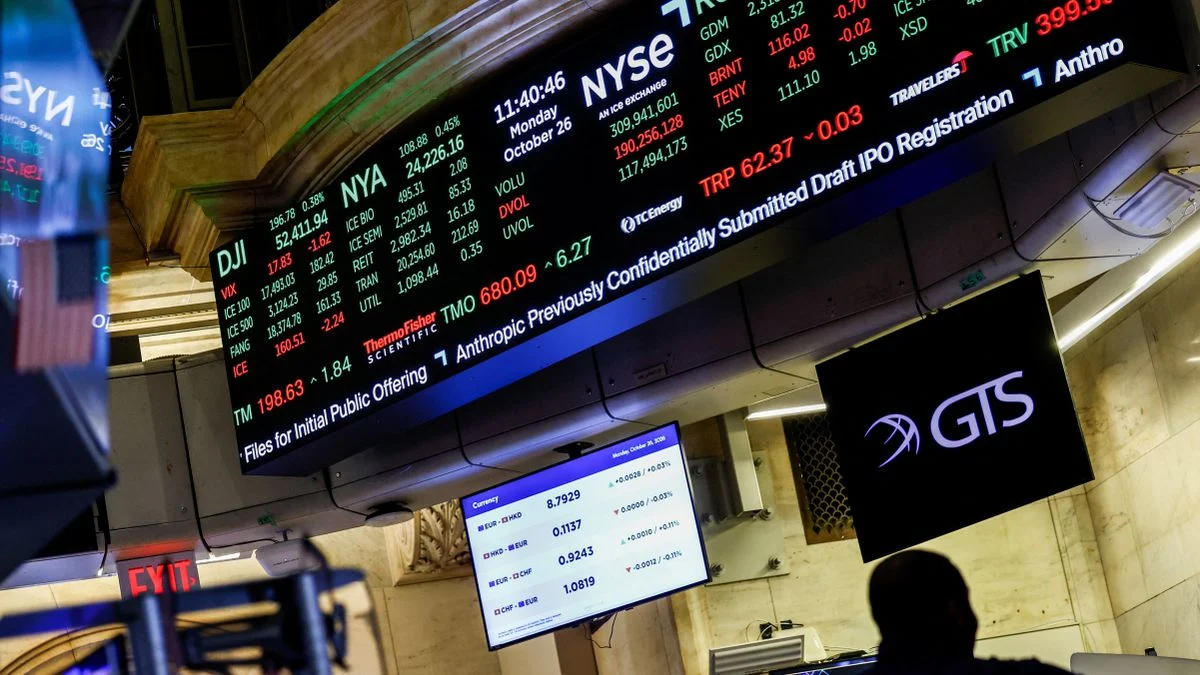
DÜSSELDORF/NEW YORK – The euphoria that has defined the U.S. stock market for much of the year is facing a severe reality check. As the current trading week draws to a close, investors on Wall Street are grappling with a growing sense of anxiety—not over the fundamental health of the economy, but over the staggering financial commitment required to lead the Artificial Intelligence (AI) revolution.
Major U.S. indices remained largely in the red on Friday, extending a period of volatility that has rattled a market previously accustomed to a relentless upward trajectory. This correction, driven by a skeptical re-evaluation of big-tech spending, marks a pivotal moment for the sector that has been the primary engine of the S&P 500 and Nasdaq’s record-breaking performance.
The Core Conflict: Profits vs. Projections
At the heart of the current market turbulence is a fundamental shift in investor sentiment. For months, the narrative was simple: AI is the next industrial revolution, and those who invest first will dominate the future. However, as quarterly earnings reports rolled in this week, the narrative grew more complex.
While many of the "Magnificent Seven" and other tech giants reported robust revenue growth and solid quarterly earnings that initially boosted market optimism, the mood soured almost immediately upon review of their guidance. These companies, in their pursuit of AI supremacy, signaled an intent to aggressively ramp up capital expenditure (CapEx) to build the infrastructure required for generative AI—data centers, specialized semiconductors, and energy-intensive cooling systems.
Investors are now asking a difficult question: When will these massive outlays translate into meaningful returns? The fear is that the "AI Arms Race" is becoming a profit-margin killer. If tech firms must sacrifice short-term earnings to fund unproven long-term AI projects, the premium valuations that these stocks currently command may no longer be justified.
Chronology: From AI Euphoria to Strategic Doubt
Early Week: The Optimism Phase
The week began with a sense of continuity. Investors were focused on earnings beats, with major tech players showing strong cloud computing growth and resilient consumer demand. The market seemed poised to continue its record-breaking rally, with AI-related stocks serving as the primary drivers of growth.
Mid-Week: The Pivot to Cost Analysis
By Wednesday and Thursday, the initial glow of the earnings reports faded. Analysts and institutional investors began parsing the fine print of balance sheets. The focus shifted from "How much did you make?" to "How much are you spending to make it?" The realization that the cost of developing AI is exponentially higher than traditional software development led to a sudden sell-off.
Friday: The Correction Intensifies
By the end of the week, the pressure intensified. The tech-heavy Nasdaq index, which had been the darling of the market, saw significant downward pressure. Earlier in the week, the index suffered a 2.6% decline—its largest single-day loss since the beginning of June. This was not merely a technical correction but a psychological shift, as investors retreated to the sidelines to reassess the risk-to-reward profile of the AI sector.
Supporting Data: Volatility and Market Sentiment
To understand the current state of the market, one must look beyond the raw index figures and examine the underlying volatility.
According to data from LSEG, the volatility index of the Nasdaq 100 currently sits at approximately 29. Thomas Altmann, a portfolio manager at QC Markets, provides a crucial perspective on this figure: "The average over the past twelve months has been 24. We are currently seeing an elevated level of uncertainty, but it is important to maintain context."
While a reading of 29 indicates a market that is undeniably nervous, it is not yet in the grip of full-scale panic. For comparison, the volatility barometer reached nearly 40 points in April 2025 during a period of acute macroeconomic uncertainty. The current market is "on edge," but it is not yet "unhinged." This suggests that while institutional investors are reducing their exposure to high-growth tech, they are not yet initiating a total capitulation.
Official Responses and Analyst Perspectives
Industry leaders have spent the week attempting to reassure shareholders that their capital allocation strategies are sound. Executives at major cloud providers and chip manufacturers have emphasized that the current infrastructure build-out is a "once-in-a-generation" opportunity.
"We are building the rails for the next century of digital commerce," said one senior executive during an earnings call this week. "To pull back now would be to forfeit our leadership position in the most important technological shift of our lifetimes."
However, the buy-side is less convinced. Many analysts have begun to downgrade tech stocks, not because the businesses are failing, but because the path to monetization remains opaque. "The market is allergic to uncertainty," notes one lead equity strategist. "Companies are telling us the ‘what’ and the ‘how’ of AI, but they are failing to articulate the ‘when’ regarding the return on investment. Until they provide clear metrics on how these AI investments will increase operating margins, the stock price will reflect that skepticism."
Implications: A New Era of Scrutiny
The current market environment carries several long-term implications for the tech sector and the broader economy.
1. The End of "Growth at Any Cost"
The era of blind faith in tech growth is arguably coming to an end. Investors are returning to traditional metrics: free cash flow, operating margins, and dividend sustainability. Companies that cannot demonstrate a clear bridge from AI spending to bottom-line profitability will likely face continued share price volatility.
2. A Bifurcation in the Tech Sector
Not all tech companies are viewed through the same lens. There is a growing divide between the "enablers" (chip manufacturers and infrastructure providers) and the "appliers" (software firms). The enablers are currently facing the highest scrutiny because their capital expenditure requirements are the most immediate. The appliers, meanwhile, are under pressure to prove that their AI software can command premium pricing from customers.
3. The Macroeconomic Ripple Effect
Because technology stocks hold such a significant weighting in the S&P 500, the volatility in the Nasdaq is spilling over into broader market indices. This creates a challenging environment for retirement funds and passive investors whose portfolios are heavily concentrated in tech. If the correction deepens, it could force a reallocation of capital into more defensive sectors, such as utilities, consumer staples, or even fixed-income assets, which have become more attractive as interest rates have stabilized.
Conclusion: The Path Forward
The "AI Arms Race" is far from over, but the rules of engagement have changed. The initial phase of excitement has transitioned into a phase of disciplined evaluation. Wall Street is no longer buying the promise of AI; it is demanding the proof of its performance.
As we move into the coming weeks, market participants will be watching the next round of guidance closely. The key will be transparency—can these corporations demonstrate that their AI investments are not merely expensive experiments, but engines of future revenue?
For now, the market remains in a state of watchful waiting. The volatility index reflects an investor base that is wary of the costs but cognizant of the potential. Whether this correction marks the beginning of a broader downturn or a necessary "cooling off" period remains the defining question of the current financial year. One thing is certain: the era of easy, AI-driven gains is over, and the era of rigorous fundamental analysis has returned to the forefront of the financial world.