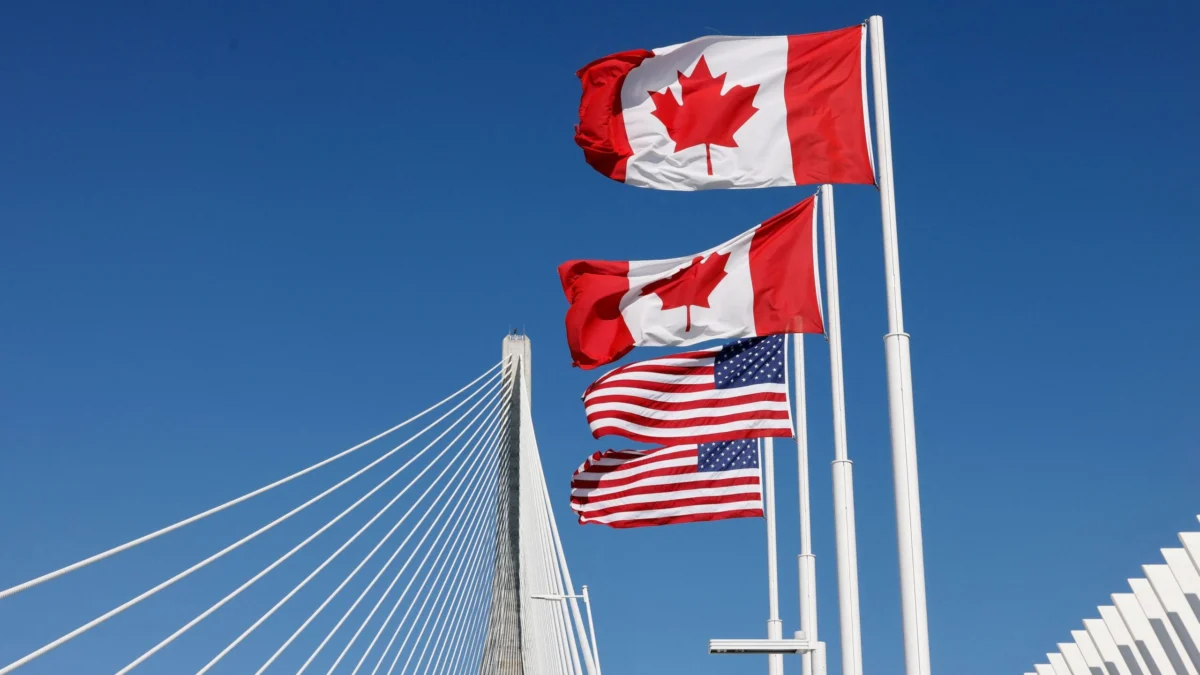
The international trade landscape is currently defined by a volatile web of protectionist measures, retaliatory tariffs, and high-stakes diplomatic maneuvering. At the center of this storm are the United States, Canada, and China, three nations whose interconnected economies are reeling from a series of escalating trade disputes that threaten to destabilize global supply chains and shift the geopolitical order.
From the cooling relationship between Washington and Ottawa to the complex, multi-layered negotiations with Beijing, the world is witnessing a dramatic pivot in how major powers manage national security and economic sovereignty.
The Core Conflict: U.S.-Canada Trade Relations
The relationship between the United States and Canada, traditionally one of the world’s most stable and integrated trade partnerships, has entered a period of unprecedented tension. Following the collapse of high-level trade talks in August, both nations have engaged in a tit-for-tat tariff war that has seen levies placed on everything from steel and aluminum to agricultural goods and consumer electronics.
The Anatomy of the Standoff
According to informed insiders, Washington and Ottawa are currently engaged in delicate, behind-the-scenes negotiations aimed at tempering the impact of existing duties. The U.S. has imposed tariffs of up to 50 percent on Canadian steel and 25 percent on automobiles—key pillars of the North American manufacturing sector.
The urgency of these talks is driven by domestic political pressures in both countries. In the United States, the administration is reportedly eyeing the upcoming November 3rd Congressional elections, seeking to provide relief to critical sectors in northern states like Michigan and Maine, where the economies are deeply intertwined with Canadian trade.
The Role of Domestic Politics
Senator Susan Collins of Maine recently confirmed that nine specific product categories—including potatoes, blueberries, and apples—are being considered for exemption from U.S. tariffs. This move is widely viewed as a strategic play to shore up support in the northern border states, where the economic fallout from the trade war is acutely felt. However, such concessions are not being granted in a vacuum; the U.S. is reportedly demanding broader structural concessions from the Canadian government in exchange for any tariff relief.

A Chronology of Escalation
To understand the current crisis, one must look at the rapid sequence of events that brought the two neighbors to this impasse:
- August: High-level trade negotiations between the U.S. and Canada collapse. Washington responds by imposing a 50 percent tariff on roughly 27.6 billion Canadian dollars’ worth of goods.
- Early September: Canada retaliates with its own set of tariffs, ranging from 15 to 50 percent, targeting an equivalent value of American products.
- September 8th: President Donald Trump signs a series of executive orders mandating a ban on the import of specific Canadian dairy products, alcoholic beverages, and motorcycles, marking a significant escalation in the dispute.
- Mid-September: Reports emerge of potential "targeted" relief, where specific agricultural and forestry goods are removed from the tariff list, though these remain subject to intense negotiation.
- Late September: The standoff continues, with both nations maintaining a "wait-and-see" approach while keeping diplomatic channels open through Trade Ministers and cabinet-level officials.
The China Factor: Balancing Trade and Security
Parallel to the North American dispute, the United States is navigating a precarious path with China. Despite the aggressive rhetoric and tariffs, there are signs of a calculated de-escalation.
The $30 Billion Breakthrough
Recent reports indicate that Washington and Beijing have reached a preliminary agreement to reduce or eliminate tariffs on "non-sensitive" goods worth approximately 30 billion U.S. dollars. While the specific product lists remain under wraps, officials have hinted that these include agricultural products, medical equipment, and consumer goods.
The Still-Holding Pattern
The "trade truce" between the U.S. and China has been extended, providing a two-month window for continued dialogue. However, tensions remain high regarding critical technology. U.S. lawmakers, including Senate Democrat Chuck Schumer, have issued stern warnings against granting China broader access to advanced semiconductor chips and AI production equipment, citing national security concerns.
The Chinese side, represented by Ambassador Xie Feng, has clearly defined four "red lines": Taiwan, democracy and human rights, China’s political system, and its development rights. These issues, according to Beijing, are non-negotiable and represent the boundary of what they are willing to discuss in a trade context.
Economic Implications and Industry Feedback
The uncertainty generated by these policies is sending shockwaves through the global automotive and manufacturing sectors.

Industry Alarm
The German Association of the Automotive Industry (VDA) has expressed profound concern, noting that many manufacturers and suppliers operate deep, cross-border supply chains. "Constant changes in tariffs and trade rules, combined with endless threats, create a climate of extreme uncertainty that discourages long-term investment," a spokesperson stated. With the U.S. threatening further tariff hikes by 2027, the industry is forced to reassess its footprint in North America.
The Tourism Paradox
Even non-industrial sectors are feeling the squeeze. Tourism boards in the U.S., particularly those in states like New York and Nevada, have launched campaigns to maintain the flow of Canadian visitors. Despite the government-level hostility, there is a clear recognition that the economic health of border regions relies on the free movement of people and capital, which these trade barriers directly undermine.
Official Responses and Diplomatic Strategy
The diplomatic response to these trade wars has been as varied as the conflicts themselves.

The Canadian Perspective
Canadian Prime Minister Mark Carney has attempted to frame the situation not as a "zero-sum game," but as a struggle for resilience. In a speech before the European Parliament, Carney emphasized that Canada is not seeking to become a "third world power," but rather a reliable partner committed to strengthening democracy and the rule of law. His overtures toward a potential "special association" with the EU have been met with interest, though they have also drawn the ire of President Trump, who threatened the EU with tariffs should they forge such an alliance.
The U.S. Stance
The U.S. administration remains steadfast in its "America First" trade policy, arguing that current measures are necessary to rectify long-standing trade imbalances. Whether it is the pressure on the International Criminal Court (IStGH) or the threats against India regarding its purchase of Russian oil, the U.S. is increasingly using its economic leverage as a tool of foreign policy, often with little regard for the concerns of traditional allies.
Looking Ahead: A Shifting Order
As the November elections approach in the United States, the immediate future of these trade disputes remains highly fluid. Several key indicators will determine the trajectory of the next year:

- The Outcome of the U.S. Midterms: The pressure to deliver economic "wins" or tariff relief for specific states will likely dictate the tone of negotiations with Canada in the final quarter of the year.
- The U.S.-China AI Dialogue: Scheduled for November, this meeting will be a litmus test for whether the two nations can manage their technological rivalry without triggering a full-scale trade war.
- Global Alignment: The potential for a Canadian-EU association or similar regional blocs suggests that nations are looking to diversify their trade dependencies, potentially moving away from a U.S.-centric model.
In conclusion, the world is currently navigating a "new normal" where trade policy is indistinguishable from national security. The era of frictionless global commerce is being replaced by a more fragmented, protectionist, and politically charged environment. For businesses, the challenge will be to remain agile in the face of shifting tariff regimes, while for policymakers, the goal is to prevent these localized skirmishes from escalating into a global economic downturn.
The next few months will prove decisive. Whether the current path of brinkmanship leads to a new, more balanced trade equilibrium or a period of prolonged instability depends on the willingness of these major powers to prioritize long-term economic stability over short-term political gains. As it stands, the world is holding its breath.