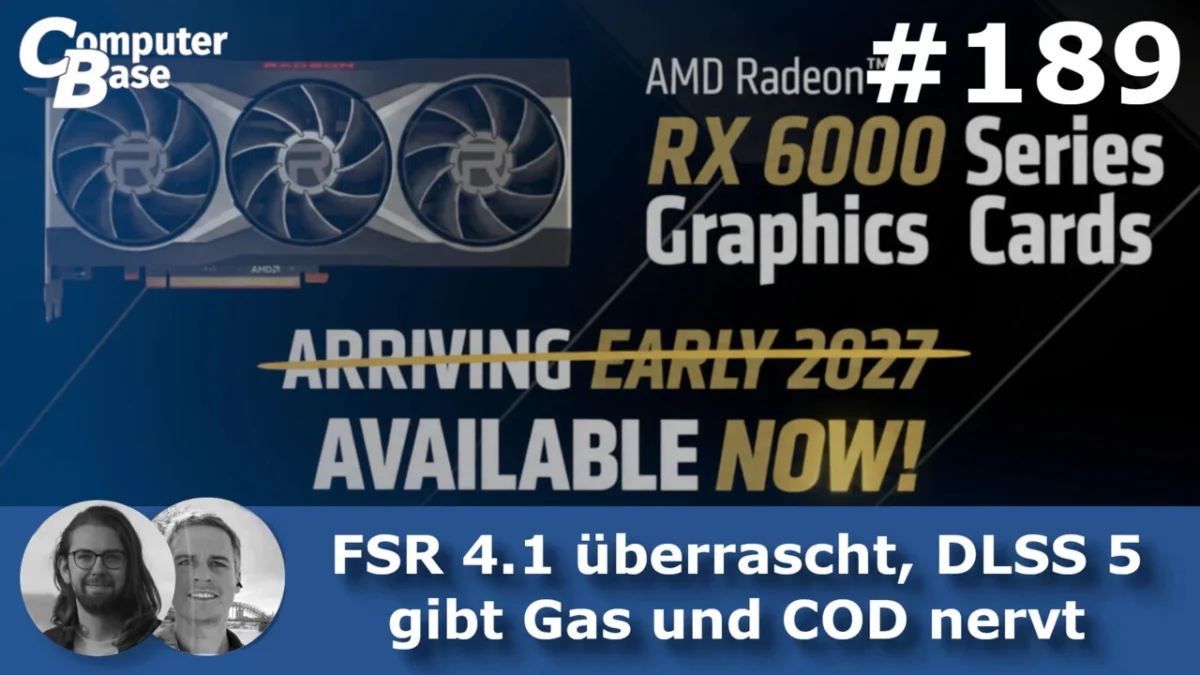
The latest installment of the CB-Funk podcast, episode 189, arrives at a pivotal moment in the hardware industry. Hosted by Jan and Fabian, this week’s discussion navigates a landscape defined by rapid software advancements, confusing hardware availability, and the ongoing tug-of-war between architectural standards. From AMD’s unexpected expansion of its upscaling technology to the performance leaps seen in NVIDIA’s latest software stack, the episode serves as a deep dive into the technical hurdles facing gamers and developers today.
Main Facts: The New Upscaling Frontier
The headline event of the week is undoubtedly AMD’s surprise announcement regarding FidelityFX Super Resolution (FSR) 4.1. Contrary to industry expectations that pinned the next major milestone for late 2027, AMD has moved to release FSR 4.1 to a significantly broader base of hardware immediately.
Crucially, this update extends support to users running RX 6000-series (RDNA 2) graphics cards and those utilizing iGPUs based on RDNA 3.5, such as the Ryzen AI (Max) 300 and 400 series. This is a strategic pivot for AMD; by democratizing access to their latest upscaling algorithms, they are attempting to cement their footprint in the mobile and mid-range desktop sectors, where hardware longevity is often hampered by aging silicon.
Simultaneously, the discussion shifts to NVIDIA’s DLSS 5. In a recent performance analysis of NBA 2K27, the latest iteration of Deep Learning Super Sampling has shown remarkable gains, with reports indicating up to a 49% improvement in frame rates compared to previous versions. This raises the bar for the industry, placing immense pressure on AMD to prove that its software-driven approach can keep pace with NVIDIA’s tensor-core-heavy architecture.
Chronology of Developments
The week began with a flurry of conflicting reports, setting the stage for a tumultuous news cycle:
- Early Week: Rumors regarding the "end-of-life" (EOL) status of the NVIDIA GeForce RTX 5090 began to dominate enthusiast forums, with inventory levels appearing to vanish from major retailers.
- Mid-Week: AMD issued a surprise press release confirming the immediate availability of FSR 4.1 for RDNA 2 and RDNA 3.5, preempting the anticipated 2027 roadmap.
- Benchmark Analysis: Independent testing of Call of Duty: Modern Warfare 4 highlighted the stark contrast between hardware capabilities and software optimization. While the title boasts impressive raw performance, the implementation of Ray Tracing remains a point of contention.
- NVIDIA Response: Following widespread speculation, NVIDIA issued a formal rebuttal regarding the RTX 5090, clarifying that the product is not "discontinued" in the formal sense, despite the practical reality of extreme market scarcity.
Supporting Data: Performance and Limitations
The CB-Funk hosts scrutinized the recent benchmark data for Call of Duty: Modern Warfare 4, a title that serves as a case study for modern engine optimization. While the game exhibits high frame-per-second (FPS) counts on current-gen hardware, the technical implementation of its graphical features is problematic.
The primary issue stems from the incompatibility between modern upsampling techniques and the game’s Ray Tracing implementation. Under current conditions, users are forced to choose between high-fidelity lighting and the performance overhead of traditional rendering. Notably, the podcast highlights that AMD’s FSR "Ray Regeneration" is currently the only viable software solution providing a bridge between these two worlds. This suggests that while raw power is increasing, the software-to-hardware synergy in the AAA gaming sector is becoming increasingly fragmented.
Furthermore, the DLSS 5 data provides a stark look at the efficiency gap. With a 49% performance jump in NBA 2K27, NVIDIA’s AI-driven frame reconstruction is proving that architectural efficiency is now being eclipsed by algorithmic refinement. For consumers, this implies that the software layer is arguably becoming as important as the GPU silicon itself.
The RTX 5090: A Study in Market Ambiguity
One of the most discussed topics in the podcast is the paradoxical state of the NVIDIA GeForce RTX 5090. Despite reports from retailers suggesting that the card has reached its EOL status and is effectively disappearing from shelves, NVIDIA maintains an official stance that the card is still in production.
This gap between corporate messaging and retail reality highlights a growing trend in the GPU market: "Soft EOL." By technically keeping a product on the books while allowing supply chains to dry up, manufacturers can manage market transitions without the negative PR of an official discontinuation announcement. The hosts explore whether this is a strategic move to clear inventory for upcoming product refreshes or a sign of deeper supply chain instability.
Implications for the Future: ARM vs. x86
The episode concludes with an insightful listener question regarding the shift toward ARM architecture versus the long-standing x86 standard. This is not merely a theoretical debate; it represents the potential for a fundamental change in how PC gaming and desktop computing operate over the next decade.
As mobile chips (like those found in modern Apple Silicon and the growing field of Windows-on-ARM laptops) continue to close the performance gap, the x86 monopoly is under unprecedented pressure. The hosts analyze the implications for gamers, specifically whether the move to ARM will necessitate a complete rewrite of game engines or if emulation layers will become the standard. The consensus suggests that while the transition will be slow, the performance-per-watt advantage of ARM makes it an inevitable successor in the long-term roadmap of the PC industry.
Why This Matters
The overarching theme of episode 189 is the increasing complexity of hardware ownership. It is no longer enough to look at raw specs like clock speed or VRAM capacity. Today, a user’s experience is defined by the quality of their upscaling software, the compatibility of their drivers with specific Ray Tracing implementations, and the long-term support cycle of their chosen architecture.
As AMD pushes to democratize FSR 4.1 and NVIDIA continues to push the boundaries of AI-enhanced gaming, the consumer is the ultimate benefactor—but also the one tasked with navigating this increasingly dense technical landscape.
For those looking to dive deeper into these discussions, the CB-Funk podcast continues to provide an essential service by distilling these complex industry shifts into accessible analysis. Whether you are a hardcore enthusiast tracking the nuances of frame reconstruction or a casual gamer wondering why your RTX 5090 is nowhere to be found, this episode offers a comprehensive roadmap of the current hardware ecosystem.
Join the Discussion
The hosts encourage listeners to reach out with their own technical queries. Whether you are interested in the minutiae of GPU architecture or have broader questions about the industry, you can contact the team via email at [email protected] or join the conversation on the official Discord server. For those who prefer to keep up with the latest episodes, CB-Funk is available on all major podcast platforms, including Spotify, Apple Podcasts, Amazon Music, and YouTube, with an RSS feed available for direct integration into your favorite podcast client.