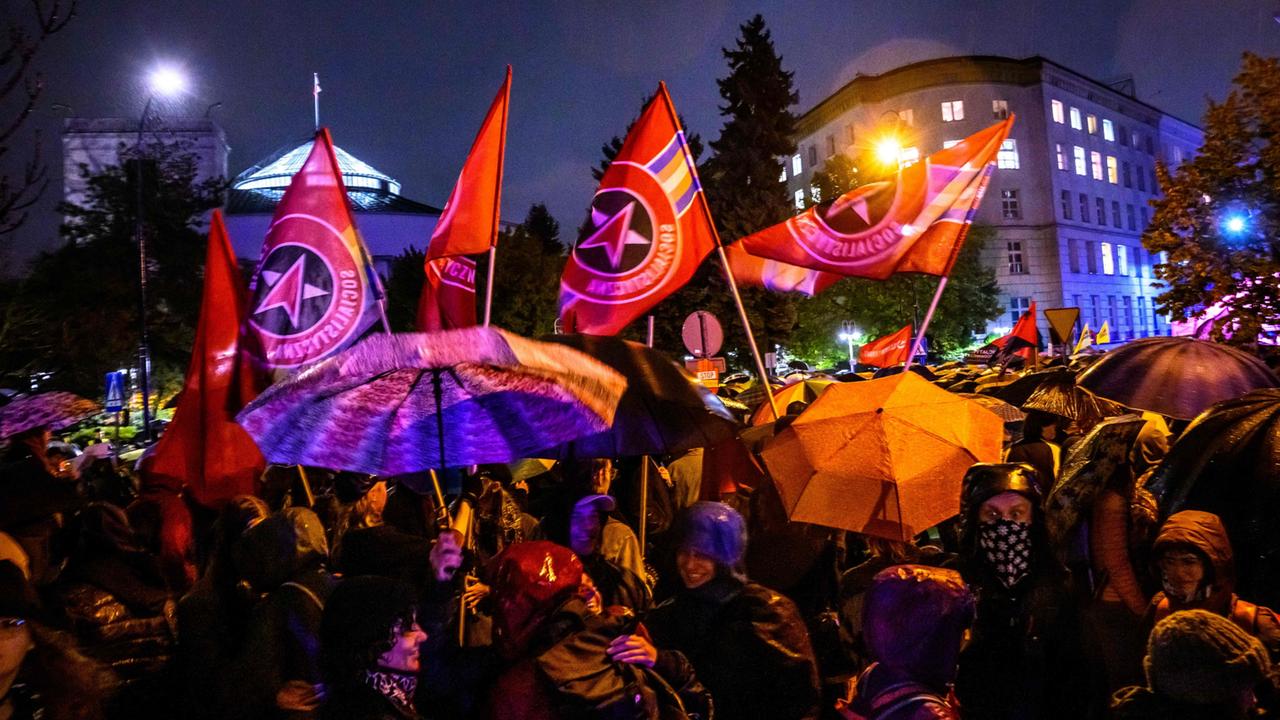
Warsaw, Poland – October 23, 2026 – A wave of protests swept across 28 Polish cities this past Saturday, as hundreds, predominantly young women, braved torrential rain to demand a liberalization of the nation’s stringent abortion laws. The demonstrations, a potent symbol of ongoing dissent, highlight the deep societal divisions and the precarious political landscape surrounding reproductive rights in Poland. While the current liberal-conservative government under Prime Minister Donald Tusk had pledged reform, activists and women’s organizations express frustration over perceived inaction, with recent legislative efforts facing significant hurdles.
A Nation Divided: The Fight for Bodily Autonomy
The echoes of "I think. I feel. I decide." reverberated through the streets of Warsaw and beyond, as protesters, many with the iconic red lightning bolt painted on their cheeks, articulated their demand for greater control over their reproductive health. Marianne, a 19-year-old demonstrator in the capital, articulated the core of the movement’s aspirations: "Abortion up to the twelfth week of pregnancy should be enshrined in law for everyone. And if life and health are endangered, then until the end of pregnancy. That is what we need, and nothing less."
These sentiments are not isolated. In Wroclaw, Bialystok, Katowice, Gdansk, Krakow, and Lodz, the message was the same: Poland’s abortion laws are among the most restrictive in Europe, a reality that clashes with the nation’s aspirations of being a modern, developed country. "A woman has no option to make a decision," stated Ernest, a 16-year-old participant. "She cannot decide about her own body – about whether she wants to bring a child into the world or not."
The Current Legal Landscape: A Tightening Grip
Poland’s abortion law, significantly tightened by a Constitutional Tribunal ruling in 2020, currently permits abortions only in two specific circumstances: when the pregnancy poses a threat to the life or health of the pregnant person, or when the pregnancy resulted from a criminal act, such as rape or incest. In all other cases, medical professionals performing abortions face potential prison sentences of up to three years.
While self-induced abortions remain technically legal, access to abortion pills is severely restricted. Furthermore, providing or mailing these medications to women is considered aiding and abetting an abortion, carrying its own set of legal repercussions. This effectively creates a situation where legal abortion is exceptionally difficult to obtain, pushing many to seek clandestine and often unsafe alternatives.
Innovative Solutions and Fierce Opposition: The "Abortomat"
In response to these legal barriers, two Polish non-governmental organizations have introduced a novel, albeit controversial, solution: the "Abortomat," a type of parcel locker designed to dispense abortion pills. Justyna Wydrzynska of Abtok, one of the organizations behind the initiative, explained the rationale: "It does not collect digital data. There is no camera, you don’t have to enter a phone number. Collecting or dropping off shipments from such an Abortomat is not dangerous from the perspective of activists."
The Abortomat aims to provide a discreet and relatively safe method for women to access medication for early-term abortions without direct medical intervention, thereby circumventing the restrictive legal framework. However, this innovation has ignited a firestorm of criticism from pro-life organizations, the Catholic Church, and certain medical professionals, who view it as a dangerous circumventing of established medical protocols and legal boundaries.
Political Promises and Legislative Roadblocks: A Stalled Reform
The current liberal-conservative government, led by Prime Minister Donald Tusk, had made the liberalization of abortion laws a significant promise during the 2023 election campaign. The hope was that a Tusk-led administration would usher in a new era of reproductive rights. However, the path to reform has proven fraught with challenges.

A previous attempt to reform the abortion law two years prior failed to pass in parliament, underscoring the deep divisions within the political establishment. Despite the widespread public demand and the government’s electoral pledges, concrete legislative progress has been slow.
A Glimmer of Hope? New Draft Laws Emerge
In a surprising development this week, the Polish Sejm (parliament) has taken a step forward by approving two new draft laws related to abortion. The first proposal seeks to decriminalize abortion and the assistance of abortion up to the twelfth week of pregnancy. The second aims to permit abortions in cases where the fetus has severe malformations.
While these draft laws represent a potential shift, many protesters argue they do not go far enough. For them, the demand remains for an unrestricted right to abortion. More critically, the ultimate fate of these legislative proposals hinges on the signature of Polish President Andrzej Duda. Given his national-conservative stance, the likelihood of him approving a significant loosening of abortion laws is considered by many to be remote. This political reality suggests that for women in Poland, the struggle for reproductive autonomy is far from over, and continued activism and protest will likely be necessary.
The Broader Implications: A European Context
The situation in Poland is emblematic of a wider trend across Europe, where the debate over reproductive rights has intensified in recent years. While some countries have moved towards more liberal abortion laws, others have seen a tightening of restrictions, often influenced by conservative political and religious forces. Poland’s case, with its stark legal limitations and the passionate public outcry, serves as a critical focal point in this ongoing European dialogue. The country’s trajectory on abortion rights will undoubtedly be closely watched, not only within Poland but by international human rights organizations and neighboring nations grappling with similar issues. The current impasse highlights the complex interplay of societal values, political will, and legal frameworks in shaping access to essential healthcare services.