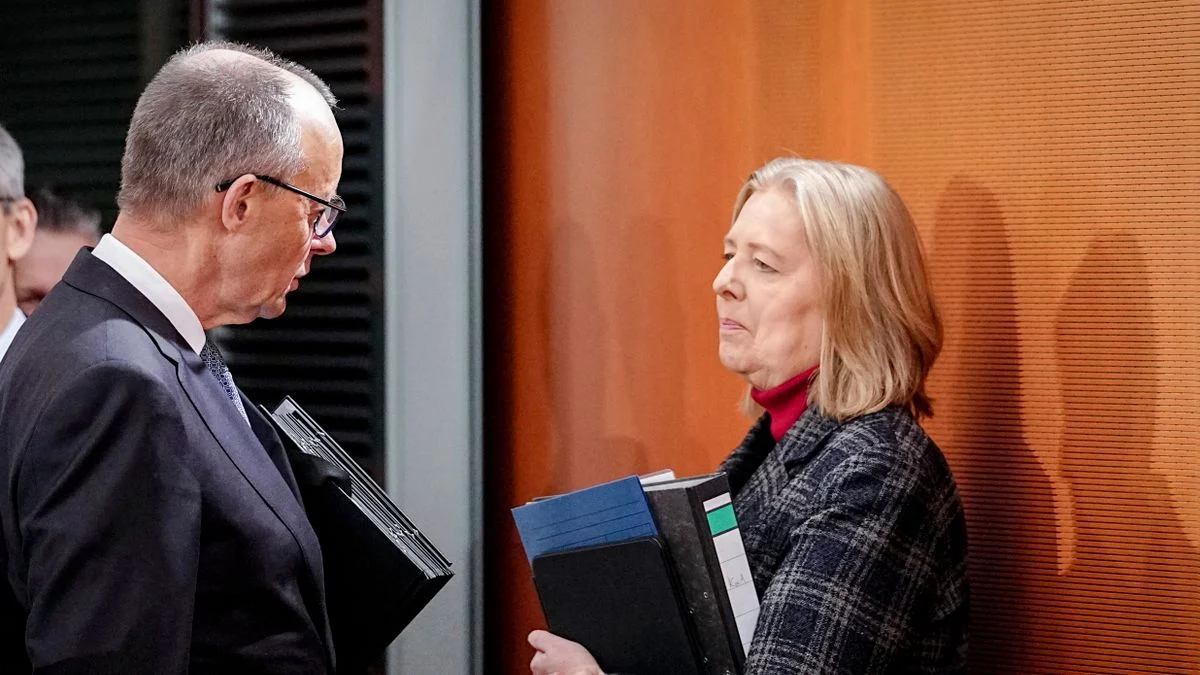
Berlin, Germany – As the Bundestag reconvenes for a pivotal legislative session, Germany stands at a critical juncture, grappling with monumental decisions concerning the future of its cherished, yet increasingly strained, social welfare system. What has been dubbed a "week of destiny" by political observers sees the nation’s political elite locked in intense debate over comprehensive reforms to its pension and healthcare systems. At the heart of this high-stakes political drama are two formidable figures: Friedrich Merz, leader of the opposition Christian Democratic Union (CDU), and Bärbel Bas, the President of the Bundestag, whose role as arbiter of parliamentary procedure becomes paramount amidst the fervent discussions.
The proposed reforms, spearheaded by the ruling "Ampel" (traffic light) coalition of the Social Democratic Party (SPD), the Greens, and the Free Democratic Party (FDP), seek to address the demographic time bomb ticking beneath Germany’s social security structures. With an aging population and declining birth rates, the long-term sustainability of the current pay-as-you-go pension system and the escalating costs of healthcare pose an existential threat to the nation’s social contract. This week’s legislative calendar is packed with crucial debates, committee votes, and potentially the first readings of key bills, setting the stage for a prolonged and contentious political battle that will define Germany’s social landscape for generations to come.
Germany’s Defining Moment: The High Stakes of Pension and Health Reforms
The urgency of the current reform push cannot be overstated. Germany, a beacon of social stability and economic prosperity in Europe, faces an unprecedented demographic shift. Its population is not only aging rapidly but also experiencing a steady decline in the proportion of the working-age population relative to retirees. This demographic imbalance places immense pressure on the current social security framework, which relies heavily on contributions from the working generation to fund the benefits of the retired. Without significant adjustments, experts warn of an impending crisis characterized by unsustainable contribution rates for workers, diminished benefits for retirees, or a crippling national debt.
The ruling coalition has positioned its reform package as a necessary, forward-looking strategy to safeguard the welfare state for future generations. Key proposals include the introduction of a capital-funded component for pensions, often referred to as "Generationenkapital" (generational capital), aiming to diversify funding sources beyond traditional contributions. In healthcare, the focus is on structural adjustments to reduce bureaucracy, enhance digital integration, improve regional access to medical services, and stabilize the financial foundations of the statutory health insurance system.
However, these proposals have met with fierce resistance from the opposition, particularly from Friedrich Merz and the CDU/CSU. Merz argues that the government’s plans are either insufficient, fiscally irresponsible, or ideologically driven, failing to offer genuinely sustainable long-term solutions. He champions alternative approaches, often advocating for greater individual responsibility, more market-oriented solutions, and a fundamental rethinking of the welfare state’s scope. The "week of destiny" therefore encapsulates not just legislative decisions but also a profound ideological clash over Germany’s societal values and economic direction.
Bärbel Bas, as the President of the Bundestag, occupies a unique and critical position during this tumultuous period. While her role is primarily procedural – ensuring fair debate, upholding parliamentary rules, and fostering a constructive legislative environment – the sheer intensity and political significance of the upcoming debates elevate her office to a crucial point of stability and impartiality. Her ability to navigate the charged atmosphere, facilitate productive dialogue, and ensure the democratic process functions effectively will be essential in a week where every word, every vote, and every compromise carries immense weight for the nation’s future. The convergence of demographic imperatives, economic pressures, and political posturing ensures that the outcomes of this week will reverberate far beyond the confines of the Reichstag building.
The Core Challenge: Demographic Shift and Fiscal Strain
Germany’s social safety net, built on the principles of solidarity and intergenerational equity, is under unprecedented strain. The nation’s demographic trajectory reveals a stark reality: by 2035, the number of people aged 67 and over is projected to increase by 22% to nearly 21 million, while the working-age population (20-66 years) is expected to decline by 4% to 48 million. This dramatic shift exacerbates the inherent vulnerability of the "pay-as-you-go" pension system (Umlagesystem), where current workers’ contributions directly finance current retirees’ pensions. The ratio of contributors to beneficiaries is steadily shrinking, creating an ever-widening funding gap that threatens to overwhelm the system.
Simultaneously, the healthcare system faces its own set of formidable challenges. Advances in medical technology, an aging population requiring more intensive care, and persistent workforce shortages contribute to spiraling costs. Despite Germany’s robust economy and high healthcare spending (among the highest in the world as a percentage of GDP), patients experience long waiting times, regional disparities in access, and a bureaucratic burden that stifles innovation. The financial reserves of statutory health insurance funds are frequently depleted, necessitating regular injections of taxpayer money or increases in contribution rates, which in turn burden employers and employees. The confluence of these demographic and fiscal pressures demands urgent and decisive political action, making the ongoing debates not just a matter of policy, but of national survival.
A Complex Chronology: Decades of Debate and Incremental Changes
The current "week of destiny" is not an isolated event but the culmination of decades of evolving challenges and often incremental, sometimes controversial, reforms to Germany’s social security architecture. Understanding this historical context is crucial to grasping the depth of the present crisis and the political complexities involved.
Foundations and Early Pressures (Post-War to 2000s)
Germany’s social welfare state has its roots in Otto von Bismarck’s pioneering social legislation of the late 19th century, which established the world’s first modern social insurance system. After World War II, the Federal Republic meticulously rebuilt and expanded this system, enshrining social security as a cornerstone of its post-war identity and economic model. For decades, a relatively young and growing workforce, coupled with a robust industrial base, ensured the system’s viability.
However, by the late 20th century, demographic shifts began to cast a long shadow. Declining birth rates and increasing life expectancy meant fewer young contributors supporting more elderly beneficiaries. The first significant alarm bells rang in the 1990s, prompting a series of discussions and minor adjustments. The most impactful reforms came under Chancellor Gerhard Schröder’s SPD-Green government in the early 2000s with the "Agenda 2010." These reforms, while primarily focused on the labor market (Hartz IV), also included measures for the pension system, such as gradually increasing the retirement age to 67 (Rente mit 67) and introducing a sustainability factor to link pension increases to the demographic development. While highly controversial at the time, these measures were designed to slow the rise of pension costs and stabilize contribution rates.
The Ampel Coalition’s Mandate and Initial Proposals
The federal election of 2021 brought to power the "Ampel" coalition, a novel alliance of the SPD, Greens, and FDP. Each party entered government with distinct, yet overlapping, mandates to modernize Germany, including a commitment to reforming the social security systems. The coalition agreement specifically highlighted the need for sustainable pension funding and a more efficient, patient-centric healthcare system.
For pensions, a key innovative proposal was the "Generationenkapital" – a publicly managed, capital-funded component designed to invest a portion of state funds in global capital markets. The aim is for the returns from this fund to supplement the traditional pay-as-you-go system, thereby alleviating pressure on future contribution rates. This marks a significant ideological departure for the SPD, traditionally wary of capital-market solutions for pensions, and a victory for the FDP’s long-standing advocacy for such mechanisms.
In healthcare, the coalition outlined ambitious goals: digitizing health records, reducing bureaucratic hurdles for doctors, strengthening preventative care, and reforming hospital financing to move away from a purely case-based remuneration system towards one that prioritizes quality and accessibility. The underlying objective is to ensure equitable access to high-quality healthcare across urban and rural areas, while simultaneously reining in costs and making the system more resilient to future shocks.
The Road to the ‘Week of Destiny’
The path to this pivotal week has been fraught with challenges. Early legislative drafts and policy papers have been subject to intense scrutiny from expert commissions, academic institutions, and powerful interest groups. Initial parliamentary debates revealed deep divisions, not only between the coalition and the opposition but also, at times, within the coalition partners themselves, reflecting their diverse ideological backgrounds.
Public hearings have seen passionate arguments from trade unions advocating for the protection of retirees’ benefits and workers’ contribution rates, while employer associations voiced concerns about rising labor costs and Germany’s international competitiveness. Medical associations and patient advocacy groups have weighed in on the healthcare proposals, often highlighting specific concerns about implementation and potential impacts on service quality.
Crucially, the government has spent months engaging in internal negotiations to reconcile differing views and forge a cohesive legislative package. The "week of destiny" arrives as these carefully crafted, yet still contentious, bills are set for their initial formal parliamentary stages. This includes the first readings of the pension reform bill, potentially laying out the legal framework for the "Generationenkapital," and preliminary discussions on the healthcare reform bill, which proposes a fundamental overhaul of hospital financing and digital infrastructure. The stakes are extraordinarily high, with the coalition needing to demonstrate unity and resolve, while the opposition aims to expose perceived weaknesses and present itself as a more credible alternative.
The Data Don’t Lie: Unpacking the Numbers Behind the Crisis
The political debates surrounding Germany’s social reforms are underpinned by stark demographic and economic realities. A detailed examination of the supporting data reveals the profound challenges facing the nation’s social security systems and underscores the urgency of effective policy interventions.
Pension System Projections
The cornerstone of the pension crisis is Germany’s rapidly shifting demographic pyramid. The old-age dependency ratio, which measures the number of people aged 65 and over per 100 people aged 20-64, is projected to rise from around 37 in 2020 to over 50 by 2040. This means that by 2040, for every 100 working-age individuals, there will be 50 retirees to support, a significant increase from today’s figures. Life expectancy continues to rise, adding to the duration for which pensions must be paid out.
Without reform, current projections indicate that the statutory pension contribution rate, presently around 18.6% of gross wages, would need to increase dramatically to over 22% by 2040 and potentially to 24% by 2045 to maintain current benefit levels. Such increases would place an unbearable burden on workers and employers, stifling economic growth and making Germany a less attractive location for investment. Conversely, maintaining the contribution rate would necessitate substantial cuts to pension benefits, leading to widespread social hardship and increased poverty among the elderly.
The proposed "Generationenkapital" aims to address this by generating additional income from capital markets. While the exact initial investment figures vary in proposals, estimates suggest that even a modest return of 4-5% annually on a substantial initial capital base (potentially tens of billions of euros, growing over time) could significantly alleviate pressure on the contribution rate or help stabilize benefit levels. However, critics point to the inherent risks of capital market investments and the long lead time required for such a fund to generate meaningful returns, arguing it might be "too little, too late" to avert immediate shortfalls. International comparisons with countries like Sweden, Norway, or Canada, which have successfully integrated capital-funded components into their pension systems, often serve as reference points, highlighting both the potential benefits and the complexities of implementation.
Healthcare Sector Strains
Germany’s healthcare expenditure is among the highest globally, consistently accounting for over 11% of its Gross Domestic Product (GDP) – approximately €450 billion annually. Despite this, the system grapples with escalating costs driven by an aging population, the prevalence of chronic diseases, and the rapid pace of technological advancements in medicine. Per capita spending continues to climb, yet patient satisfaction indicators and wait times for specialist appointments remain a concern.
A critical issue is the severe shortage of medical professionals. Data from the German Medical Association reveals a growing deficit of doctors, particularly in rural areas and in specialties like general practice and psychiatry. Nursing shortages are even more acute, with thousands of vacant positions across hospitals and care homes. This workforce crisis is exacerbated by an aging medical workforce, with a significant proportion of doctors and nurses nearing retirement.
Furthermore, the existing hospital financing system, heavily reliant on a case-based flat rate (DRG system), is widely criticized for incentivizing efficiency over quality and for contributing to hospital closures, particularly in less populated regions. The proposed reforms seek to move towards a system that rewards quality of care and ensures the financial viability of hospitals providing essential services, irrespective of patient volume. The digital transformation also lags, with Germany trailing many other developed nations in the widespread adoption of electronic health records and telehealth services, despite the potential for significant efficiency gains and improved patient outcomes.
Public Sentiment and Economic Impact
Public opinion polls consistently reveal deep anxieties among Germans regarding the future of their social security systems. A significant majority expresses concern about whether their pensions will be adequate and whether the healthcare system will be able to provide quality care as they age. This public unease creates a powerful mandate for reform but also makes any proposed changes politically sensitive.
Economic analyses commissioned by various think tanks and government bodies paint a stark picture: inaction is not an option. Without reform, the burden on future generations, both in terms of contributions and taxes, will become unsustainable, potentially leading to intergenerational conflict and diminished economic dynamism. High social security contributions can also reduce Germany’s competitiveness in the global market, making it less attractive for businesses and skilled workers. Conversely, well-designed reforms that ensure fiscal sustainability could boost confidence, encourage investment, and stabilize the labor market, albeit with potential short-term adjustments. The data unequivocally points to a future where significant changes are unavoidable, making the decisions of this "week of destiny" truly consequential.
Voices from the Arena: Official Responses and Political Battle Lines
The intense debates unfolding in Berlin reflect a broader ideological struggle over the future direction of Germany’s social model. Each political faction and stakeholder group brings its own perspective, shaping the contours of the "week of destiny."
The Coalition’s Stance: Navigating Reform and Compromise
The ruling "Ampel" coalition—comprising the SPD, Greens, and FDP—presents a united front, at least publicly, in advocating for its reform package. Chancellor Olaf Scholz (SPD) and his relevant ministers, including Minister of Labour and Social Affairs Hubertus Heil (SPD) and Minister of Health Karl Lauterbach (SPD), emphasize the imperative of balancing fiscal responsibility with social justice. They argue that their proposals represent a pragmatic and forward-looking approach to safeguard the welfare state without placing an undue burden on any single generation.
Minister Heil often highlights the "Generationenkapital" as a crucial, long-term supplementary pillar for the pension system, designed to provide stability without resorting to drastic cuts or exorbitant contribution increases. He stresses that the reforms are not about dismantling the pay-as-you-go system but about intelligently diversifying its funding. Minister Lauterbach, a trained epidemiologist, is particularly vocal about the need for structural changes in healthcare, asserting that his hospital reform plans will lead to better patient outcomes and more equitable access, especially in underserved regions. The coalition’s narrative is one of careful stewardship, acknowledging the complexity of the challenges and calling for a consensual approach to secure Germany’s social future. They frequently reiterate their commitment to social cohesion and solidarity as core tenets guiding their policies.
Friedrich Merz and the Opposition’s Counter-Narrative
Friedrich Merz, leader of the CDU and the CDU/CSU parliamentary group, has emerged as the most prominent critic of the government’s reform efforts. He consistently lambastes the "Ampel" coalition for what he perceives as a lack of courage, insufficient ambition, and a tendency towards short-term fixes rather than genuine structural reform. Merz argues that the "Generationenkapital" is merely a symbolic gesture, too small and too slow to address the fundamental demographic challenges facing the pension system. He often suggests that the government is shying away from more robust, potentially politically unpopular, solutions that would involve greater individual responsibility and a more market-oriented approach, such as strengthening private supplementary pensions or re-evaluating the current retirement age framework.
On healthcare, Merz and the CDU/CSU criticize the proposed hospital reforms as overly centralized and bureaucratic, potentially jeopardizing the diversity and quality of care. They advocate for greater autonomy for hospitals, stronger incentives for innovation, and a focus on reducing administrative overheads without compromising medical standards. Merz positions the opposition as the true guardians of Germany’s long-term stability and economic competitiveness, offering alternative policies that he contends are more fiscally prudent and sustainable. His rhetoric often frames the debate as a fundamental choice between sound economic principles and what he portrays as the government’s incremental and potentially unsustainable policies.
Bärbel Bas: Presiding Over the Crucible
As President of the Bundestag, Bärbel Bas (SPD) holds a constitutionally neutral but politically significant position. While she refrains from engaging in partisan policy debates, her role in facilitating the legislative process during this "week of destiny" is paramount. She is responsible for ensuring that parliamentary debates are conducted fairly, that all voices are heard within the rules of procedure, and that the dignity of the institution is upheld amidst what are expected to be heated exchanges.
Bas has consistently emphasized the gravity of the decisions before the Bundestag, calling for robust but respectful discussion. Her statements often underscore the democratic imperative of finding broad consensus on issues that affect all citizens for decades to come. In a week where every procedural decision could be scrutinized and every debate could escalate, Bas’s calm demeanor and strict adherence to parliamentary rules will be crucial in steering the legislative process through potentially turbulent waters. Her symbolic presence as the embodiment of parliamentary democracy highlights the immense responsibility resting on the shoulders of all elected representatives during this defining moment.
Stakeholder Reactions: Unions, Employers, Experts
Beyond the political parties, a chorus of stakeholder voices contributes to the complex tapestry of the reform debate. Trade unions, such as the German Trade Union Confederation (DGB), staunchly advocate for maintaining the current level of pension benefits and protecting workers from increased contribution burdens. They often express skepticism about capital-funded components, fearing that market volatility could jeopardize retirees’ financial security. Their focus is on strengthening the pay-as-you-go system through mechanisms like stable minimum wages and robust collective bargaining agreements.
Employer associations, including the Confederation of German Employers’ Associations (BDA), express deep concerns about the rising cost of social security contributions, which they argue burden businesses and hinder Germany’s competitiveness. They generally support reforms that aim to stabilize contribution rates and often advocate for greater individual responsibility in pension provision and more market-driven efficiencies in healthcare. They view the "Generationenkapital" as a step in the right direction but often call for more ambitious reforms.
Independent expert bodies and economic institutes frequently offer diverging analyses and recommendations. While many agree on the necessity of reform, their proposed solutions often vary widely, reflecting different economic philosophies. Some economists emphasize the need for fundamental structural changes, potentially including a higher retirement age, while others advocate for greater state intervention and wealth redistribution to fund social services. These varied expert opinions further complicate the political decision-making process, providing ammunition for different sides of the debate.
The Road Ahead: Implications for Germany’s Future
The outcomes of this "week of destiny" and the subsequent legislative process will have profound and far-reaching implications for Germany, touching upon its social contract, economic trajectory, and political landscape for decades to come.
Stability of the Social Contract
At its core, the debate over pension and health reforms is a renegotiation of Germany’s social contract – the implicit agreement between citizens and the state, and between generations, regarding mutual responsibilities and entitlements. The decisions made will determine whether the principle of intergenerational solidarity, a cornerstone of German society, can be upheld in the face of demographic pressures. Successful reforms could reaffirm trust in the state’s ability to provide a stable social safety net, fostering social cohesion. Conversely, a failure to implement sustainable solutions, or reforms perceived as unjust, could lead to increased social unrest, exacerbate intergenerational conflict, and erode public confidence in democratic institutions. The balance between individual responsibility and collective provision will be redefined, shaping the very fabric of German society.
Economic Ramifications
The economic implications are equally significant. Germany’s social security costs directly impact its competitiveness on the global stage. High social security contributions, if unchecked, can increase labor costs, making German goods and services more expensive and potentially driving businesses to relocate or reduce investment within the country. This could lead to job losses, slower economic growth, and a decline in Germany’s overall economic prowess.
Conversely, effective reforms that stabilize contribution rates and ensure the long-term solvency of the social systems could bolster investor confidence, attract skilled labor, and strengthen Germany’s position as a leading industrial nation. The "Generationenkapital," if successful, could provide a new source of investment income for the state, potentially freeing up fiscal space for other priorities. The efficiency of the healthcare system also directly impacts the productivity of the workforce and the overall health of the economy, making its reform vital for sustained prosperity.
Political Landscape and Coalition Durability
For the "Ampel" coalition, the successful passage and implementation of these reforms will be a crucial test of its ability to govern effectively and deliver on its promises. A failure to reach consensus or to push through meaningful changes could severely undermine the coalition’s credibility, exacerbate internal tensions between the SPD, Greens, and FDP, and potentially destabilize the government. Political missteps or a perceived inability to tackle these fundamental issues could significantly impact the coalition’s standing in future federal elections.
For Friedrich Merz and the CDU/CSU opposition, their ability to constructively challenge the government’s proposals, offer compelling alternatives, and articulate a clear vision for Germany’s social future will be a key determinant of their political fortunes. Their performance during this "week of destiny" will either solidify their position as a credible government-in-waiting or expose divisions within their own ranks. The debates will undoubtedly shape the narrative leading up to the next election cycle, influencing voter perceptions of leadership and competence across the political spectrum.
A Model for Europe?
Finally, Germany’s approach to these reforms holds significant implications beyond its borders. As Europe’s largest economy and a demographic bellwether, Germany’s successes or failures in addressing its pension and health challenges will be closely watched by other aging European nations grappling with similar issues. Its chosen path could serve as a model – either cautionary or exemplary – for how advanced industrial democracies adapt their welfare states to the realities of the 21st century. The reforms could influence EU-level discussions on social policy coordination and fiscal stability, potentially shaping the future of the European social model itself.
In conclusion, the "week of destiny" unfolding in Berlin is far more than a series of parliamentary debates; it is a profound national reckoning. The decisions made regarding pension and health reforms will not merely tweak existing systems but will fundamentally redefine Germany’s commitment to social solidarity, shape its economic future, and test the resilience of its political leadership. The stakes are immense, and the outcomes will resonate for generations, determining whether Germany can successfully navigate the demographic storm and emerge with a social welfare state fit for the future. Political courage, foresight, and a willingness to forge genuine consensus will be paramount in this defining moment for the nation.