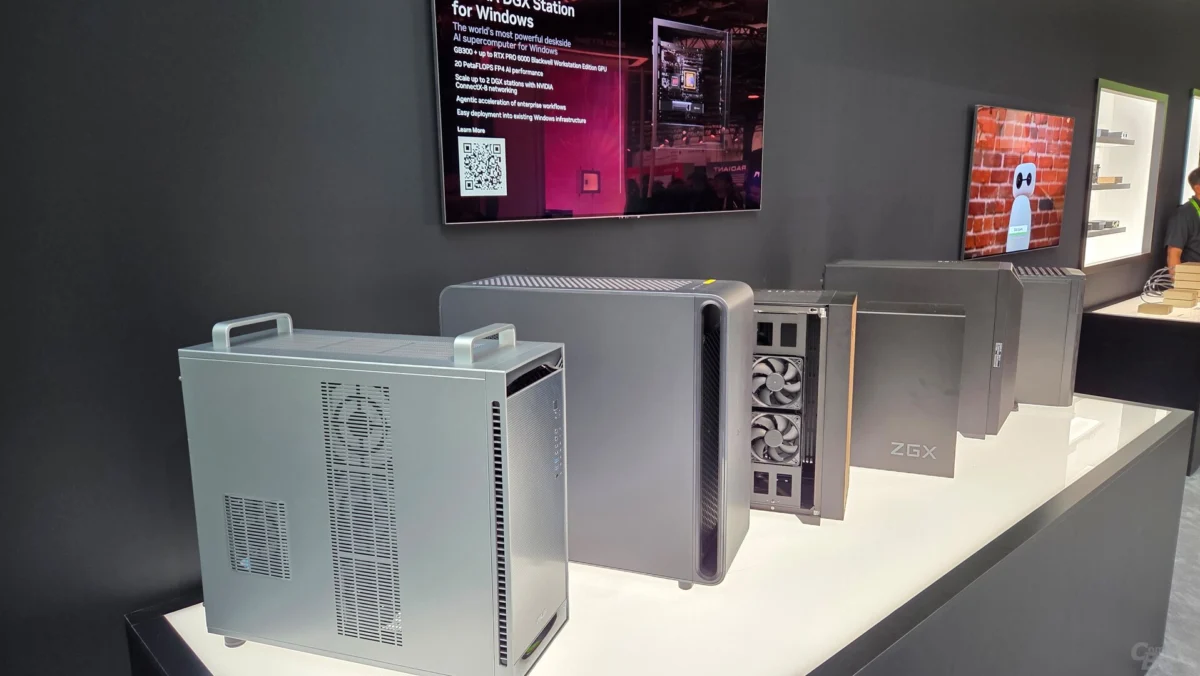
In a paradigm-shifting move for the workstation market, Nvidia has announced that its high-performance DGX Station—previously the exclusive domain of enterprise data centers—will be available for the Windows desktop ecosystem starting this December. By integrating the formidable GB300 Grace Blackwell "Superchip" into a workstation form factor, Nvidia is effectively placing the power of a supercomputer directly under the desks of researchers, AI engineers, and data scientists.
However, this transition comes with a significant price tag and substantial infrastructure requirements. With costs ranging from €100,000 to €150,000, these systems are not intended for the average enterprise workstation but rather for elite-level AI development, complex simulations, and high-fidelity raytracing workflows.
The Core Hardware: Powering the GB300
At the heart of the new DGX Station for Windows lies the GB300 Grace Blackwell Ultra Desktop Superchip. This architecture represents the pinnacle of current compute density. The system achieves its massive 748 GB memory footprint through a two-pronged memory architecture:
- System Memory: 496 GB of LPDDR5X memory, housed in user-swappable SOCAMM2 modules attached to the Grace CPU.
- GPU Memory: 252 GB of ultra-fast HBM3e memory dedicated to the Blackwell graphics cores.
The GB300 combines two GPU dies with the Grace CPU, utilizing a 900 GB/s NVLink-C2C interconnect. This allows for seamless communication between the 72 Arm-based Neoverse-V2 cores of the CPU and the GPU, ensuring that data bottlenecks are minimized during intensive AI model training. Nvidia quotes a total AI performance of 20 PetaFLOPS, a figure calculated using FP4 precision with sparsity acceleration.
For users requiring additional graphical power, the station includes a PCIe 5.0 slot capable of housing an RTX Pro 6000. This adds another 96 GB of VRAM to the total system memory, bringing the total capacity for some configurations near the terabyte threshold. Users can also opt for lower-tier GPUs, such as the RTX Pro 2000, which can reduce the system’s overall price by over $10,000, though this significantly compromises the raw AI compute potential.

Chronology of the Transition: From Cloud to Client
The journey of the DGX Station from a rack-mounted server to a tower-based desktop has been a long-term strategic goal for Nvidia.
- Q1 2025: Nvidia signaled a pivot toward "Personal AI Supercomputers," recognizing that developers were being bottlenecked by limited cloud access and high latency.
- May 2025: Initial Linux-based variants of the GB300-powered DGX Stations entered the market. Pricing at that stage hovered around the $85,000 entry point.
- Late 2025: As supply chain constraints intensified, the scarcity of these units became apparent. Market prices for Linux units began to climb, with current listings on the Nvidia Marketplace now showing prices ranging from $96,000 to $160,000, often requiring bespoke quotes from OEM partners rather than direct purchases.
- December 2025: The official launch of the Windows-compatible variant. This milestone marks the first time that the full software stack of the Blackwell architecture has been fully optimized for the Windows environment, expanding the accessibility of the hardware to a wider array of professional software suites.
Infrastructure Demands and Power Considerations
One of the most overlooked aspects of deploying a "desktop" supercomputer is the sheer power requirement. The DGX Station is not merely a high-end PC; it is a thermal and electrical beast.
An RTX Pro 6000 alone consumes 600 watts under full load. When paired with the GB300 Superchip, the system’s total power consumption is capped at 1,600 watts. This presents a logistical challenge for many offices. Standard US household or office outlets typically provide 1,800 watts, which is perilously close to the system’s maximum draw.
Nvidia has issued a clear recommendation: prospective buyers should prepare their office environments with power circuits capable of handling at least 2,400 watts to ensure stability. While specific electrical requirements for the Windows-based units are still being finalized, it is expected that they will mirror the Linux counterparts due to the shared hardware architecture. Failure to provide stable, high-capacity power could lead to system throttling or hardware damage, undermining the investment.
Market Implications: Availability and Pricing
The market for these machines remains volatile. As observed with the Linux-based DGX Stations, "availability" is a fluid concept. The Nvidia Marketplace currently lists units that are ostensibly "for sale," but the reality is a fragmented market where supply is severely constrained by the global demand for HBM3e and Blackwell dies.

The OEM Partnership Model
Nvidia is offloading the complexity of assembly and support to OEM partners. This is a strategic move to manage the high failure rates and logistical support issues associated with such complex hardware. By selling through certified partners, Nvidia ensures that the end-user receives professional-grade cooling solutions, chassis integration, and enterprise-level technical support. However, this also means that the final price is often opaque, determined by regional taxes, import duties, and the specific memory/storage configurations mandated by the end-user.
The "Cost of Innovation"
The price jump from $85,000 in May to current market peaks is reflective of the "AI gold rush." As companies scramble to train their own Large Language Models (LLMs) and local inference engines, the demand for local, high-bandwidth hardware has outpaced supply. The DGX Station represents a premium solution for companies that wish to keep their proprietary data off the cloud—a significant privacy and security consideration in modern enterprise environments.
Supporting Data: Technical Specifications at a Glance
| Feature | Specification |
|---|---|
| CPU Architecture | Arm Neoverse-V2 (72 Cores) |
| GPU Architecture | Blackwell (Dual-Die) |
| System Memory (CPU) | 496 GB LPDDR5X (396 GB/s bandwidth) |
| GPU Memory (HBM3e) | 252 GB |
| Interconnect | NVLink-C2C (900 GB/s) |
| Networking | ConnectX-8 SuperNIC (800 Gbit/s) |
| AI Performance | 20 PetaFLOPS (FP4/Sparsity) |
| Max Power Draw | 1,600 Watts |
Future Implications: Why Windows?
The shift to Windows is not merely a branding exercise. It signifies a maturation of the AI development ecosystem. Historically, the Linux kernel was the only environment capable of managing the complex orchestration required by the DGX software stack. With the introduction of the Windows-compatible DGX Station, Nvidia is signaling that the Windows developer ecosystem—which remains the largest in the world—is ready for native, high-performance AI deployment.
This development will likely catalyze:
- Democratization of Local AI: Software developers who were previously tethered to Linux environments for deep learning can now leverage their existing Windows toolchains (such as Visual Studio and Windows-native data science suites) without sacrificing performance.
- Corporate Adoption: Many large corporations have strict IT mandates that prioritize Windows infrastructure for security and identity management. The ability to deploy a supercomputer within an existing Windows domain makes the DGX Station a viable procurement option for departments that were previously blocked by IT security policies.
- The Rise of the "Super-Workstation": The line between a traditional workstation and a data center server is blurring. As we move into 2026, the industry should expect more "office-friendly" supercomputers, provided that manufacturers can continue to solve the thermal and electrical challenges inherent in such high-density computing.
Conclusion
The Nvidia DGX Station for Windows is an engineering marvel that brings the raw power of the data center to the professional’s desk. With its 20 PetaFLOPS of AI performance and massive memory bandwidth, it is the ultimate tool for the modern AI practitioner. However, the barrier to entry remains high—not just in terms of the six-figure price tag, but in the electrical infrastructure and supply chain wait times that currently plague the industry. For those who can afford the cost and the logistical preparation, it represents the most potent computational tool available in the personal computing market today.