
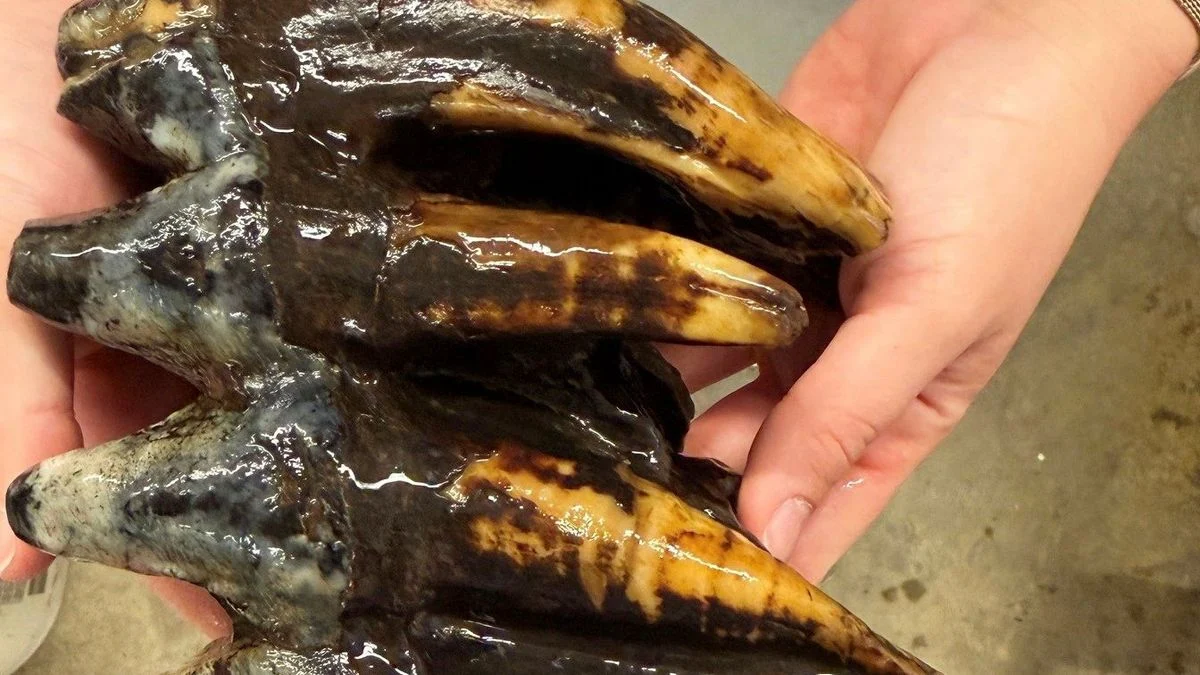
In a remarkable convergence of geological fortune and scientific curiosity, researchers have unveiled the discovery of a near-perfect molar belonging to an adult Pacific Mastodon. The specimen, recovered from sediment layers that have remained undisturbed for millennia, has been hailed by experts as the most complete and pristine example of its kind ever documented in the region. This rare find not only offers a vivid snapshot of a prehistoric giant but also serves as a critical diagnostic tool for understanding the evolution and extinction of megafauna in North America.
Main Facts: A Window into the Pleistocene
The fossilized tooth—a massive, complex molar—has been formally identified by paleontologists as originating from the Pacific Mastodon (Mammut pacificus). Unlike the more widely recognized American Mastodon, the Pacific Mastodon represents a distinct evolutionary branch of the Proboscidea order.
The specimen is characterized by its exceptional preservation, displaying virtually no signs of erosion or structural compromise despite the immense passage of time. For paleontologists, a molar of this caliber is akin to finding a "Rosetta Stone" of the Pleistocene epoch. Because teeth are composed of enamel—the hardest substance in the mammalian body—they are often the most durable remnants of ancient creatures. However, finding one that retains its full structural integrity, complete with intact roots and cusp patterns, is an extraordinary rarity.
Chronology of the Discovery
While the exact location of the find remains protected to prevent unauthorized excavation, the chronology of the discovery follows a path common to many significant paleontological events. It began with an incidental observation during a routine survey of geological strata. Once identified as a biological specimen rather than a common rock, the item was secured and transferred to experts for professional assessment.
Following the initial identification, a team of specialists conducted a multi-phase analysis. This involved clearing away localized sediment, stabilization treatments to prevent air-exposure damage, and rigorous verification against existing fossil records held at major natural history museums. Within weeks of the discovery, the specimen was transferred to the Stanford University geological collection, where it is currently undergoing high-resolution imaging to document the minute details of its wear patterns and isotopic composition.
Supporting Data: Understanding the Pacific Mastodon
To understand the magnitude of this find, one must distinguish the Pacific Mastodon from its more famous cousin, the American Mastodon (Mammut americanum). Although both were formidable members of the megafauna that dominated North America during the Ice Age, they possessed distinct physiological signatures.
Morphological Distinctions
The Pacific Mastodon is defined by specific anatomical traits that suggest a different environmental adaptation. Most notably, the teeth of the Pacific variety are significantly narrower than those of the American Mastodon. Furthermore, skeletal analyses—specifically of the limb bones—indicate that the Pacific species possessed thicker, more robust bone density. These physical adaptations suggest that the Pacific Mastodon may have occupied specialized ecological niches, potentially navigating more rugged terrain or different forest densities than the American species.
Geographic Range and Habitat
Paleontological mapping suggests that the Pacific Mastodon thrived across a vast swathe of the Western North American landscape. Evidence points to a habitat range that spanned the temperate forests and basins of modern-day California and Oregon, stretching northward into the Rocky Mountains and southward into parts of Mexico. By studying the chemical signatures trapped in the tooth’s enamel, researchers hope to map the migratory patterns of these animals and determine how they responded to the fluctuating climates of the Pleistocene.
Official Responses: The Scientific Significance
The discovery has sent ripples of excitement through the academic community. For those on the front lines of the excavation, the experience was visceral.
"The tooth itself is in immaculate condition. It is the most complete Mastodon molar from our region and the most spectacular one I have ever seen," remarked paleontologist Wayne Thompson. "I had goosebumps. It is another piece of the Ice Age puzzle that we can now place into its proper position."
Thompson’s sentiment reflects the broader importance of the find. In paleontology, every specimen adds a data point to a vast, incomplete map. By confirming the presence and physical characteristics of the Pacific Mastodon in this specific region, researchers can refine their models regarding how these animals moved across the continent as glaciers receded and landscapes transformed.
At Stanford University, where the specimen is now housed, the focus has shifted toward the long-term utility of the fossil. Christine Garcia, curator and head of the university’s geosciences collection, emphasized that the tooth is more than just a museum display piece.
"Fossils are the only way we have to get an impression of the biodiversity that once existed," Garcia stated. "We can study fossils to better understand the history of the Earth, the former fauna, and the ecosystems of that time. This knowledge allows us to make better predictions and decisions regarding how we can preserve our current ecosystems and biodiversity."
Implications for Modern Science and Conservation
The study of this molar is not merely an exercise in looking backward; it is a vital component of modern environmental science. By reconstructing the diet, health, and habitat of the Pacific Mastodon, scientists are essentially studying the "success and failure" mechanisms of a massive mammal species.
The Lessons of Extinction
The extinction of the megafauna at the end of the Pleistocene remains one of the most debated topics in natural history. Was it a result of rapid climate change, human intervention, or a combination of both? By analyzing the isotopic data within the molar—which acts as a chemical archive of the animal’s life—researchers can determine what the Mastodon ate and how its diet changed over time. This data can reveal whether the species was already under environmental stress before its final extinction.
Biodiversity and Future-Proofing
As Garcia noted, the preservation of modern biodiversity is the ultimate beneficiary of this research. By understanding how the Pacific Mastodon interacted with its environment during a period of massive climatic shift, contemporary biologists can build better models for how modern species might cope with current anthropogenic climate change. The Mastodon’s struggle for survival provides a cautionary tale and a roadmap for identifying the environmental stressors that drive extinction today.
The Role of Academic Donation
The decision to donate the fossil to Stanford University highlights the critical importance of institutional partnerships. When private finds are handed over to research universities, they enter a cycle of perpetual study. Through scanning, geochemical sampling, and comparative anatomy, a single tooth can provide data for decades of peer-reviewed research. It elevates the find from a curiosity to a cornerstone of academic inquiry.
Conclusion: A Legacy in Enamel
The discovery of this Pacific Mastodon molar is a testament to the enduring mystery of our planet’s history. It reminds us that beneath the surface of our modern landscapes lie the remnants of a world dominated by giants—a world that was dynamic, harsh, and profoundly influential in shaping the biodiversity we see today.
As researchers continue their work at Stanford, the "spectacular" tooth will yield secrets about the life of an ancient beast that walked through the forests of California and Oregon thousands of years ago. In doing so, it serves as a bridge between the deep past and our collective future, proving that even the smallest fragment of the past can hold the key to understanding the survival of life on Earth. Through the meticulous work of paleontologists like Wayne Thompson and curators like Christine Garcia, the Pacific Mastodon has been given a new voice, speaking from the ice of the past to the climate-conscious researchers of the present.