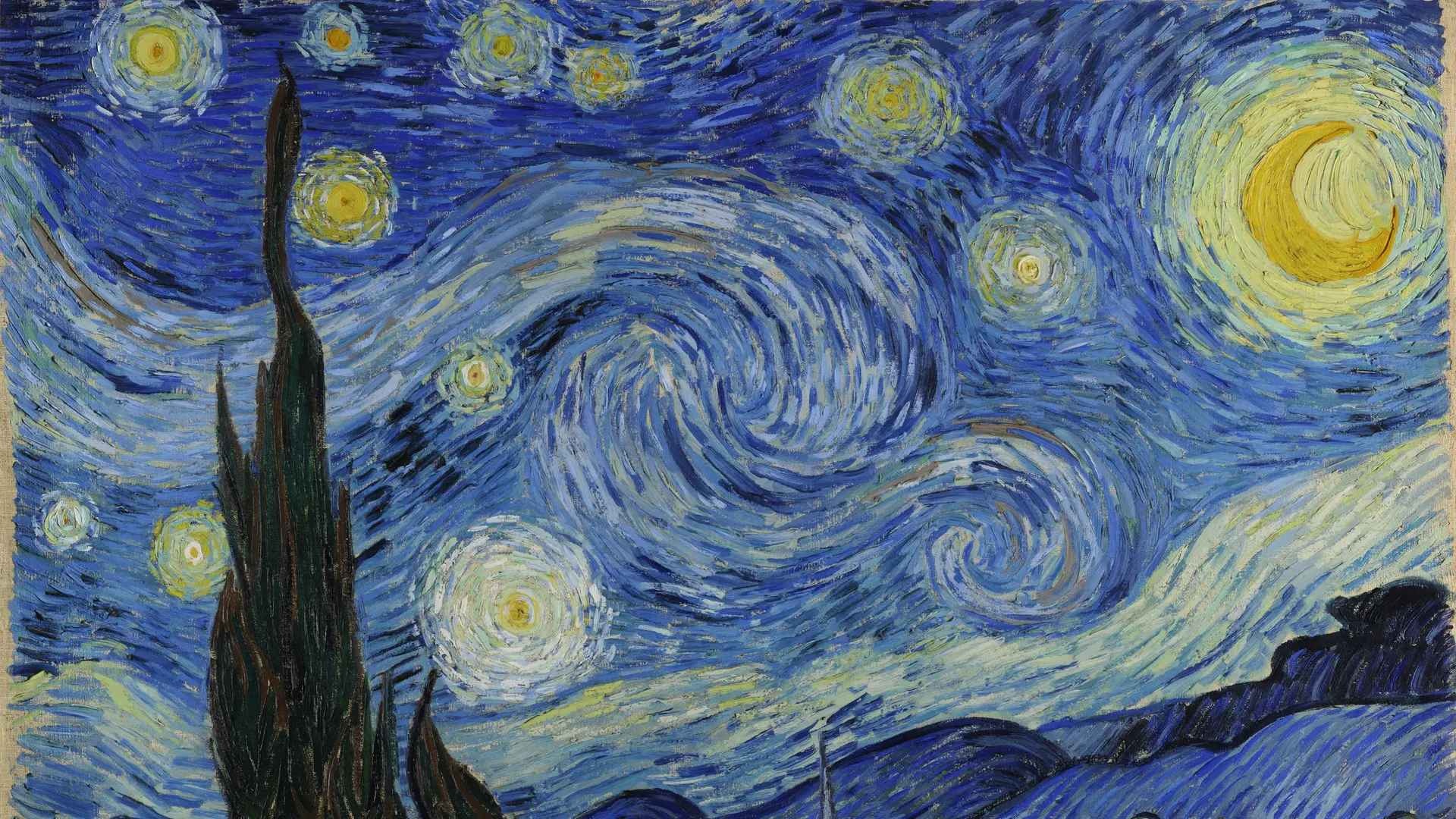
For over a century, Vincent van Gogh’s The Starry Night (1889) has captivated the world, its swirling, turbulent sky serving as a portal into the artist’s turbulent mind. While art historians have long debated the balance between the artist’s subjective expression and his observation of the natural world, modern science is now providing a quantitative lens through which to view these iconic canvases.
A groundbreaking new study, published in the journal Scientific Reports by a team of researchers led by Elijah Jeong-hyun Kim, has reignited the debate over the astronomical accuracy of Van Gogh’s night skies. By utilizing advanced celestial mapping and historical data, the team suggests that The Starry Night may not be a mere product of imagination, but a deliberate composition based on a specific morning in July 1889—a revelation that, if true, challenges established timelines of the artist’s life in the asylum of Saint-Rémy-de-Provence.
The Intersection of Art and Astronomy
The question of whether Van Gogh painted the "real" sky or an invented one has haunted scholars for decades. Van Gogh himself was famously ambiguous on the matter. In September 1889, he described his night paintings as "exaggerated in terms of arrangement," and months later, he confessed to his friend Émile Bernard that he had allowed himself "once again" to paint the stars too large.
Today, however, the guesswork is being replaced by empirical data. By using modern star catalogs and orbital mechanics, researchers can reconstruct the night sky over Arles and Saint-Rémy for any given date in 1888 and 1889. By comparing these digital recreations with the specific geometry of the stars depicted in Van Gogh’s work, scientists are finally able to test the limits of his observational fidelity.
The Rhône: A Prelude to the Celestial Study
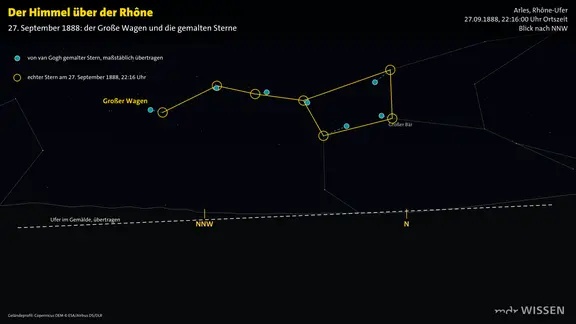
Before analyzing the famous Starry Night, researchers turned their attention to Starry Night Over the Rhône (1888). In late September 1888, Van Gogh painted the night sky from the banks of the Rhône. He explicitly mentioned to his brother, Theo, that he had painted the Great Bear (the Big Dipper) shining in green and pink against the aquamarine sky.
The team led by Kim subjected this painting to rigorous geometric analysis. By measuring the placement of the seven stars representing the Big Dipper and comparing them to the actual sky of late September 1888, they found a striking correlation. Van Gogh had rendered the constellation at almost the exact angle and altitude it would have appeared at 10:00 PM.
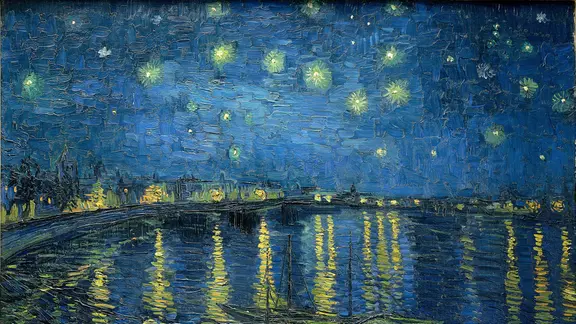
However, there is a catch: the painting shows a view looking southwest toward the bridge at Trinquetaille, yet the Big Dipper would have been in the north-northwest. This confirms that while Van Gogh was highly attentive to the appearance of individual celestial bodies, he was willing to synthesize them, placing a real constellation into a landscape view that was geographically and directionally distinct.
The Enigma of The Starry Night
The challenge of decoding the 1889 Starry Night is far more complex. Following a series of mental breakdowns in Arles, Van Gogh voluntarily entered the Saint-Paul-de-Mausole asylum in Saint-Rémy in May 1889. His room faced east, and in a letter to Theo, he wrote of seeing "nothing but the morning star, which looked very large"—a clear reference to Venus.
For decades, the consensus was split. In the 1980s, art historian Albert Boime argued the painting depicted the morning sky of June 19, 1889, while astronomer Charles Whitney proposed that the sky was a composite of multiple mornings. The primary obstacle to the June 19th theory was the moon; the painting features a thin crescent, whereas the moon was more than half-full on that date.
New Evidence: The Case for July 22, 1889
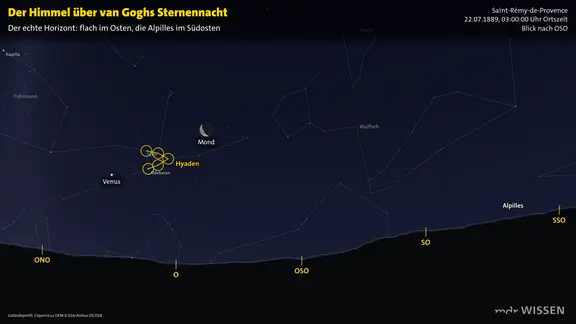
The research team in South Korea has proposed a new date: July 22, 1889. By analyzing a sketch Van Gogh made, which serves as a precursor to the final painting, the researchers calculated the specific field of view the artist captured. They found that on the morning of July 22, the crescent moon and Venus aligned in such a way that they would have been visible within that narrow frame.
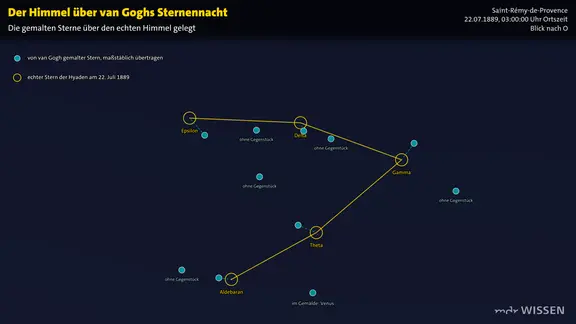
Furthermore, the study points to the Hyades star cluster in the constellation Taurus. Five of the eleven stars depicted in the painting form a distinct "V" shape, which mirrors the geometry of the Hyades cluster as it would have appeared on that morning. If this hypothesis holds, it provides the most precise astronomical date ever suggested for the masterpiece.
Chronological Implications and Historical Pushback
The adoption of a July 22 date, however, creates significant friction with the accepted biographical record. According to the standard edition of Van Gogh’s letters, the artist suffered a severe mental health crisis around July 16 or 17, 1889. The current historical narrative suggests he was incapacitated for weeks and unable to enter his studio.
The South Korean team argues that the timeline of this collapse may be misinterpreted. By cross-referencing weather logs and personal correspondence, they suggest the major breakdown might have occurred at the end of July, not the middle. Yet, they acknowledge there is no definitive proof for this adjustment.
A further complication involves a pen-and-ink drawing of The Starry Night that Van Gogh sent to his brother. If the painting was inspired by the sky of July 22, the drawing—which shows the Hyades cluster even more clearly—would have had to be completed and mailed after that date. However, records indicate this drawing was included in a shipment sent to Theo on July 2. If the drawing was already in transit, it is physically impossible for it to reflect the sky of July 22.
The Synthesis of Observation and Imagination
Despite these discrepancies, the researchers conclude that both The Starry Night and Starry Night Over the Rhône reveal a consistent methodology. Van Gogh was not a mere copyist of the heavens. He acted as an artistic director of his own sky, selecting real, recognizable star patterns and placing them into his compositions with high precision regarding their shape and orientation, while simultaneously padding the canvas with "invented" stars to enhance the emotional resonance of the scene.
Ultimately, the study suggests that the "realism" in Van Gogh’s work is not a product of scientific accuracy, but of a sophisticated artistic eye. He observed the celestial bodies with the focus of a scientist but rendered them with the freedom of a visionary.
Official Responses and Ethical Considerations
The publication of this study has sparked a nuanced discussion within the art-science community. While the astronomical calculations are mathematically sound and verifiable, the interpretation of biographical data remains speculative. The researchers themselves have disclosed a potential conflict of interest, noting that the findings could be leveraged for commercial ventures, such as educational programs, exhibitions, and media productions.
This transparency is vital. While the "July 22" theory provides an intriguing, data-driven framework for understanding the canvas, it does not offer the final word. The mystery of The Starry Night persists not because we lack the computational power to map the stars, but because the artist’s inner process remains shielded by time and the inherent subjectivity of genius.
As it stands, we are left with a compelling synthesis: Van Gogh was neither painting a purely scientific sky nor a completely fabricated one. He was painting the sky as he felt it, anchored by the very real, very bright light of Venus and the shifting patterns of the constellations, proving that even in his darkest moments, he remained a keen observer of the light above.