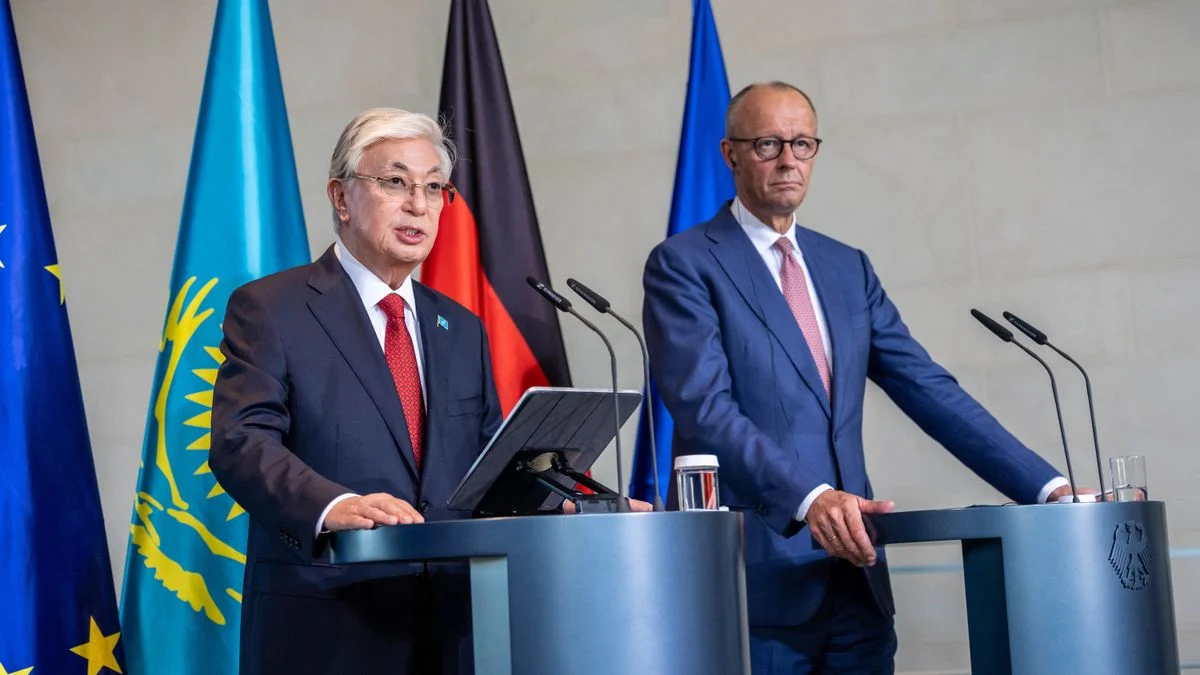
In a move signaling a significant shift in European energy security, Kazakhstan has formally signaled its intent to bolster its role as a cornerstone supplier of crude oil to Germany. During a high-level diplomatic meeting, Kazakh President Kassym-Jomart Tokajew and German opposition leader and CDU chairman Friedrich Merz underscored the strategic necessity of deepening their energy partnership. As Berlin continues its arduous transition away from Russian hydrocarbons, the Central Asian nation has emerged as an indispensable ally in stabilizing the industrial heart of the European Union.
The Strategic Pivot: A New Era in Energy Cooperation
The dialogue between President Tokajew and Friedrich Merz reflects a broader paradigm shift in German foreign and economic policy. For decades, Germany relied on the relative affordability and logistical ease of Russian pipelines. However, the geopolitical fallout from the invasion of Ukraine necessitated an urgent and comprehensive "diversification of supply chains."
"We intend to increase the volumes of crude oil, the delivery volumes, and we want to remain a reliable partner for Germany in the field of oil supplies in the future," President Tokajew stated during a press conference. His remarks were met with reciprocal enthusiasm from the German side. Merz, speaking on behalf of the necessity for energy independence, characterized the partnership as a "vital building block" in Germany’s ongoing efforts to replace the oil that once flowed freely from Russia.
While the specifics of future contracts—including precise tonnage and transit routes—remain under negotiation, the political will to expand this cooperation is unequivocal. This development is not merely a transactional trade deal; it is a structural adjustment aimed at fortifying Germany’s industrial stability against the volatility of Eastern European geopolitics.
Chronology: From Dependence to Diversification
To understand the current urgency, one must look at the timeline of the energy crisis that has gripped the German refinery sector since 2022.
- Early 2022: The onset of the full-scale Russian invasion of Ukraine triggers a seismic shift in German energy policy. The German government begins the difficult process of decoupling from Russian energy dependence, a process that was previously deemed unthinkable by many political analysts.
- January 2023: Germany formally ceases the importation of Russian oil via the northern branch of the Druzhba pipeline, leaving the PCK Raffinerie in Schwedt, Brandenburg, in a precarious position.
- Early 2023 – Mid 2023: Kazakhstan steps into the gap. By early 2023, Kazakh oil begins to account for approximately 20% of the raw material processed at the PCK refinery, serving as a critical lifeline for the plant.
- May 2024: Geopolitical tensions flare when Russia, acting as a gatekeeper of the Druzhba pipeline, halts the transit of Kazakh oil destined for Germany. This move is widely interpreted as a retaliatory measure intended to pressure Germany and signal Moscow’s displeasure with the deepening Central Asian-European ties.
- Late 2024: Following the disruption, the PCK refinery, alongside federal authorities, accelerates the search for alternative supply routes, including expanded maritime imports and increased usage of Polish infrastructure.
- Present Day: The meeting between Tokajew and Merz signals a renewed commitment to bypassing the limitations imposed by Russian-controlled transit routes, aiming to secure long-term, stable supply corridors.
The PCK Refinery: A Case Study in Resilience
The PCK Raffinerie in Schwedt occupies a central role in this narrative. The refinery is not only an economic engine for the Brandenburg region but also a symbol of Germany’s transition. A complex entity, 54% of the plant is held by German subsidiaries of the Russian state giant Rosneft. Due to the geopolitical context, these shares were placed under the "trustee administration" of the German federal government, effectively stripping Rosneft of control over its operational and investment decisions.
The refinery’s struggle to secure feedstock highlights the vulnerability of landlocked energy infrastructure. When Russian transit was severed in May, the plant had to pivot rapidly. By diversifying, Germany has demonstrated that it is no longer willing to allow the Kremlin to use energy as a weapon of blackmail. Kazakhstan’s willingness to step in, despite the evident political pressure from Moscow, marks a significant diplomatic achievement for Astana.
The Delicate Balancing Act of Astana
President Tokajew’s visit to Germany was characterized by a nuanced diplomatic performance. While he is keen to court Western investment and secure European energy markets, he remains acutely aware of his country’s geographic reality. Kazakhstan shares a massive land border with Russia and maintains deep-seated historical, cultural, and economic ties with the Kremlin.
During the press conference, Tokajew was firm on the principle of sovereignty. He stated, "We insist on the respect and safeguarding of the principle of the territorial integrity of all states." This was a clear, if diplomatic, nod to the international legal consensus regarding the Ukrainian conflict.
However, in the same breath, he emphasized his "excellent relations" with Vladimir Putin. "Whatever happens in Ukraine, we will never forget that Russia and Ukraine are our friends," he remarked. This "multi-vector" foreign policy is typical of Kazakhstan, which seeks to position itself as a neutral arbiter and a reliable partner to both East and West. For Germany, this neutrality is not a deterrent but a manageable factor in the pursuit of energy security. The focus is on the commercial and strategic reliability of the oil flow, rather than total alignment on every geopolitical issue.
Implications for European Energy Security
The potential for increased oil flows from Kazakhstan to Germany carries several critical implications:
1. The Death of the "Single-Source" Model
The era of German energy policy defined by cheap, single-source dependency is over. The current push to bring in more Kazakh oil is part of a broader "de-risking" strategy. By integrating Central Asian crude into the European market, Germany is reducing the leverage that any single authoritarian state can exert over its domestic energy prices.
2. Infrastructure Expansion
Increasing volume from Kazakhstan will require more than just goodwill; it requires technical upgrades. The Druzhba pipeline, while functional, is subject to the political whims of the Kremlin. Future planning will likely involve diversifying transit modes—such as utilizing the Baku-Tbilisi-Ceyhan (BTC) pipeline—and strengthening connections through the Trans-Caspian corridor. This creates a secondary, long-term benefit: the development of a more robust Eurasian energy transit infrastructure that bypasses Russia entirely.
3. Economic Synergies
Beyond oil, the partnership between Germany and Kazakhstan is deepening in sectors such as green hydrogen, rare earth minerals, and agricultural technology. Germany’s industrial expertise, combined with Kazakhstan’s vast natural resources, creates a symbiotic relationship that extends well beyond the current energy crisis.
4. A Template for Central Asia
Kazakhstan’s willingness to expand ties with the West serves as a potential template for other Central Asian republics, including Uzbekistan and Turkmenistan. As these nations observe Kazakhstan successfully balancing its relations with Russia, China, and the West, they may feel emboldened to pursue similar independent trade policies, potentially opening up the entire region to further European investment.
Conclusion: A Pragmatic Path Forward
The dialogue between President Tokajew and Friedrich Merz underscores a pivotal moment in international relations. For Germany, the transition to alternative oil sources is an existential necessity for its industrial base. For Kazakhstan, the partnership represents a strategic opportunity to modernize its economy and deepen its ties with the European market.
While the challenges of geography and the lingering influence of Russian political pressure remain, the momentum is clearly in favor of diversification. As both nations move to formalize their cooperation, the focus will remain on the technical realities of transport and the economic benefits of a stable, secure energy flow. In an era of global volatility, the burgeoning energy alliance between Berlin and Astana stands as a testament to the power of pragmatic diplomacy, proving that even in the face of immense geopolitical pressure, new paths—and new pipelines—can be forged.